- Home
- About Us
- Research
- Research Areas
- Agriculture
- Air Pollution
- Climate Change
- Economy
- Education
- Environmental Law & Justice
- Energy & Electricity
- Federalism
- Governance, Accountability & Public Finance
- Health & Nutrition
- Indian Politics
- International Relations & Security
- Jobs
- Land Rights
- Sanitation
- Social Justice
- State Capacity
- Technology
- Urbanisation
- Water
- Miscellaneous
- Research Initiatives
- Research Areas
- Publications
- People
- Events
Highlight>

Why are Indian Elections so Unpredictable?
July 22, 2026
“Data forces you to think, and how you think about elections in India.”
With these words, Professor Pradeep K. Chhibber invited the audience to go beyond the surface-level explanation of what dictates Indian elections and confront a fundamental question: why are elections in India so unpredictable?
That question brought a packed audience to the Indian International Centre (IIC) on July 15, for a discussion on why nearly a quarter of India’s electorate shifts its vote from one election to the next, and what this reveals about the country’s democratic politics. The discussion challenged conventional assumptions about Indian elections, to deep dive into how village-level electoral volatility and the weak political mobilisation of poorer classes create shifting voting patterns.
Organised by the IIC in collaboration with the Centre for Policy Research, the discussion featured Professor Pradeep K. Chhibber (University of California), Barkha Dutt (Senior Journalist and Founder, MoJo Story), Roshan Kishore (Political Economy and Data Editor, Hindustan Times), and Rahul Verma (Fellow, CPR). Drawing on Chhibber’s forthcoming book, “The Reciprocity Trap: Weak Parties, Elite Networks, and the Marginalization of the Poor in India”, co-authored with Francesca Jensenius (Professor of Political Science, University of Oslo) and village-level election data, national surveys, and extensive fieldwork, the panel explored why Indian elections continue to defy prediction.
While caste, religion, and community remain central to electoral politics, frequent vote swings and shifting party loyalties suggest that identity alone cannot explain voting behaviour.
Data presented by Chhibber shows that India’s electoral volatility. defined “as the net change within the party system resulting from individual vote transfers”, remained remarkably high between 1952 and 2004 compared with many other large democracies. The evidence raises a compelling question: what drives these persistent shifts in voter behaviour?
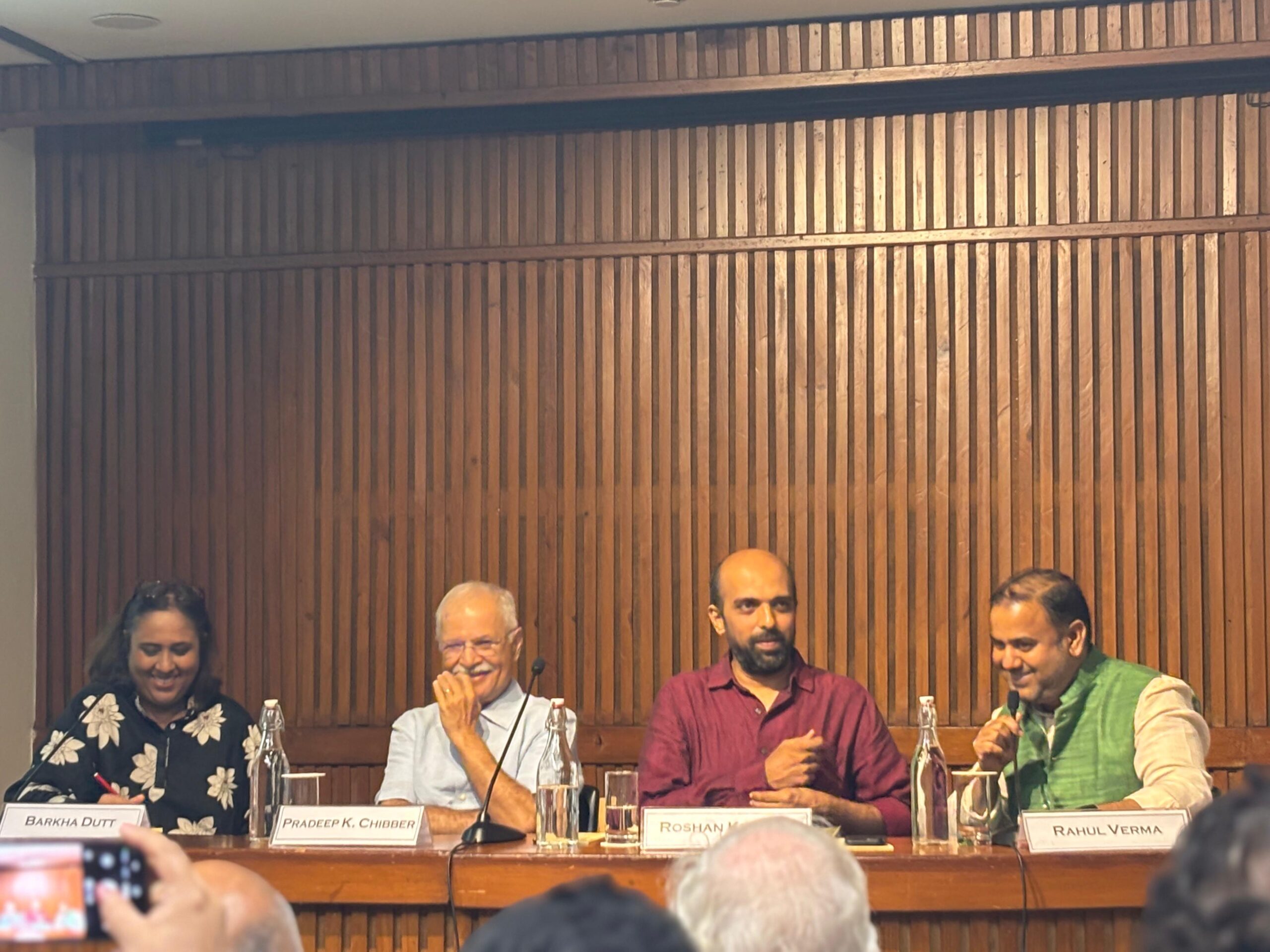
Electoral Volatility and Political Stronghold
Polling booth data from the 2009–2019 Lok Sabha elections suggests that electoral volatility originates in the “villages” because of two major reasons, which Chhibber attributes to: lack of local political strongholds, and patterns of identity-based political mobilisation.
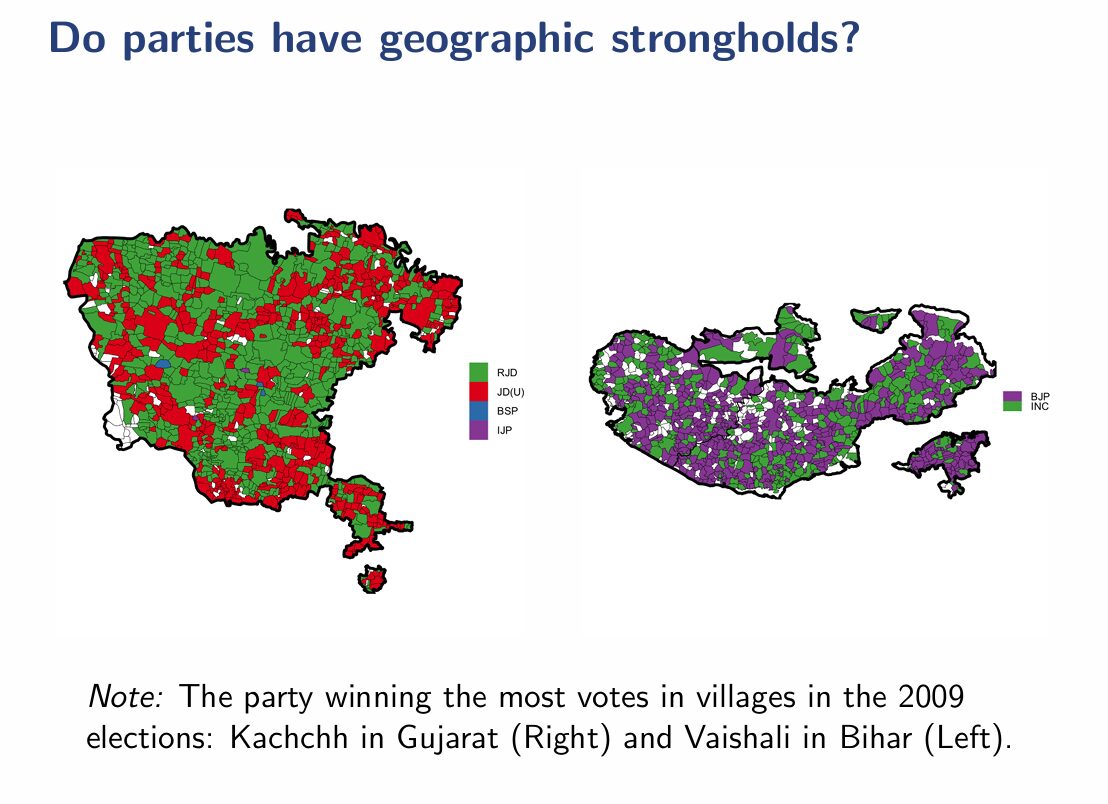
An analysis of the Election Commission of India’s polling booth data for the 2009 and 2014 Lok Sabha elections reveals an interesting trend. While many villages gave a clear majority of votes to a single party in each election, very few consistently backed the same party over time.
Chhibber argued that this challenges the conventional wisdom that Indian political parties enjoy stable village-level “strongholds”. A party may win a village by a large margin in one election, but that does not mean voters will support it again in the next. The data shows that electoral loyalties at the village level are far more fluid than is often assumed, making genuine long-term party strongholds relatively rare.
The same trend is visible even during the BJP’s sweeping victory in Uttar Pradesh during the 2014 and 2019 Lok Sabha elections. Despite the party’s perceived national dominance, support at the village level remained more volatile indicating that local voting patterns continue to shift from one election to the next.
“And that’s something you need to think about. So even for the case of the BJP in 2014-2019, the same pattern appears — definitely more strongholds, but not as many strongholds as we like to think there are,” Chhibber noted.
As against the popular belief of “geographical strongholds”, Chhibber also challenged the idea that political parties enjoy geographically entrenched support bases. Comparing village-level voting patterns across states such as Gujarat and Uttar Pradesh, he analysed that different political parties dominate neighbouring regions despite their geographic proximity.
While the BJP and the Indian National Congress (INC) dominated most villages in Kutch, parties such as the Rashtriya Janata Dal (RJD), the Janata Dal (United) (JD(U)), the Bahujan Samaj Party (BSP) and the Indian Justice Party dominated villages in Uttar Pradesh during the 2009 Lok Sabha elections.
Teasing one to think, he said, “So in other words, there’s very little evidence that parties control nationally that parties control these geographies.”
Drawing on additional data analysis, such as the spatial distribution of BJP votes in Uttar Pradesh between 2014 to 2019, the speaker returned to his central argument on how Indian voting patterns are often based on weak political strongholds at the village level and the persistent disconnect between poor and political parties.
How EV Affects Vote at Village Levels
Chhibber argued that voters in poorer areas are more likely to change their voting preferences from one election to the next.
Drawing on National Election Studies (NES) and CSDS survey data from 1996 to 2024, he found that poorer voters across all major social groups are less likely to be contacted by political parties during election campaigns. As a result, they are more likely to switch parties, vote for smaller parties or NOTA, and are less likely to turn out to vote.
His forthcoming book argues that these patterns are driven not by voters’ preferences, but by political parties’ failure to engage and mobilise poorer communities during elections, leaving them less politically connected and more open to changing their vote.
The question that follows is why is this the case? Why aren’t the poor mobilised? Well, the answers are multifactored.
Local Influencers and Reciprocity Trap
Indian elections are infamous for their immensity. In order to self-finance large political campaigns, and with limited grassroots infrastructure and vast constituencies to cover, parties increasingly outsource campaign mobilisation to “local influential figures”, who tend to engage only their own caste- and community-based elite networks. As a result, large sections of poorer voters remain outside the reach of party campaigns, making electoral support more fluid and weakening the emergence of durable local strongholds.
“What this means is a party system based on caste and community identity politics can coexist with vote volatility. When parties mobilise only a part of each caste and community, they’re only mobilising the elites. This is what we call the reciprocity trap,” Chhibber noted.
To break it down, the ‘reciprocity trap’ is what follows when political parties need votes and funds for winning and political gains. Due to their organisational weakness, local candidates rely on local influencers to provide access to both. These local influencers extract resources from parties, gain wealth, status and impunity. These elite networks are class biased. A reciprocity trap locks parties and influentials into this arrangement. In some cases, this deepens ties between parties and influentials. And therefore the under mobilisation of the poor “is a structural equilibrium of Indian politics.”
Reviewing Chhibber’s analysis, Roshan Kishore observed that funding elections requires wealthy intermediaries, reinforcing patronage networks and limiting the state’s ability to address deeper structural problems. Hence, despite ideological differences, major political parties broadly converge in their relationship with capital.
Class, Caste, and Identity over Populism and Welfarism
An important question, however, remained: what role do welfare schemes and populism play?
Drawing on three decades of covering elections, Barkha Dutt asked whether welfare schemes could mobilise poorer voters by bypassing local power networks. “Is a welfare scheme a form of mobilisation that bypasses the local influential network? This has been known to mobilise masses from weaker economic sections,” she observed.
This returned to the book’s central argument that while welfare schemes and populist measures may temporarily strengthen the relationship between political parties and poorer voters, they do not eliminate parties’ dependence on local elites. As a result, class continues to play a significant role in shaping electoral politics.
Kishore argued that class is often masked by talks of identity politics, even though economic interests continue to shape political behaviour in crucial ways. Recognising this changes how we understand Indian democracy. If stronger party organisations are essential to representing poorer citizens, then the relationship between class, political parties and democratic participation deserves nuanced attention.
He emphasised that democracy is not just about elections, but also about how effectively political parties organise and mobilise people. Parties that are better organised at the village levels are more likely to reach, engage and represent a wider section of society, particularly those who are often left out of the political process.
Looking at India’s political history, Kishore noted that class-based politics was once a significant force, as seen in the early success of the Communist Party of India (CPI). Reflecting on its decline, Roshan argued that communist parties struggled because they failed to effectively address caste alongside class. Outside the states of West Bengal and Kerala, he said, their inability to navigate caste politics limited their electoral appeal and contributed to their decline.
The Case for Bengal and Kerala Stand aside
However, the research also establishes that states, such as West Bengal and Kerala, which have greater political outreach to poorer voters, have lower electoral volatility. This suggests that stronger party structures can reduce dependence on local intermediaries and produce more consistency in voting patterns and durable strongholds. Kerala and Bengal continue to hold local-level Panchayat elections, an important avenue to engage poorer voters directly.
Kishore noted, “West Bengal, Kerala, and Tamil Nadu have partisan tribal elections and party mobilisation is the lever. Our survey data shows that this is not because the poor are poor. But the poor, who are contacted and politically included, their attitudes and political behavior indeed changes.”
For Chhibber, the implication is clear: the political exclusion of the poor is not a structural consequence of poverty, but a consequence of how political parties are organised. Where parties invest in grassroots mobilisation, poorer voters are more likely to participate, remain politically engaged and exhibit more stable voting behaviour.