- Home
- About Us
- Research
- Research Areas
- Agriculture
- Air Pollution
- Climate Change
- Economy
- Education
- Environmental Law & Justice
- Energy & Electricity
- Federalism
- Governance, Accountability & Public Finance
- Health & Nutrition
- Indian Politics
- International Relations & Security
- Jobs
- Land Rights
- Sanitation
- Social Justice
- State Capacity
- Technology
- Urbanisation
- Water
- Miscellaneous
- Research Initiatives
- Research Areas
- Publications
- People
- Events
Highlight>

CPR Insights | Do Capital Intensive Industries have Less Women Workers?
October 18, 2024
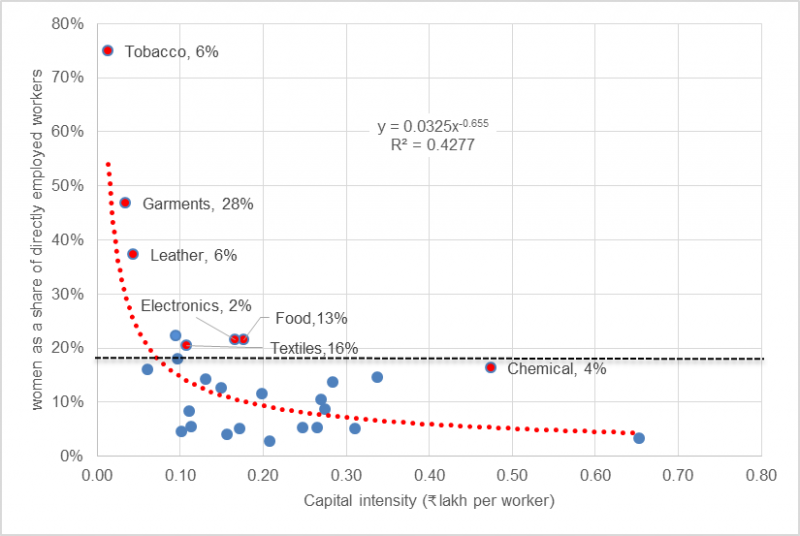
Source Table 4a in Annual Survey of Industries 2021-22: https://mospi.gov.in/sites/default/files/publication_reports/ASI%20Volume%20I%202021-22%20%20Final.pdf
There has been a long-running discussion about the low and falling female labour force participation, especially in the non-farm sector. Simultaneously, it has been claimed that industrial growth in India has not been labour intensive. So, the question arises – does the nature of industrial growth, whether it is capital or labour intensive, affect the gender composition of the workforce, e.g., do capital intensive industries have fewer women workers?
To answer the question, we turn to the Annual Survey of Industries, which collects information from a relatively formal group of industries, i.e., units with ten or more workers (with power), or twenty or more workers without power, registered under Sections 2(m)(i) and 2(m)(ii) of the Factories Act, 1948 or the Bidi & Cigar Workers (Conditions of Employment) Act, 1966. Some large units registered under other acts are also included but, the survey excludes small unregistered units.
Within this group of units, the figure above shows that industries that have a high share of women in directly employed (i.e., non-contractual) women workers, e.g., garments (28%) textiles (16%), food (13%), tobacco (6%), leather (6%), and electronics (2%) do indeed have lower capital intensity (the available data does not allow us to investigate this for contractual workers[1]). Industries where the share of women is above average (dotted line) all have a capital intensity of less than ₹ 0.2 lakh per worker. The figures in parenthesis show the share of women employed in that industry to total female employment and these six industries together employ over 70% of the female workforce (which is why the average is where it is, though many industries have lower shares).
So, the answer is yes, capital intensive industries do indeed employ fewer women and that an increase in labour intensive manufacturing may have the additional benefit of boosting female labour force participation.
- It is possible that that the regular workers are more likely to be male and if so, the use of regular workers understates the female-intensity of the workforce, but unless this varies systematically across industries, the conclusion would continue to hold.