- Home
- About Us
- Research
- Research Areas
- Agriculture
- Air Pollution
- Climate Change
- Economy
- Education
- Environmental Law & Justice
- Energy & Electricity
- Federalism
- Governance, Accountability & Public Finance
- Health & Nutrition
- Indian Politics
- International Relations & Security
- Jobs
- Land Rights
- Sanitation
- Social Justice
- State Capacity
- Technology
- Urbanisation
- Water
- Miscellaneous
- Research Initiatives
- Research Areas
- Publications
- People
- Events
Highlight>

CPR Insights | The Possible Fiscal Impact of VB G RAM G on States
Partha Mukhopadhyay, Anmol Kumari
December 29, 2025Figure 1: Impact of Making States Pay for MGNREGS Expenditure

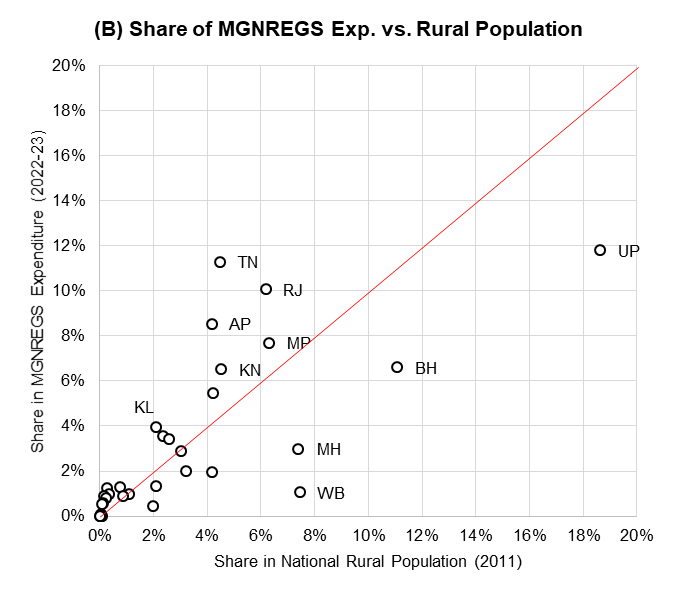
Source: For MGREGS https://mnregaweb4.nic.in/netnrega/Citizen_html/financialstatement.aspx?lflag=eng&fin_year=2022-2023&source=national&labels=labels&Digest=kODLAkQv8M9FT6WbXb7zhA and RBI State Finances https://rbi.org.in/Scripts/AnnualPublications.aspx?head=State%20Finances%20:%20A%20Study%20of%20Budgets and Census 2011
One of the differences between MGNREGS and VB G RAM G is that the states will now need to pay a portion of the VB G RAM G bill.[1] How will this affect the states’ fiscal condition? To answer this question, we look at data from 2022-23, the year for which final accounts are available across states from the RBI and also the year for which actual state-wise expenditure is available for MGNREGS. We calculate two metrics, viz. 40% of the share of expenditure on MGNREGS in a state divided by the state’s developmental expenditure and the state’s total own revenue (its own taxes and share in central taxes), i.e., an expenditure-based metric and a revenue-based metric.
The grey and black bars in Figure 1(A) show that this number can vary considerably across states, from less than 0.5% to more than 5%. For about half the states using both the revenue metric (16) and expenditure metric (15), this share would have been below 2% in 2022-23. All five states where both metrics are more than 3% are in the Northeast, viz. Nagaland, Meghalaya, Manipur, Tripura, and Mizoram (Jammu and Kashmir is the sixth state by the revenue metric). But how are we to judge these metrics – how burdensome is it to re-allocate 3% of revenue or spend an extra 3% of developmental expenditure? For this, we compare it to the amount of rural development expenditure being undertaken by the states. Table 1 groups the states into four – those with high and low shares of MGNREGS spending to total revenue, vis-à-vis high and low shares of rural development spending to total revenue. In some states like Kerala, Tamil Nadu, and Rajasthan in the upper left quadrant, the share of MGNREGS expenditure compared to their share of the rural population is also high, as in Figure 1(B).
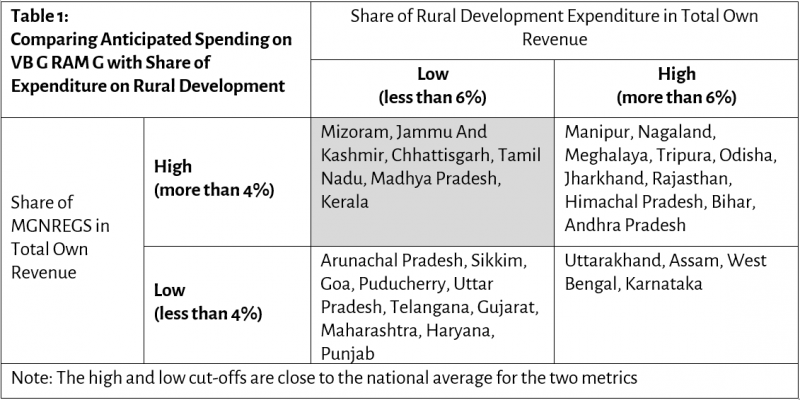
Among major states where the anticipated (40%) share of MGNREGS in total revenue is high, the increase in expenditure in Kerala due to the anticipated state share of MGNREGS would be a massive 80% of the amount that is currently spent on rural development (which is often a fraction of what is budgeted in the state). In Tamil Nadu (54%) and Madhya Pradesh (47%), the increase in expenditure due to the state share of MGNREGS would be half as much as is spent on rural development, in Chhattisgarh (37%) and Andhra Pradesh (31%), it would be about a third as much. And finally, in states like Rajasthan (26%), Himachal Pradesh (26%), Odisha (22%), Bihar (20%) and Jharkhand (19%), it is about a fifth to a quarter, since these states already spend a high proportion of revenue on rural development. These numbers indicate that the impact could be substantial, especially without a phase-in period.
______________________________________
[1] One of the more pointed criticisms of the shift from MGNREGS to VB G RAM G is that it is like “providing a work guarantee without any guarantee that the guarantee is in place” as pointed out by Jean Dreze, referring to the “switch off clause”. See https://indianexpress.com/article/india/jean-dreze-vb-g-ram-g-bill-providing-work-guarantee-place-10425760/). This post does not address these or other critiques of the shift.