- Home
- About Us
- Research
- Research Areas
- Agriculture
- Air Pollution
- Climate Change
- Economy
- Education
- Environmental Law & Justice
- Energy & Electricity
- Federalism
- Governance, Accountability & Public Finance
- Health & Nutrition
- Indian Politics
- International Relations & Security
- Jobs
- Land Rights
- Sanitation
- Social Justice
- State Capacity
- Technology
- Urbanisation
- Water
- Miscellaneous
- Research Initiatives
- Research Areas
- Publications
- People
- Events
Highlight>

CPR Insights | How is China’s Real Estate Sector Doing?
July 29, 2025
Figure 1: Price Indices of New and Second-Hand Buildings in Chinese Cities
(Jan-May 2024 = 100)
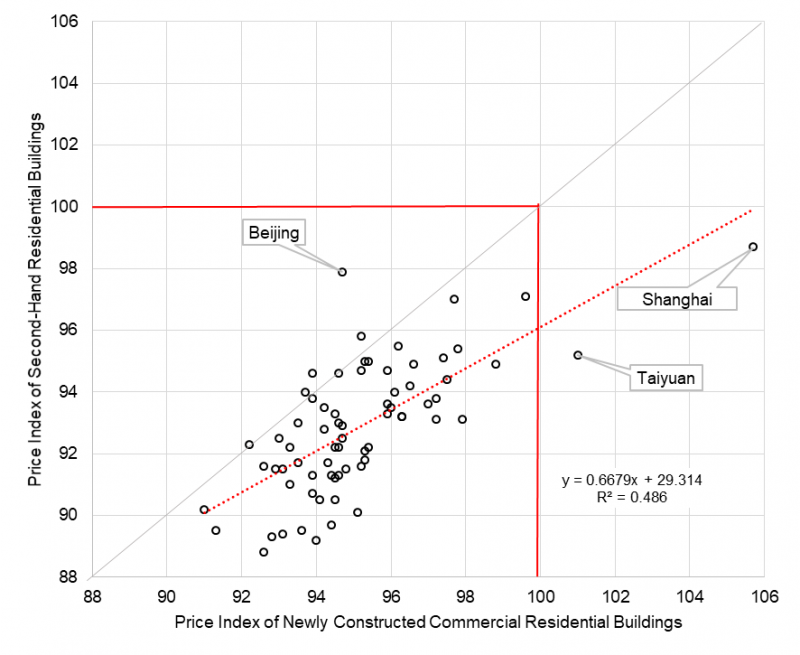
Source: National Bureau of Statistics of China Sales Prices of Commercial Residential Buildings in 70 Medium and Large-sized Cities: https://www.stats.gov.cn/english/PressRelease/202506/t20250616_1960179.html
Last week, the National Bureau of Statistics of China (NBS) released data on real estate prices. Of the seventy cities for which the NBS collects data, in all except two, viz. Shanghai, the second-richest city, and Taiyuan, the capital of Shanxi province and among the poorer cities in China, the price of newly constructed buildings is lower in the first half of this year compared to the same period in the last year. Furthermore, the price of second-hand buildings is lower in all the cities, even Shanghai and Taiyuan and in all but five, of which Beijing is one exception, where prices of new buildings have fallen by more than that of older buildings, the price of second hand buildings has fallen by more than for new buildings. All this does not point to a stabilizing real estate market. It is also true that the overall price index for China has not grown either — the national consumer price index (CPI) decreased by 0.1%, year on year, with the rural CPI falling by 0.4%, but that is cold comfort.
In the least affected quintile, i.e., the 14 cities with the least fall in prices, the average fall was 1.6%, while in the most affected quintile, the 14 cities with the highest fall in prices, the average fall was 7.3% and these include important economic cities like Wenzhou, Guangzhou, Fuzhou and Tangshan. Indeed, based on a sub-sample of 35 of these cities for which city GDP data is easily available, there is little relationship with the economic well-being of the city.
Given the current global economic and political uncertainty, which is also reflected in China’s own growth, it is natural that homebuyers are cautious. Further, the fall in prices may lead them to wait and see if the prices will come down even more. It looks like the malaise that started with the fall of firms like Evergrande and Country Garden may continue for some time.
By contrast, in India, based on the RESIDEX index released by the National Housing Bank (https://residex.nhbonline.org.in/) for 50 cities, the top quintile, i.e., the ten cities with the highest increase in prices, saw an average rise of 22.8%, though the bottom ten saw almost no increase, with two, Thiruvananthapuram and Haora, registering a decline. The other three quintiles saw a rise of 4.9% to 10.3% over last year, very different from the Chinese picture.