- Home
- About Us
- Research
- Research Areas
- Agriculture
- Air Pollution
- Climate Change
- Economy
- Education
- Environmental Law & Justice
- Energy & Electricity
- Federalism
- Governance, Accountability & Public Finance
- Health & Nutrition
- Indian Politics
- International Relations & Security
- Jobs
- Land Rights
- Sanitation
- Social Justice
- State Capacity
- Technology
- Urbanisation
- Water
- Miscellaneous
- Research Initiatives
- Research Areas
- Publications
- People
- Events
Highlight>

CPR Insights | Russia and India’s Imports of Petroleum Crude
September 19, 2025
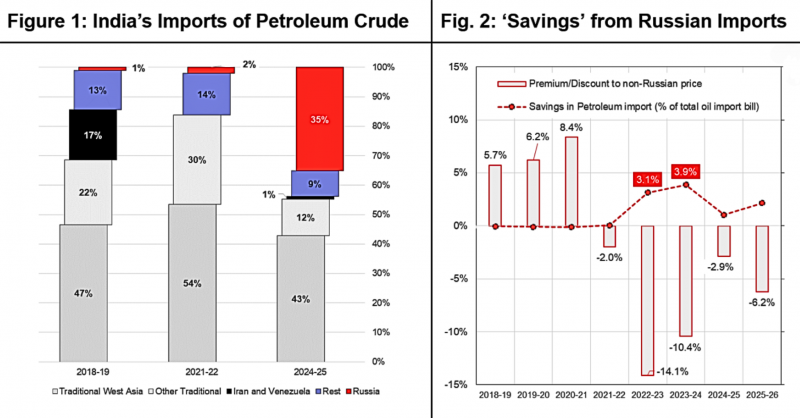
Source: Author analysis of data from EIDB->SYSTEM ON INDIA’s Export Import, Ministry of Commerce https://tradestat.commerce.gov.in/ 2025-26 refers to the first quarter of the fiscal year, i.e., April 2025 to June 2025
Note that “Traditional West Asia” refers to three large sources, viz. Iraq, Saudi Arabia, and UAE. Other Traditional includes USA, Brazil, Kuwait, Mexico, Nigeria and Oman. Together with Russia, they were the top ten sources in 2021-22, before the spurt in crude imports from Russia. Rest comprises other 31 countries from which there were imports under HSN code 27090000 for 2018-19 to 2021-22 and HSN 27090020 for 2022-23 to 2025-26.
Figure 1 shows how the source countries of India’s imports of petroleum crude has changed since 2018-19, with the rise in the share of Russia from 1% in 2018-19 to 35.1% (by value) in 2024-25 (35.8% by volume). However, over this period, there have actually been two transitions.
The first transition, over 2018-19 to 2021-22 (admittedly, a CoVID-affected year), was when India stopped importing from first, Iran and then Venezuela. Their share of 17% in 2018-19, about 41 million tons out of a total of 226 million tons, was largely made up by stepping up the share from traditional sources.
The second transition is the increase in imports from Russia, which goes from 4 million tons in 2021-22 to over 87 million tons in 2024-25. In this shift, the share of Iraq, Saudi Arabia and UAE reduced by 11 percentage points, but since the overall import went from 196 million tons to 244 million tons, their overall quantity remained about the same. However, for the other six countries, not only did their share drop by 18 percentage points, the quantity imported from them reduced by more than half, from over 60 million tons to under 30 million tons. The shares of other countries (‘Rest’) also declined, as did overall imports from them. However, imports from some countries, like Angola and South Korea, show an increase over 2021-22 to 2024-24. Some imports from Venezuela also seem to have resumed. Thus, the increase in imports from Russia has been accompanied by a decrease in imports from many countries, some of whom saw a drastic fall in their exports to India.
Figure 2 compares average unit values (total imports by value divided by imports by volume) of imports from Russia and other countries. Before 2021-22 (this Russia Ukraine war started in February 2022), Russian crude was priced at a premium, while post 2021-22, it was indeed priced at a discount. The discount was substantial in the two years, 2022-23 (14.1%) and 2023-24 (10.4%). This implies savings in the total crude import bill of about USD 5 billion a year or 3.1% and 3.9% respectively, given the counterfactual that Russian crude was substituted with crude at the average non-Russian price. However, if India were to shift to other suppliers, given its import volume, the global price might actually have risen, i.e. this is the claim that US wanted India to buy Russian crude to keep the oil market stable and prices in check. So, the value of savings may have been higher, but it would have been likely be under 1% of the total Indian import bill.