- Home
- About Us
- Research
- Research Areas
- Agriculture
- Air Pollution
- Climate Change
- Economy
- Education
- Environmental Law & Justice
- Energy & Electricity
- Federalism
- Governance, Accountability & Public Finance
- Health & Nutrition
- Indian Politics
- International Relations & Security
- Jobs
- Land Rights
- Sanitation
- Social Justice
- State Capacity
- Technology
- Urbanisation
- Water
- Miscellaneous
- Research Initiatives
- Research Areas
- Publications
- People
- Events
Highlight>

Bridging Research and Education to Address Capacity Gaps for Realising Adequate Housing for All
June 5, 2026
World Urban Forum 13, Baku, Azerbaijan, 21 May 2026
The UN-Habitat Academia and Research Roundtable at the 13th World Urban Forum (WUF13) brought together global experts to confront a stark reality: how the global housing crisis is not just a shortage of buildings, but a profound mismatch of data, capacity, and outdated educational models. The Roundtable was organised in two panels; Panel 1 on research and Panel 2 on academia. I was invited to participate in Panel 1 of the Roundtable as a representative from the Asia Region.
Conceptualised and coordinated by Ms Raphaelle Vignol, Programme Officer, Capacity Development Section, Global Knowledge and Advocacy Division, UN-Habitat, Nairobi, Kenya and moderated by Prof. Carlos Moreno, Sorbonne University, Paris, France, the discussion pivoted away from traditional metrics of “supply and demand” toward a more nuanced, “situated” understanding of how people actually live.
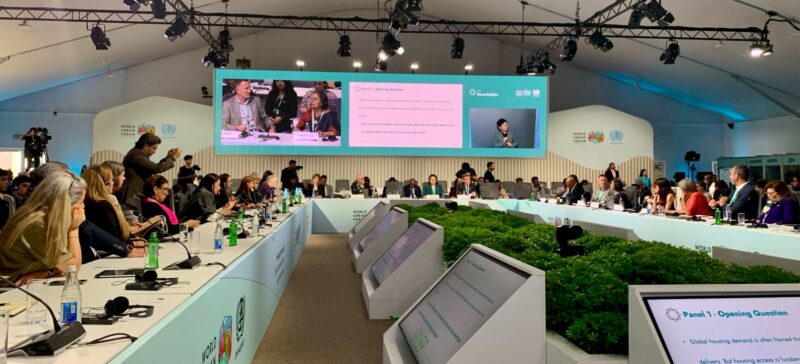
Panel 1: A New Philosophy for Housing Research
In her opening remarks, Ms Ana Claudia Rossbach, Executive Director, UN-HABITAT, highlighted the challenge of a mismatch that exists between the global housing crisis and capacity. There are critical data and research gaps on housing and housing markets in the global South with some communities and geographies suffering much more than others and of course, the capacities are also uneven. While innovation is happening daily on the front lines in the Global South, this knowledge is often “locked” or uncaptured because traditional research is designed around available data rather than ground-level needs.
Referring to the UN-HABITAT Strategic Plan – 2026-29 that puts housing at the centre, along with land, basic services, informal settlements, requires means of implementations, including financial means, urban planning to multi-level governance, the local action, participation, data, access to data, access to knowledge. That’s why it is so important for us to maximise the potential that we have at WUF13, and specifically the WUF Academy, to make sure that we build a community which remains united towards a shared research and capacity development agenda. To this, Ms Ana argued that we must move toward co-production of knowledge where researchers work alongside practitioners and communities who do not have the luxury of time to stop and document their innovations.
Moving Beyond “Units” and “Deficits”
Dr Camila Cociña, Senior researcher (housing justice), International Institute of Environment and Development, presented an unconventional argument that the housing crisis cannot be solved by simply building more houses. and the real gap lies in improving existing housing stock and supporting the efforts people who are making house themselves. This requires researchers to move away from “supply/demand” deficit models and instead understand the “trade-offs” residents make between long-term investment and immediate tenure security.
The Paradox of the “Empty City”
Citing a peculiar phenomenon in the Sub-Saharan Africa, Dr Uchendu Eugene Chigbu, University of Science and Technology, Namibia, highlighted how the presence of high-end, “beautiful houses” in major cities like Lagos and Nairobi remain completely unoccupied while millions suffer from homelessness. He noted that a newly elected government in Ethiopia identified around 200 such unoccupied houses, underscoring the disconnect between housing supply and housing need. He argued that current research relies too heavily on formal market assumption, namely, that that people have titles and access to bank funding. This framework, arguably, fails to capture the data and address the reality of a mobile population of itinerant labourers who move frequently for work and often remain invisible to conventional planning and tracking systems.
Plurality and Changing Minds
Dr David Dodman, General Director Institute for Housing Studies, Netherlands, argued that the “highest goal” of research is not just data generation, but changing minds and actions. He advocated for a plurality of approaches, recognising that no single method —whether it’s mortgages, self-builds, or large-scale public housing — can solve the crisis alone. Highlighting the value of long-term evidence, he pointed to the “longitudinal work” of Caroline Moser as a gold standard for housing research. By tracing how settlements and communities evolve over decades, such research offers perspectives often lost in short-term policy cycles.
The “Invisible” Rental Market
As part of the distinguished panel, I, Dr Pushpa Pathak, Centre for Policy Research, New Delhi, India, drew attention to the massive research gap in the low-income rental housing market. Most housing data focuses on ownership, rental housing remains understudied, at all levels, and especially in informal settlements. This is important because the quality and affordability of rental housing determine the decision to move with family or alone that affects the pace of urbanization, the commitment of people to cities and the nature of rental housing demand. Emphasis should be on understanding the private response to rental housing for lower income groups: who makes it, how is it financed, who does it cater to, and is there discrimination? What are the identity markers of discrimination? Language, religion, region, gender, or family versus single rentals? These questions require deeper empirical investigation to understand rental housing market for lower income groups in Asia’s expanding urban areas.
Big Data vs. Small Data
Dr Karen Chapple, Director of the School of Cities, University of Toronto, Canada, warned of a dangerous trend: while “Big Data” and AI are flourishing, the census and “small data” (household-level surveys) are disappearing or becoming irregular. She shared an unconventional finding from her work at the Urban Displacement Project – on how most people actually experience “emplacement” rather than displacement, implying they try to stay as close to home as possible even under pressure. Without “small data” to understand motivations and choices, Big Data risks making lower-income and racialized populations even more invisible.
The Scale of the Neighbourhood and the City
Dr Margarita Greene, Professor, School of Architecture, Pontifical Catholic University of Chile, argued that research has focused too much on “the house” and not enough on the neighbourhood scale. She suggested that “situated research” is needed to understand how different cultures approach social cohesion. A major failure of modern urbanism, according to Greene, is the inability to “combine properly” different social groups; we need to understand how the poor and the rich can coexist in a way that enriches both rather than leads to segregation.
“Situated” Approach for Reconstruction and Development
Dr Fariz Ismayilzada, Member of Parliament and Vice Director, Azerbaijan Diplomatic Academy (ADA) and Information Technologies University, Baku, Azerbaijan, provided a concrete example of this “situated” approach through the reconstruction of the Karabakh region. He described using university surveys to ensure that the creation of new villages from scratch matched the economic skills and family structures of the 80,000 displaced people returning to their lands.
Panel 2: Higher Professional Education to Fill the Capacity Gaps and Foster Innovation
The second half of the roundtable focused on reforming education to teach the next generation of urban professionals for a world that is changing rapidly.
Housing as Land Policy
Dr Enrique R. Silva, Chief program officer, Lincoln Institute of Land Policy, Cambridge, USA, emphasised that the most urgent gap in education is the failure to link housing policy to land policy. Housing is too often treated as a construction or finance issue when it is fundamentally a land problem. Unconventionally, Silva suggested how land policy literacy at the primary or high school level, can help build a “talent pipeline” of citizens who are aware of their communities and understand how they function.
Universities without Walls
Dr Gul Sola Mamedova, Rector of the Azerbaijan Nature and Construction University, BAKU, Azerbaijan advocated for universities to go “beyond their own walls” and become “city laboratories”. Mamedova emphasised lifelong learning, noting that because cities change so fast, a bachelor’s degree is no longer sufficient; professionals need “agile” programs to upgrade their knowledge on issues like climate change and digitalisation every few years.
The Systems Integrator
Dr.Edgar Pieterse, Founding Director of the African Centre for Cities, University of Cape Town, South Africa, South Africa, emphasised that given the multidimensional nature of sustainable urbanism, housing and the land question, we have to adopt a systems perspective. What is needed are “Systems Integrators” who may start as architects or engineers but are trained to “curate” the process of learning, failing and testing repeatedly within a highly politicised, under-resourced environments. Pieterse argued that these professionals need more than just technical skills; they need “adaptive leadership,” “spiritual attentiveness” (or “Zen”) and new competencies like AI to navigate the emotional and ethical trade-offs of urban governance.
The Missing Skill: Urban Finance
Ms Lucy Slack, Commonwealth Local Government Forum, London, UK, pointed out that while we talk about planning, urban finance is rarely treated as its own specialised profession or skill set. She noted that high-level skills often reside in the private sector rather than the municipalities that need them. She called for a “professionalisation of local governments” to make cities places where high-level experts actually want to work.
Professionals as Trans-discipline Bridges
Ms Alexa Martinez Soto, Monterrey Institute of Technology and Higher Education, Mexico, framed housing as a “socio-technical complex system”. She argued that the new generation of professionals must act as “bridges” who can speak the languages of economists, architects, and community members simultaneously. She highlighted the need for “caring cities,” a concept often ignored in technical planning, which focuses on the needs of women and caregivers. Interestingly, she suggested that AI could be a tool for radical inclusion, helping city governments process the “complexity of multiple perspectives” from citizen voice notes and texts that are currently ignored.
City and Housing as Interdisciplinary Conversations
Ms Karla Planter Perez, Rector General of the Universidad of Guadalajara, Mexico, delivered a provocative critique, stating that universities are currently providing “professional training for a world that doesn’t exist anymore”. She argued that because reality is not “segmented,” education must move toward systemic and critical thinking that allows professionals to read “what does not appear on indicators,” such as daily experiences of exclusion. The interdisciplinary vision needs to go beyond infrastructure, finance, and urban planning, and think of the questions around the city and housing as interdisciplinary conversations.
Key Themes Emerging from the Discussions
Several discussions challenged conventional approaches to housing and urban planning, highlighting the need to rethink how cities respond to rapid urbanisation, inequality, and social change.
Focus on Improvement, Not Just Construction
Scholars and experts argued that addressing the housing crisis requires more than increasing housing supply. Equal attention must be paid to improving existing stock and supporting ground-level efforts than by just building new supply.
The Mobile Urban Population Problem
A recurring theme was the growing disconnect between planning frameworks and lived realities. Planners continue to design for static populations while African urban residents are increasingly mobile and “itinerant,” and require entirely new tracking and planning models. Understanding and responding to this mobility remains a significant challenge for housing policy and urban governance.
The “Luxury Vacancy” Paradox
Speakers highlighted the contradiction of rising homelessness existing alongside increasing vacant luxury housing. This phenomenon raises important questions about how housing markets function and whom they ultimately serve, a gap that traditional market research has failed to address.
Emplacement over Displacement
Discussions also challenged assumptions about mobility and relocation. Contrary to common belief, data shows people have a powerful “emplacement” drive, often staying in high-risk or inadequate housing just to remain near their community owing to strong social, economic, and cultural ties Housing solutions, therefore, must account for people’s attachment to place rather than focusing solely on physical relocation.
The Death of the Specialist
As urban challenges become increasingly interconnected, participants stressed the need for professionals who can work across disciplines. The “hyper-specialised” professional (just an architect or just an economist) is becoming obsolete, replaced by “Systems Integrators” who are capable of understanding “interdependencies” of the city.
Spiritual Leadership in Planning
Several speakers reflected on the qualities needed to lead cities through sensitive transitions. Effective urban leadership requires “emotional confidence” and “spiritual attentiveness” to survive the “political fights” of municipal governance.
AI as a Listener
The potential of artificial intelligence was discussed not only as a tool for data analysis but also as a means of engaging with citizen voices at scale. Participants explored how rather than just using AI for data analytics, it can be used to “hear” and process thousands of diverse citizen voices that traditional governments find too “complex” to manage.
In Conclusion: Research and Education for Change
The roundtable concluded with a call for international collaboration to break out of “insular conversations”. As Ms. Raphaelle Vignol summarised, together with you we are going to drive the housing research and capacity development agenda in the next three years. The goal is to move toward research and education that is designed for change, putting the human experience and the “neighbourhood scale” back at the heart of the global housing agenda.
My own personal takeaway is largely similar to Ms. Vignol’s. The thrust of the research panel was to re-scale away from individual housing to neighbourhood level issues and its interaction with housing choices, a greater focus on private responses, especially at lower income groups, which would include rentals and incremental interventions. Similarly, on the educational front, the emphasis was on an approach that equipped students with a more integrated and cross-disciplinary toolkit that could relate to community experiences, rather than specific disciplinary inquiries.
Access the session’s recording here