


- Home
- About Us
- Research
- Research Areas
- Agriculture
- Air Pollution
- Climate Change
- Economy
- Education
- Environmental Law & Justice
- Energy & Electricity
- Federalism
- Governance, Accountability & Public Finance
- Health & Nutrition
- Indian Politics
- International Relations & Security
- Jobs
- Land Rights
- Sanitation
- Social Justice
- State Capacity
- Technology
- Urbanisation
- Water
- Miscellaneous
- Research Initiatives
- Research Areas
- Publications
- People
- Events
Highlight>

Discussion on ‘Jugalbandi: The BJP Before Modi’ by Vinay Sitapati
Date and Time
December 17, 2020
7:00 pm to 8:15 pm
Location
Online via Zoom
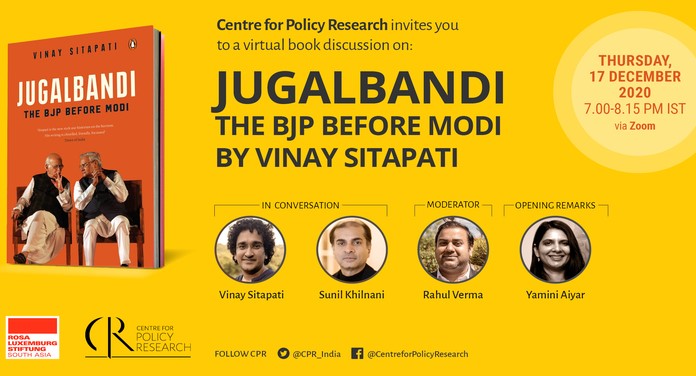
Centre for Policy Research invites you to a virtual book discussion on: ‘Jugalbandi: The BJP Before Modi’ by Vinay Sitapati
The author, Vinay Sitapati will be in conversation with Sunil Khilnani
Moderator: Rahul Verma
Opening remarks by: Yamini Aiyar
The sessions will be online via Zoom. To register, please fill this form. It will also be live-streamed on CPR’s Facebook page.
In case of any issues and for any queries, please email at communication@cprindia.org.
ABOUT THE BOOK
Narendra Modi has been a hundred years in the making. Vinay Sitapati’s Jugalbandi (Penguin Random House India) provides this backstory to his current dominance in Indian politics. It begins with the creation of Hindu nationalism as a response to British-induced elections in the 1920s, moves on to the formation of the Bharatiya Janata Party (BJP) in 1980, and ends with its first national government, from 1998 to 2004. And it follows this journey through the entangled lives of its founding jugalbandi: Atal Bihari Vajpayee and Lal Krishna Advani.
Over their six-decade-long relationship, Vajpayee and Advani worked as a team despite differences in personality and beliefs. What kept them together was fraternal love and professional synergy, of course, but also, above all, an ideology that stressed on unity. Their partnership explains what the BJP before Modi was, and why it won.
In supporting roles are a cast of characters-from the warden’s wife who made room for Vajpayee in her family to the billionaire grandson of Pakistan’s founder who happened to be a major early funder of the BJP. Based on private papers, party documents, newspapers and over two hundred interviews, this is a must-read for those interested in the ideology that now rules India.
ABOUT THE SPEAKERS
Vinay Sitapati is a political scientist, lawyer and journalist. He has a PhD from Princeton University, and degrees from Harvard University and the National Law School of India University, Bangalore. His first book, Half Lion (2016), was a best-selling biography of P.V. Narasimha Rao. Sitapati teaches at Ashoka University.
Sunil Khilnani is Professor of Politics and History at Ashoka University. Previously he was Avantha Professor and Director of the India Institute, which he established at King’s College London in 2011. His most recent book is Incarnations: A History of India in 50 Lives (2016), which accompanies his 50-part BBC podcast and radio series.
Rahul Verma is a Fellow at Centre for Policy Research and a PhD candidate in Political Science at the University of California at Berkeley. He is the author of Ideology and Identity: The Changing Party Systems of India (2018) and is a regular columnist for various news platforms.
Yamini Aiyar is the President and Chief Executive of Centre for Policy Research, where she founded the Accountability Initiative in 2008. Her research interests are in the fields of social policy and development. She is a TED fellow and a founding member of the International Experts Panel of the Open Government Partnership.