- Home
- About Us
- Research
- Research Areas
- Agriculture
- Air Pollution
- Climate Change
- Economy
- Education
- Environmental Law & Justice
- Energy & Electricity
- Federalism
- Governance, Accountability & Public Finance
- Health & Nutrition
- Indian Politics
- International Relations & Security
- Jobs
- Land Rights
- Sanitation
- Social Justice
- State Capacity
- Technology
- Urbanisation
- Water
- Miscellaneous
- Research Initiatives
- Research Areas
- Publications
- People
- Events
Highlight>

How Is India Adapting to Heatwaves?: An Assessment of Heat Action Plans With Insights for Transformative Climate Action
Aditya Valiathan Pillai
Tamanna Dalal
Centre for Policy Research
March 27, 2023
What are heat action plans (HAPs)?
HAPs are India’s primary policy response to economically damaging and life threatening heatwaves. They prescribe a variety of preparatory activities, disaster responses, and post-heatwave response measures across state, district, and city government departments to decrease the impact of heatwaves.
Our assessment of Indian HAPs
In this report, we conduct what is, to our knowledge, the first critical review of heat action plans in India. We analyse 37 heat action plans at the city (9), district (13) and state (15) levels across 18 states and identify several opportunities to strengthen Indian HAPs. We also document an encouragingly wide range of solutions (covering 62 distinct intervention types) prescribed across these HAPs, from promoting green roofs to state-wide school awareness programs (see the interactive figure below). This lays out a consolidated toolbox of options for the Indian HAP designer and policymaker.
Findings
1. Most HAPs are not built for local context and have an oversimplified view of the hazard;
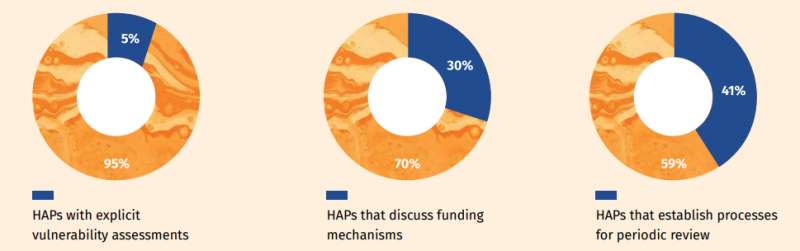
2. Nearly all HAPs are poor at identifying and targeting vulnerable groups;
3. HAPs are underfunded;
4. HAPs have weak legal foundations;
5. HAPs are insufficiently transparent;
6. Capacity building is sectorally-targeted.
Linking HAPs with existing policies
None of the HAPs reviewed explore policy integration across all listed interventions. Many actions in agriculture, water, housing, infrastructure, and urban design could usefully be linked to existing policies to unlock capacity and finances. In the interactive figure below, we lay out an indicative list of national and state-schemes that could be tapped into to improve implementation prospect:
Suggested citation: Aditya Valiathan Pillai and Tamanna Dalal. (2023). How is India adapting to heatwaves?: An assessment of heat action plans with insights for transformative climate action. CPR report.