- Home
- About Us
- Research
- Research Areas
- Agriculture
- Air Pollution
- Climate Change
- Economy
- Education
- Environmental Law & Justice
- Energy & Electricity
- Federalism
- Governance, Accountability & Public Finance
- Health & Nutrition
- Indian Politics
- International Relations & Security
- Jobs
- Land Rights
- Sanitation
- Social Justice
- State Capacity
- Technology
- Urbanisation
- Water
- Miscellaneous
- Research Initiatives
- Research Areas
- Publications
- People
- Events
Highlight>

CPR Insights | Are Higher Wages Associated with More Contractualisation?
August 23, 2024
Source: https://www.mospi.gov.in/sites/default/files/publication_reports/ASI%20Volume%20I%202021-22%20%20Final.pdf
(Table 4a)
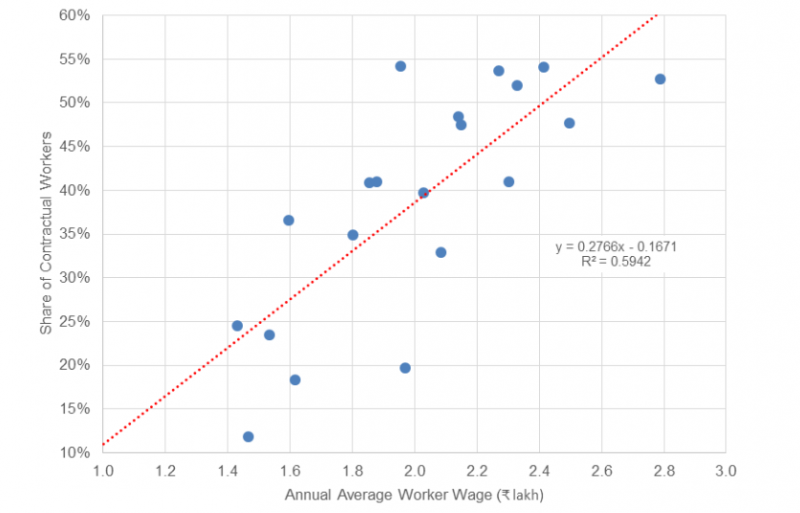
The share of contract workers in organised Indian industry is rising relatively rapidly. From just under 22% percent in 2001-02, it has risen to over 40% in 2021-22. But the share of contract workers differs across industries, from well over half in industries like beverages (54%) and the production of salt (67%) to less than one fifth in garments (12%) and textiles (18%).
This information can be found in the Annual Survey of Industries (the latest version being 2021-22) brought out by the Industrial Statistics wing of the National Statistical Office. There is also a lot of other information in the document, one of which is wages paid to the workers
So, does the variation in the use of contract workers differ across industries because of the difference in cost of workers (wages) across them? The figure above plots the average annual worker wage (this includes both contractual and non-contractual workers) versus the extent of use of contract workers. As can be seen, the extent of contractualisation appears to rise with the increase in wages. This is to be expected if contract workers cost less than regular workers, with a rise in wages leads to substitution of regular workers by contract workers.
Of course, there are many other factors that will determine the extent of contractualisation, which will emerge in a fuller analysis, e.g., the extent of embedded skills in workers. An industry where such worker-specific human capital is high will have more difficulty substituting regular workers by contract workers. Industries with such worker-specific human capital are also likely to pay workers more and this will lead to an association of higher wages with lower contractualisation, the opposite of the posited relationship. The fact that it is not evident may indicate that such effects may not have a strong impact.
1. It should be noted that the inclusion of contract workers would reduce the average wage in industries with high share of contract workers and would bias the data against the hypothesis. The fact that the relationship remains evident despite this indicates a strong underlying relationship. Information on wages paid to contract workers is available in what is called the unit level data but accessing that is a too complicated an exercise for this blog, which focuses on readily available data. There are existing works that examine such data in detail, e.g. Singh, Bir (2023) India’s Informal Economy Contractual Labour in the Formal Manufacturing Sector Routledge, London.