Background on National Ambient Air Quality Standards (NAAQS)
Air quality standards are primarily health-based standards that define the ambient concentration of air pollution to which the public can be exposed without suffering harm to their health. In India, the Central Pollution Control Board (CPCB) is tasked with setting the National Ambient Air Quality Standards (NAAQS) under the Air (Prevention and Control of Pollution) Act of 1981.
The NAAQS were first established in 1982 for four pollutants (suspended particulate matter, nitrogen dioxide, sulphur dioxide and carbon monoxide) and subsequently revised in 1994 and 1998 to include several more. The current iteration of the NAAQS were notified in 2009 and were aligned with the World Health Organization’s (WHO) interim air quality guidelines. The most recent revision of the WHO guidelines for ambient air quality in September 2021 rendered the NAAQS as substantially weaker in comparison. The alignment of the NAAQS with these global guidelines will require integration of the wealth of new health data generated since 2009 on the deleterious effects of air pollution on health both locally and globally.
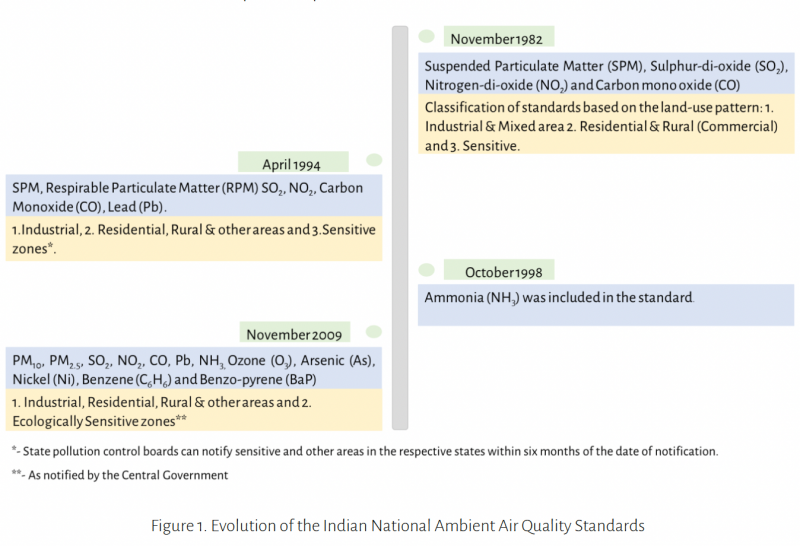
The 2009 NAAQS revisions were notified through the Gazette of India with no contextual information provided on the composition of the committee tasked with the revisions, or on the kind of data or information used by the committee to draw its conclusions on the acceptable levels of exposure to various pollutants. In August 2021, the CPCB convened a committee to review and update the NAAQS. The committee’s wide-ranging remit includes an assessment of the health risks of air pollution, establishing guidelines for monitoring, identifying non-attainment areas, and revising the Air Quality Index (AQI) through which health risks are communicated to the public.
Proposed framework for revising the NAAQS
While the proposed revision of the NAAQS is a step in the right direction, at the time of this paper’s publication it remains unclear how evidence on the harmful effects of air pollution to health would be weighed by the committee, whether the committee has adequate disciplinary diversity, how it would consider economic and social factors in its decision-making, and how it would engage with the public.
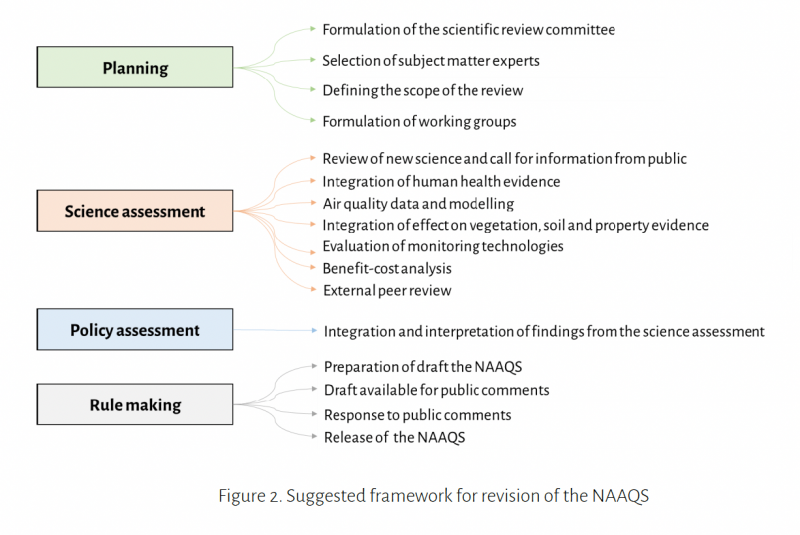
Based on the need to establish scientifically robust health-based standards, this working paper evaluates the global best practices for setting or revising air quality standards. Through this, the authors suggest a structured approach to revising the current and future NAAQS – through an inclusive, expert-driven institutional process, with appropriate timelines, evidence integration, and public participation for the Indian context.
The authors propose a broad framework for revising the NAAQS with four significant steps i.e., planning, science assessment, policy assessment, and rulemaking. The approach laid out in this paper aims to enshrine a set of core principles in the revision process including periodicity, interdisciplinarity, and transparency while centering health in the setting of any new standards.
Download the PDF here.
Download the annexure here.