From Touring Cinema to Home Theaters: The Changing Face of Mass Entertainment in Dhampur

Source: Google Images

Imagine the sun setting over an open field, a film projector being set up, a screen being tied between poles by two young men, and as the night sky darkens a large number of men and children taking their seats on the ground for an evening of entertainment. Tickets were cheap at around four to four-and-a-half annas (around 28 paise in today’s decimal Rupee system) drawing a sizable audience. Even a larger number of people watching from a distance with a mix of curiosity, resistance, moral anxiety and the draw of the screen. This was a typical night out to cinema in and around Dhampur, a small town in Western Uttar Pradesh, where touring cinema was introduced in the mid-1950s. Avtar Singh, now a prominent citizen of Dhampur, was one of those two young men screening films in the open-air theaters.

The story of Dhampur’s cinema culture is inseparable from the life journey of Avtar Singh, a man whose family came from their ancestral village in Shakargarh tehsil, Narowal district, Punjab province, in today’s Pakistan. Like countless families during the Partition of 1947, his kin were split by an arbitrary border. Their land, property and some family members remained on the other side, while a part of the family was resettled in Gurdaspur district of Indian Punjab. Avtar Singh completed his graduation from Gurdaspur. Then he followed his elder brother to district Bijnor, where his brother was already involved in running a touring cinema showing films in the open air temporarily in different locations.

Dr. Pushpa Pathak (Senior Visiting Fellow, CPR) in conversation with Avtar Singh

Recognizing that cinema needed a more permanent and respectable space, in 1958 Avtar Singh and his brother shifted from touring cinema to a rented hall in Dhampur. This hall came to be known as Basant Talkies, the first permanent cinema hall in the town. This move marked an important transition, from touring shows to institutionalized entertainment at a landmark location in the map of the town.

In the initial years, the days of institutionalized cinema were uncertain. There were days when no audience turned up “no man, no show”. But Avtar Singh continued popularizing cinema, gradually experimenting with programming and show timings. Early screenings focused on stunt films and later on social and family-oriented films titles such as Mother India, Naagin, Anarkali, Mughal-e-Azam etc.

The turning point for cinema in Dhampur came in the early 1970s with large infrastructure projects in the region, particularly the construction of the Kalagarh and Harevli dams. These projects attracted thousands of workers from outside the town. Dhampur’s railway station became a crucial node for the labour movement, and the town’s economy expanded rapidly. For migrant workers living away from families, cinema was one of the few affordable forms of entertainment. Basant Talkies benefited directly from this demographic shift. Show numbers increased from one show a day to two, and by the late 1960s and early 1970s, three or more shows on weekends.

In small towns like Dhampur, cinema is not just about films. It is about acceptance of a new form of entertainment and aspirations of the people to be modern. It is not only a major form of mass entertainment but also a marker of social change. According to Avtar Singh, the Dhampur society at that time was hardly receptive to cinema. Films were looked upon with suspicion as something immoral. Respectable families hesitated to watch films and women never went to the cinema.

Perhaps the most striking aspect of Dhampur’s cinema story is how deliberately it was used to negotiate social change. During the 1960s, Avtar Singh introduced special “lady shows” and children’s shows. Religious and social films were screened specifically to encourage women’s attendance, making it easier for families to send their daughters accompanied by mothers. Flat ticket rates, removed class distinctions inside the hall, also making it more affordable.

In a town where women’s presence in public spaces was minimal in the early 1960s, cinema became one of the first socially sanctioned reasons for women to step out. What began as mothers escorting their children to see films transformed into women going out to enjoy cinema for themselves. Cinema, in this sense, functioned as a quiet social reform trigger for normalizing women’s visibility outside the home and asserting their right to entertainment.

At present, Dhampur has two functioning cinema halls namely; Sheela Talkies, established in 1977 and Bansal Cinema in 1979. According to Umesh Bansal, the owner of Bansal Cinema, the audience turnout has steadily declined over the years. A noticeable exception is during festivals such as Eid and Diwali, when films starring Shah Rukh Khan or Salman Khan get released and shows run to full capacity. Outside these festival windows, however, the halls rarely witness a full house. Ticket prices range between ₹100 and ₹200, and are not seen as high-price. A key reason for the decline of the audience is the growing dominance of television and OTT platforms, which have transformed viewing habits and expectations. OTT platforms offer a wider variety of content; web series, regional films, shorter formats etc., which are more attractive to the younger audiences than mainstream theater-based cinema releases. The convenience of watching films at home where viewers can pause, resume, or abandon content at their will has begun to replace the fixed, time-bound outside home experience. Cinema, once a shared social outing for families and groups of men and women, has increasingly become an individual and private form of entertainment.
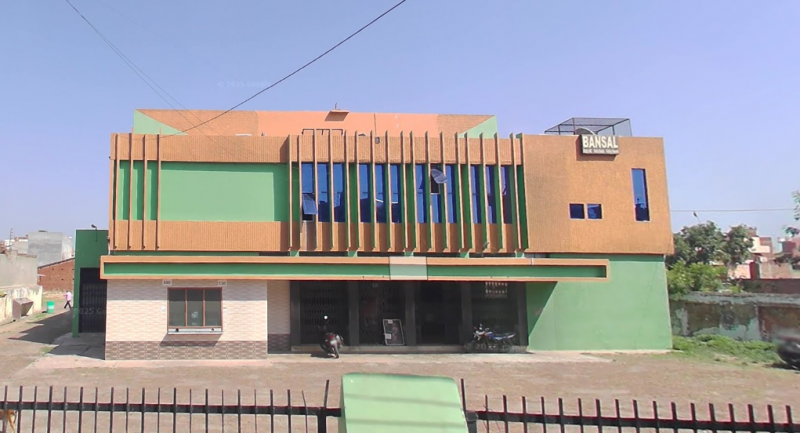
 

Bansal Cinema, Dhampur; Source: Google Map Images

What makes Avtar Singh’s story compelling is not only that he helped establish cinema culture in Dhampur, but that he did so without inherited capital or land. Subsequently, he also became a successful businessman who owns a shop selling readymade garments and footwear. His journey from a Partition-affected family that lost all their property in 1947 to becoming a cultural entrepreneur in a small Indian town by the late 1950s reflects a broader post-Partition narrative of rebuilding lives through education, enterprise and upward social mobility.

Cinema, in this story, is not just a business. It is a lens through which we can see changing attitudes towards leisure, gender, morality, and public space. In Dhampur, the flicker of a projector helped loosen social boundaries, brought women into public view, and offered migrant workers a sense of pause in an otherwise harsh working life.

Today, when multiplexes dominate urban landscapes and single-screen theatres struggle to survive, stories like Basant Talkies remind us that cinema once played a much larger social role. In towns like Dhampur, it was a bridge between past and present, between private homes and public life, and between a displaced past across the border and a rooted future in a new town.

CPR Insights | The Possible Fiscal Impact of VB G RAM G on States

Figure 1: Impact of Making States Pay for MGNREGS Expenditure

Source: For MGREGS https://mnregaweb4.nic.in/netnrega/Citizen_html/financialstatement.aspx?lflag=eng&fin_year=2022-2023&source=national&labels=labels&Digest=kODLAkQv8M9FT6WbXb7zhA and RBI State Finances https://rbi.org.in/Scripts/AnnualPublications.aspx?head=State%20Finances%20:%20A%20Study%20of%20Budgets and Census 2011

One of the differences between MGNREGS and VB G RAM G is that the states will now need to pay a portion of the VB G RAM G bill.[1] How will this affect the states’ fiscal condition?  To answer this question, we look at data from 2022-23, the year for which final accounts are available across states from the RBI and also the year for which actual state-wise expenditure is available for MGNREGS. We calculate two metrics, viz. 40% of the share of expenditure on MGNREGS in a state divided by the state’s developmental expenditure and the state’s total own revenue (its own taxes and share in central taxes), i.e., an expenditure-based metric and a revenue-based metric.

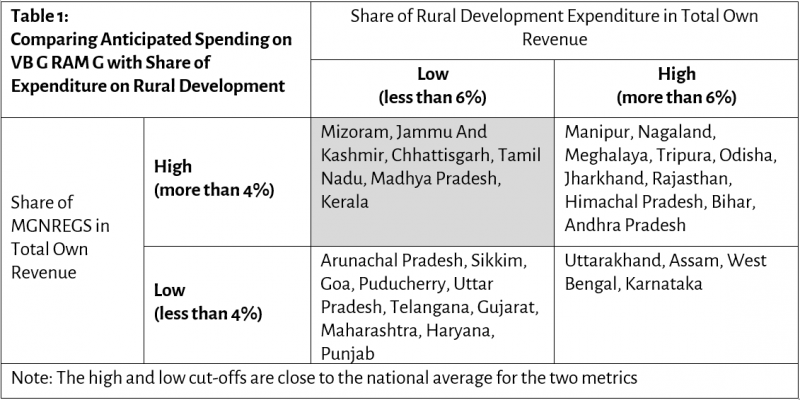
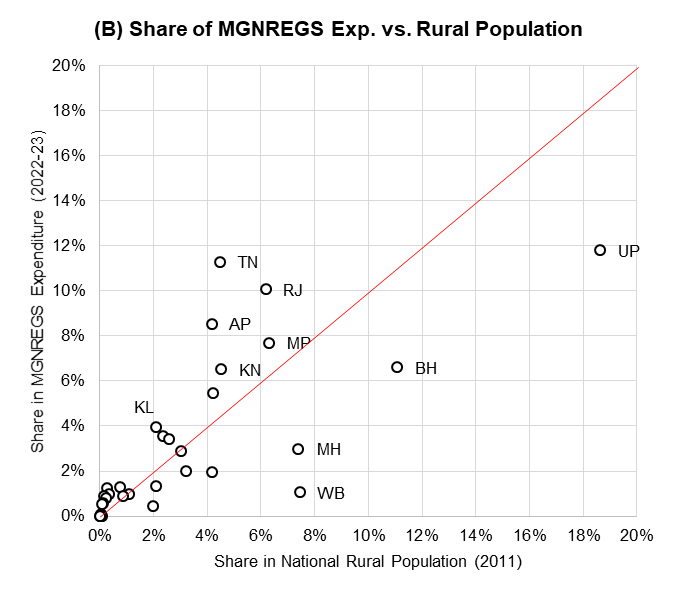
The grey and black bars in Figure 1(A) show that this number can vary considerably across states, from less than 0.5% to more than 5%. For about half the states using both the revenue metric (16) and expenditure metric (15), this share would have been below 2% in 2022-23. All five states where both metrics are more than 3% are in the Northeast, viz. Nagaland, Meghalaya, Manipur, Tripura, and Mizoram (Jammu and Kashmir is the sixth state by the revenue metric). But how are we to judge these metrics – how burdensome is it to re-allocate 3% of revenue or spend an extra 3% of developmental expenditure? For this, we compare it to the amount of rural development expenditure being undertaken by the states. Table 1 groups the states into four – those with high and low shares of MGNREGS spending to total revenue, vis-à-vis high and low shares of rural development spending to total revenue. In some states like Kerala, Tamil Nadu, and Rajasthan in the upper left quadrant, the share of MGNREGS expenditure compared to their share of the rural population is also high, as in Figure 1(B).

Among major states where the anticipated (40%) share of MGNREGS in total revenue is high, the increase in expenditure in Kerala due to the anticipated state share of MGNREGS would be a massive 80% of the amount that is currently spent on rural development (which is often a fraction of what is budgeted in the state). In Tamil Nadu (54%) and Madhya Pradesh (47%), the increase in expenditure due to the state share of MGNREGS would be half as much as is spent on rural development, in Chhattisgarh (37%) and Andhra Pradesh (31%), it would be about a third as much. And finally, in states like Rajasthan (26%), Himachal Pradesh (26%), Odisha (22%), Bihar (20%) and Jharkhand (19%), it is about a fifth to a quarter, since these states already spend a high proportion of revenue on rural development. These numbers indicate that the impact could be substantial, especially without a phase-in period.

______________________________________

[1] One of the more pointed criticisms of the shift from MGNREGS to VB G RAM G is that it is like “providing a work guarantee without any guarantee that the guarantee is in place” as pointed out by Jean Dreze, referring to the “switch off clause”. See https://indianexpress.com/article/india/jean-dreze-vb-g-ram-g-bill-providing-work-guarantee-place-10425760/). This post does not address these or other critiques of the shift.

Dhampur: A Small Town Shaping into a Regional Educational Hub

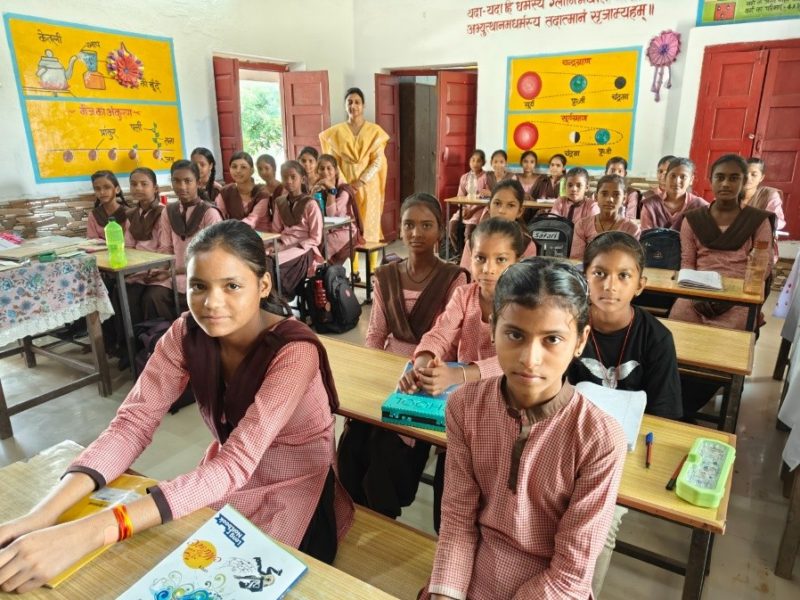
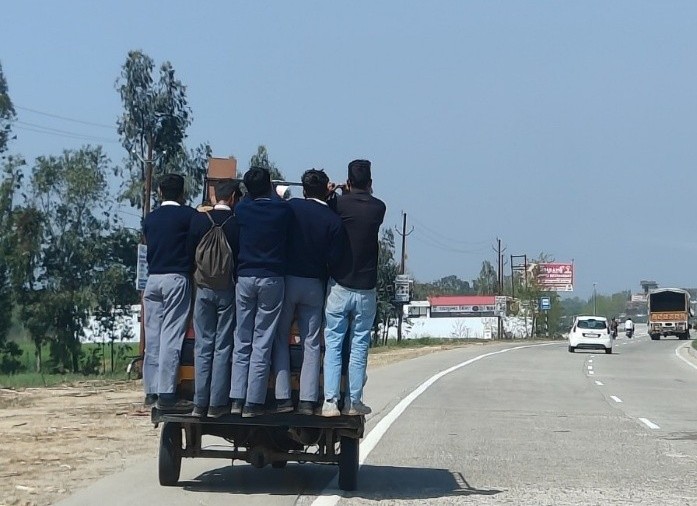
Education is a quiet sunrise that empowers human potential, and even a small town like Dhampur can play a major role in shaping the educational landscape of the town and its hinterland. In 2024, during field visits for our longitudinal research study titled “Forty Years’ Development Saga of Dhampur: Growth Dynamics and Regional Transformation Potential of an Indian Small Town,” we observed numerous schools and colleges spread out across the town and on its periphery. The mornings in the town begin with the steady flow of school buses, e-rickshaws and autos carrying children, and some students also riding their own bicycles to school. It was indeed surprising for us to see such a large number of schools and colleges for a small town like Dhampur with about 1 lakh population located in district Bijnor, Uttar Pradesh. The very first question that came to our mind was, do these schools and colleges serve only the students from the town, or do they also cater to the students from surrounding towns and villages?

Narendra Gupta, an industrialist and a prominent citizen of Dhampur, who has seen the educational transformation of the town, mentioned that the quality of education was very poor in Dhampur in the early days of his education, before independence. Therefore, he used to travel daily by an early morning train at 3:20 am to attend his intermediate college in Nagina town located about 26 kilometres away. At present, the educational situation has changed completely. Most of the students don’t even need to go to other nearby towns for their early education. Now, only a small number of students from influential and affluent families, such as industrialists, doctors, and big traders, pursue their higher education in prestigious institutions across India and abroad, particularly in countries like the UK and the USA. As incomes rise and aspirations increase, these families prefer prestigious national and international universities that they perceive as offering higher-quality education, broader exposure, and superior career opportunities.  

Yashpal Tuli, a retired professor of RSM Inter College and another prominent citizen of the town, informed us that in 1947 there was a primary school commonly known as the Free School Dhampur, where even the rich kids used to study. In addition, there were three inter colleges set up in 1943, two co-ed colleges, namely the RSM Inter College and KM Inter College, as well as a Kanya Inter College, where parents could send their daughters to study without any concerns or hesitation. 

Both the prominent citizens mentioned that educational institutions in Dhampur are comparatively more affordable and offer facilities of a national standard. They also stated that Dhampur’s school and colleges are not just serving the surrounding villages but also the nearby towns such as Sherkot, Nagina, Nehtaur and Afzalgarh. Their views align with our field observations that Dhampur also serves the students of neighbouring districts. During our fieldwork, we came across some well-dressed students in school/college uniform at the railway station of Dhampur who commute daily from Moradabad to Dhampur to pursue higher education, particularly BSc in agriculture. According to these students, although Moradabad has larger and better colleges, they commute about 100 kilometres daily as higher education in Dhampur is comparatively more affordable, making it a preferred choice for many economically conscious students.

Photograph by Pushpa Pathak

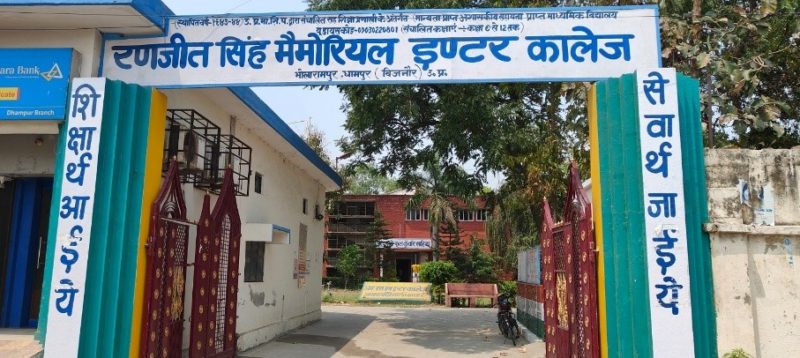
The aristocratic and industrialist families have played an important role in empowering the educational potential of Dhampur. It began with the vision of Rani Phool Kunwari Sahiba, who in 1943 laid the foundation by establishing the Ranjeet Singh Memorial (RSM) Inter College as a heartfelt tribute to her husband, late Kunwar Ranjeet Singh. The inter college began as a school and progressed to become RSM Degree College in 1958. It offers education at both undergraduate and postgraduate level. At present, RSM Degree College serves approximately 3700 students from Dhampur and nearby villages.  In memory of Rani Phool Kunwari Sahiba, the family later established the Rani Phool Kumari Memorial School in 1974, which is currently managed by her daughter-in-law, Bhaktiji.

Another influential figure Seth Kirori Mal established the K. M. Inter College in 1943. Industrialist Narendra Gupta has also contributed greatly to the town’s educational development. He founded three institutions: Premwati Devi Memorial Mahila Mahavidyalaya (2009), Premwati Devi Memorial Convent School (2012), and Usha Memorial School. He is also involved in the management of Shikhar Shishu Sadan School and Dhampur Mahila Shiksha Sabha Sadan. The founding Goel family of Dhampur Sugar Mill has further supported local education by establishing one of the town’s leading schools, Pushp Niketan School, in 2005.

Source: Google Images

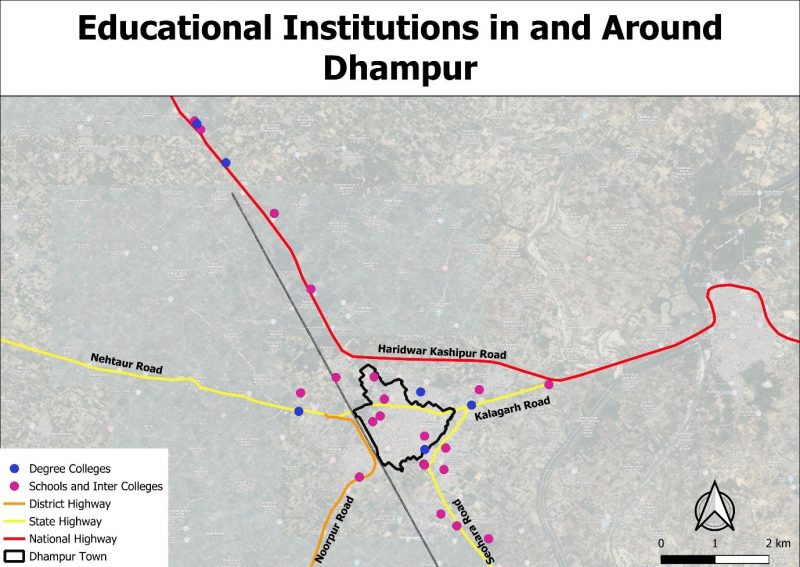
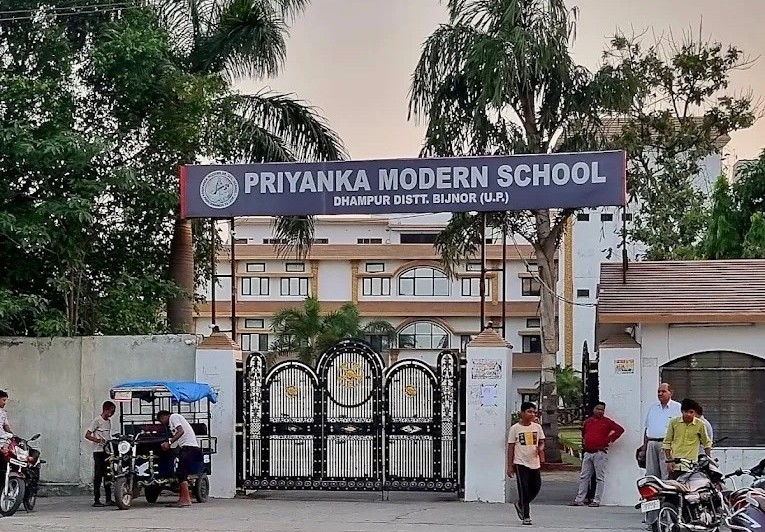
At present, there are around 30 schools and colleges in and around Dhampur. Some of the prominent colleges and schools are RSM Degree College, KM College, Disha Group of Institutions, Dhampur Institute of Technology, Holy Angel Academy Dhampur, Kanya Inter College, Pushp Niketan School, Priyanka Modern School, St.Mary’s Convent Senior Secondary School, Durga Public Senior Secondary School, etc. Colleges offer graduation, post-graduation and PhD courses in social sciences, sciences, technical fields, agriculture, nursing, and law etc. Many of the new schools and colleges have come up in the town’s outskirts along the four highways due to availability of large parcels of land required to establish these institutions. From being a social service supported by the philanthropic elite of the region in the early 20th century, education has emerged as the sunrise service sector considered as a profitable venture by private investors even in a small town like Dhampur.

The presence of such a large number of educational institutions has certainly helped in reaching a higher literacy rate in Dhampur. According to the Census of India 2011, the literacy rate of Uttar Pradesh was about 68 percent, while Dhampur tehsil performed better with a literacy rate of 71 percent in the same year. 

Census 2011 also shows that about 43 percent of the population of Bijnor district is Muslim, which is considerably higher than the national average of about 14 per cent for the same year. Therefore, we considered it important to explore how inclusive the education in Dhampur is along religious and gender lines. We asked this question in three sample schools. There are about 3,500 students in RSM Inter College and about 1,000 students in Durga Public Senior Secondary School. Of the total students enrolled in these two institutions, 67 percent are Hindu and 33 per cent are Muslim. Around 70 percent of the students are boys, and 30 per cent are girls. Whereas in Shikhar Shishu Sadan School the Hindu-Muslim break-up of the students is equal at about 50 per cent. However, these results may have a sample bias as more girls may be going to exclusive girls’ schools. Also, lower muslim students’ enrollment may possibly be because many students may be attending religious schools or Madrasas located in the core city.

Photograph by Pushpa Pathak

The direct impact of good educational facilities in Dhampur can also be seen on the sample nearby villages, too, especially Aladinpur Bhogi where 40 per cent of both men and women have studied in Dhampur or are currently studying there. About 24 per cent study within the village, and the remaining 36 per cent study in nearby villages and towns like Puraini and Nagina, which are around 9 and 14 km away from Aladinpur Bhogi. In Sarakthal Madho, the situation is different where only 19 per cent of both men and women study or have studied in Dhampur. Around 15 per cent study within the village, while 66 percent go to nearby villages, namely Umri and Morna, located at 3.5 km and 4.5 km distance respectively, which have several good educational institutions such as Indra Devi Memorial Girls Degree College and Devta Inter College, along with multiple private schools. This is understandable considering that Dhampur is around 10 km away from Sarakthal Madho. Villagers said that good schools and colleges are now available in these closer areas, so they prefer sending their children there instead of Dhampur. Only a small number of fourteen students from both villages have gone out of the state to study. These students, mostly from prominent families and large farming households, are studying in cities like Delhi, Dehradun, Ghaziabad, Garhwal, Roorkee, and Noida.

Photograph by Shubham Kashyap

The education levels have generally improved across Uttar Pradesh over the past four decades, largely as more schools and colleges have been established and also because of the active state promotion for increasing school enrolment. Results from our longitudinal study, conform to this trend of increased school attendance in the two sample villages. In 1979-80, about 48 per cent of both males and females below the age of 21 years of Aladinpur Bhogi and 50 per cent of male and female below the age of 21 years of Sarakthal Madho were going to school at that period of time. In 2024, in Aladinpur Bhogi 97 per cent males and 81 per cent females below the age of 21 were going to school. In Sarakthal Madho, 90 per cent of both males and females below the age of 21 years were going to school. 

The government has also played a major role in improving education in the state by creating more infrastructure. As per Purna Borah, Chief Development Officer, District Bijnor, informed us that library facilities have been created in 45 of about 1000 government schools and they plan to cover all the schools in due course. They are also planning to set up scientific labs in these schools. Bijnor stands in the top 5 of National Initiative for Proficiency in Reading with Understanding and Numeracy (NIPUN) Bharat Mission Districts. NIPUN Mission launched in July 2021 by India’s Ministry of Education, is a national mission to ensure all children achieve Foundational Literacy and Numeracy (FLN) by the end of Grade 3 by 2026-27. It focuses on improving skills in reading with understanding, writing, and basic numeracy for every child through initiatives like teacher training and developing resources

In the past 7-8 decades, from students going to other towns for their education to students coming from other towns and villages to Dhampur for their education shows how  Dhampur has grown as an important institutional hub offering affordable and accessible education that benefits nearby villages and other towns, improving student enrolment, opportunities, and overall literacy over time. The establishment of schools and colleges as a charitable act by the affluent aristocratic and business families, and subsequently supported by the private sector is the main drive behind a small town like Dhampur becoming an important educational hub in the region.