CPR Faculty Speak: Arkaja Singh

READ THE FULL INTERVIEW
CPR

Arkaja Singh is a Fellow at CPR and a part of the State Capacity Initiative, where she is responsible for developing a new programme of research on state capacity in Indian cities. Her areas of interest include municipal government, informal settlements, land, water and sanitation (and especially the issues around sanitation labour and manual scavenging), and the interface of law and the Indian administrative state. She studied law at the National Law School of India University, Bangalore and has a LL.M. from the School of Oriental and African Studies, London.

In this edition of CPR Faculty Speak, Singh talks about her work and interests at CPR, why they matter, what impact she hopes to achieve and more.

Tell us about your research work and interests at CPR.
My research work is quite diverse, and includes a lot of seemingly different things, but it is tied together by my interest in the Indian state, and particularly in the regional and intra-state dynamics of welfare, governance and reform. At this point, I am involved in a study of the Indian regulatory state, in which I want to know what type of state the Indian regulatory authorities really are from the perspective of their formative histories and the scope of their powers and functions.

Last year, I spent some time looking at the problem of hunger and the delivery of rations and cooked food for migrant workers in the time of the lockdowns as a question of state capacity. My starting point in this inquiry was to find out why governments needed various forms of documentary identification, even to deliver emergency relief. My research led me to see how little room there is for administrative discretion in the design of welfare, and how this comes in the way of governments being able to respond to the particular needs of an unforeseen situation. A framework of rules that allows for sensible use of discretion could potentially lead to better outcomes.

I was also recently involved in some work on water federalism, in which there is an idea that state-level control of water resources is unhelpful to the sustainable management of water. I thought it might be useful to look at the history of environment law-making in India, to see how it is possible to advance policy in new areas within the federal structure. In some of my other work, I have looked at the interface of law, technology and sanitation, and the ways in which the failure of law to respond to technology contributes to the persistence of manual scavenging. I also have a long-standing and abiding interest in the legal and policy frameworks of urban governance, municipal services, and informal land and settlements.

Why does these issues interest you?
I am interested in the political economy of the Indian state, but at the same time I also interested in the arcane and subject-specific detail of policy, law and administration. I studied law, and my legal education influences how I think of the problems of the Indian state. I like for my work to be of practical value, and for this it is important to get into the detail of things. But I don’t think making better law or policy can ever be a purely technical exercise. It is important to be able to think critically about the state and about state power.

How has this issue evolved in the country and globally over the years?
I started my professional life in the period after liberalisation, when a lot of things were changing in the government. However, there was never any universal consensus around this, and one of the more interesting things about working with the Indian state is how much things are debated, challenged and even radically transformed at every level. In my own work, I have seen a lot of state-level and inter-organisation dynamics at play, and this sometimes creates spaces for more inclusive policy choices that might not have happened otherwise.

However, on the other hand, in this entire period we have been stuck with the idea of minimal government, which translated into recruitment freezing and very low budgets for lower levels of government. And with the notion that computers and technology can take the place of human decision-making. I am not advocating that we remain stuck in a time warp, but human beings and organisations matter. I will give you an example from sanitation, where the solution offered for unsafe waste disposal is improved policy declarations and geospatial tracking systems, but with a vague idea that the market will take care of the actual solution. The policy discourse is still quite unwilling to deal with the public nature of the problem, or to fully articulate the role of the state in dealing with this problem.

What impact do you aim to achieve through your research?
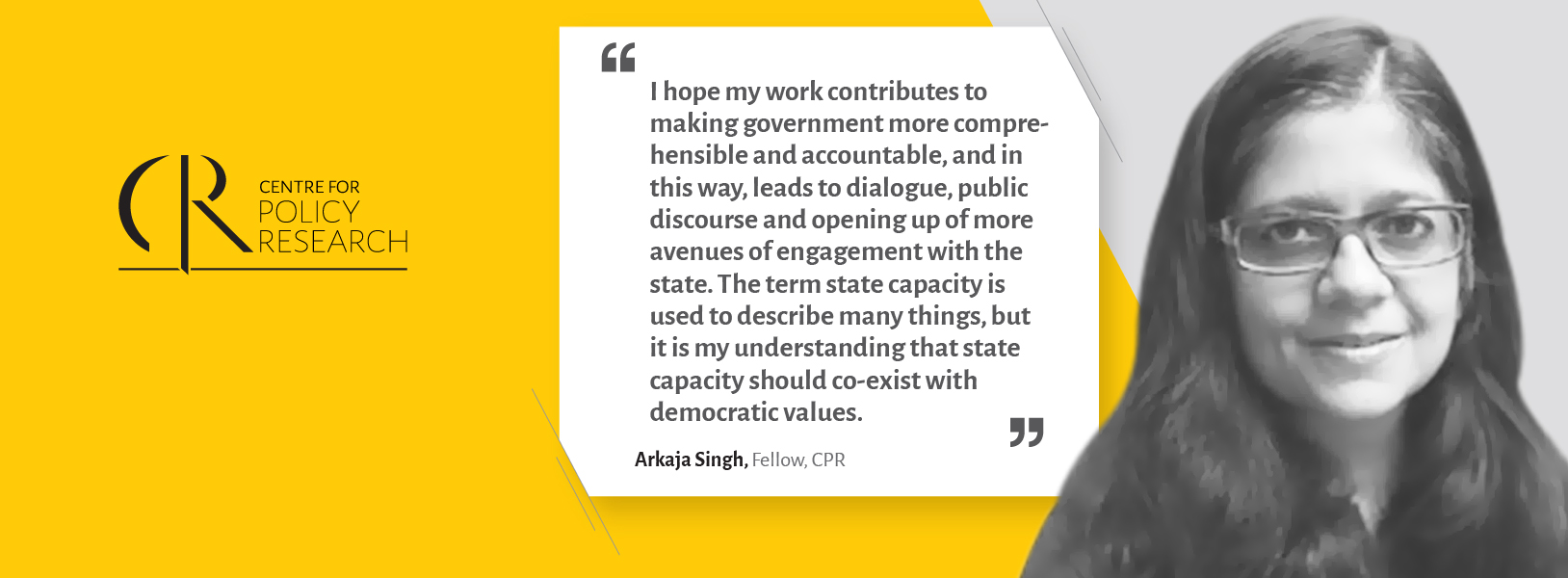
I hope my work contributes to making government more comprehensible and accountable, and in this way, leads to dialogue, public discourse and opening up of more avenues of engagement with the state. The term state capacity is used to describe many things, but it is my understanding that state capacity should co-exist with democratic values.

What does a typical day look like for you at CPR?
In the time before COVID-19, the State Capacity Initiative was newly formed, and we spent a lot of time formulating our programme of work and thinking about our projects. We were lucky to have had that time to work together in meeting rooms, because although we have developed a sense of community and shared workspace in our Zoom meetings, I miss having intense face-to-face discussions about things we all cared about. The pandemic laid to waste our carefully made research plans, but we were lucky in being able to pick up and modify some of what we had developed to suit the vastly changed circumstances.

Now, in COVID-times we still meet every week, and we might have a few more sub-project meetings through the week, but it is of course all virtual. This helps us keep in touch with what everyone is doing, and provides an opportunity for some free-flowing discussion about what we’ve been thinking and doing in the past week. We also have a few text message exchanges and unplanned phone calls in the course of the week. My working day mostly includes reading and writing and some emails. I might also attend or participate in webinars and online meetings. But my days are uneven, I respond well to deadlines and get much more done when I have tight external deadlines than when I don’t. This is even more so in the world of work-from-home.

To know more about Arkaja Singh’s work and research, click here.

CPR retains spot as leading India climate think tank for third year in a row

CPR RANKED 3RD IN THE REST OF THE WORLD CATEGORY, AND 15TH GLOBALLY
CLIMATE RESEARCH CPR

We are pleased to announce that the Centre for Policy Research has been ranked highest in India, 3rd in the Rest of the World category (non-US/Europe), and 15th globally by the International Centre for Climate Governance (ICCG) in its standardized global climate think tank ranking for 2016.

CPR’s ranking is based on the output of the 19 researchers at CPR working only on environment and climate related areas under the Environmental Law and Governance focus area, which includes the Initiative on Climate, Energy and Environment, among our total staff of about 100. In the absolute ranking, which is not adjusted for size of the environment/climate-related team, we are the second highest rated Indian think tank, and in the top 50 (33rd) globally.

The ICCG produces a ‘standardized’ ranking of climate think tanks every year, adjusted for the number of researchers. They also produce an ‘absolute’ ranking, which ranks think tanks independent of size. In both rankings, ICCG uses 15 indicators organized around three categories: Activities, Publications and Dissemination. For the full rankings, see ICCG ranking.

We are pleased to receive this high ranking, which recognizes the quality of the work done by our relatively small team. At the same time, we recognize any such ranking effort necessarily has to simplify a complex research and policy landscape to arrive at quantitative scores. This involves methodological issues, such as how to draw boundaries around environment/climate work, and substantive issues, such as providing equal emphasis to both national and international work, and mitigation and adaptation. The challenges of developing a ranking system that accounts for all these complexities should be kept in mind when reading ranking results.

We wish to acknowledge and thank our funders, partners at think tanks and academic institutions, and interlocutors in government, private sector and civil society who have enriched our work.

A full range of our work can be accessed here.

CPR ranked highest in India in the 2014 ICCG climate think tank rankings

CPR ranked highest in India in the 2014 ICCG climate think tank rankings
RANKED 14TH GLOBALLY
CLIMATE RESEARCH

We are pleased to let you know that the Centre for Policy Research has been ranked highest in India, highest among developing country think tanks, and 14th globally by the International Centre for Climate Governance (ICCG) in its standardized global climate think tank ranking for 2014.

The ICCG produces a ‘standardized’ ranking of climate think tanks every year, adjusted for the number of researchers. They also produce an ‘absolute’ ranking, which ranks think tanks independent of size. In both rankings, ICCG uses 15 indicators organized around three categories: Activities, Publications and Dissemination. For the full rankings click ICCG ranking.

CPR’s ranking of 14th globally, and highest among developing country think tanks in the standardized ranking, is based on the output of the 11 researchers at CPR working only on environment and climate related areas among our total staff of about 100. In the absolute ranking, which is not adjusted for size of the environment/climate-related team, we are the second highest rated Indian think tank and in the top 100 (74th) globally.

We are pleased to receive this high ranking, which recognizes the quality of the work done by our relatively small team. At the same time, we recognize any such ranking effort necessarily has to simplify a complex research and policy landscape to arrive at quantitative scores. This involves methodological issues, such as how to draw boundaries around environment/climate work, and substantive issues, such as providing equal emphasis to both national and international work, and mitigation and adaptation. The challenges of developing a ranking system that accounts for all these complexities should be kept in mind when reading ranking results.

We wish to acknowledge and thank our funders, partners at think tanks and academic institutions, and interlocutors in government, private sector and civil society who have enriched our work.

Navroz K Dubash
Coordinator, CPR Climate Initiative

CPR Faculty Speak: Mukta Naik

READ THE FULL INTERVIEW
CPR

Mukta Naik, a Fellow at CPR, is an architect and urban planner. Her research interests include housing and urban poverty, urban informality, and internal migration, as well as urban transformations in small cities. She has written widely in the print and digital media and has also run a market research and media services company. As trustee for a Gurugram-based NGO and a Board Member for a Netherlands-based Foundation, she is also deeply involved with community-based initiatives. Naik is a graduate of the School of Planning and Architecture, where she is also a visiting faculty member. She has a master’s degree in urban and regional planning from Texas A&M University.

In this edition of CPR Faculty Speak, Naik talks about her work and interests at CPR, why they matter, what impact she hopes to achieve and more.

Tell us about your research work and interests at CPR.

At CPR, I work broadly on thematic areas that lie at the intersection of urban governance and migration studies. A key strand of my work in this is housing, specifically forms of rental housing that accommodate migrant workers in Indian cities but also broader explorations of the links between housing informality, urban livelihoods and quality of life especially for the urban poor. A second strand examines the role of small cities in migration pathways, which links with CPR’s longstanding work on subaltern urbanisation. A third emerging strand of my work investigates how social protection and services are organised in urban areas, cross-linking with the work of the Accountability Initiative at CPR.

Why do these issues interest you?

I come from a background in urban planning and before joining CPR, my practice comprised strategies to improve habitat in informal settlements. I developed a deep interest in how low-income communities, especially rural migrants, inhabit the urban space; what their experiences of livelihood, employment, access to services and housing are; and how they interact and negotiate within their social contexts in order to achieve social mobility.

This specific intersection of migration and urbanisation is exciting because place-based governance structures have not really thought about how to deal with mobile populations, even though this seems like a fundamental need for a large, diverse country like ours with such an uneven economic geography and consequently, uneven distribution of employment opportunities.

How have these issues evolved in the country and globally over the years?

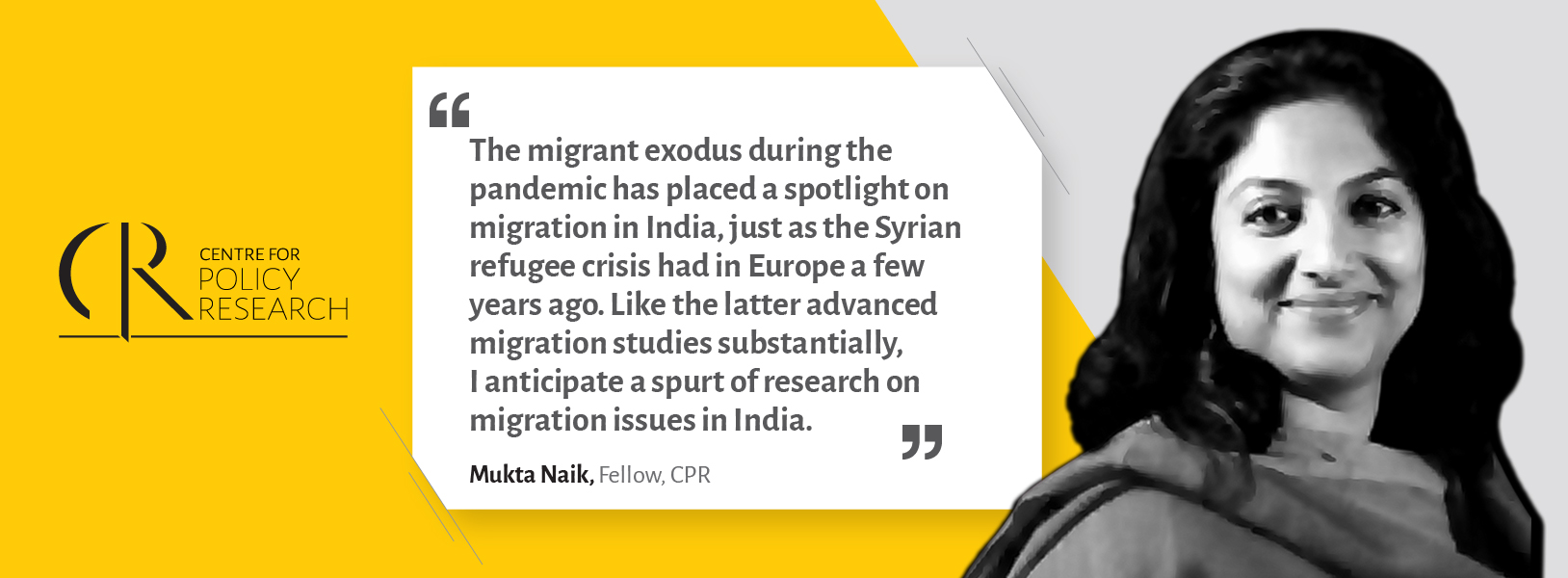
The exodus of migrant workers out of cities back to home villages during the pandemic has placed a spotlight on migration in India, just as the Syrian refugee crisis had in Europe a few years ago. Like the latter advanced migration studies substantially, I anticipate a spurt of research on migration issues in India.

What impact do you aim to achieve through your research?

In this, I hope to contribute to developing theoretical and policy frameworks around migration governance, which are deeply linked to processes of economic growth, structural transformation, urbanisation and social change in India.

What does a typical day look like for you at CPR?

A typical workday would have 2-3 meetings, a mix of internal brainstorming sessions with other team members and interactions with funders and collaborators. It might also have a component of research, like a physical field visit. Sadly, in current COVID-19 times, these have been reduced to a phone or online interactions. The rest of the time would be spent answering emails and if I’m lucky, getting in a couple of hours of writing.

What are you currently working on and why is it important?

I am currently leading a UNICEF-funded research project examining social protection and services for migrant women and children in five states, with a view to examining pre- and post-COVID-19 policy responses. The diversity, rationale and effectiveness of these responses is expected to offer insights into future policymaking in the migration context.

Parallelly, we are producing and curating a range of outputs on housing on a dedicated website called the India Housing Report, and will bring out a report by the same name in the summer of 2021. The report focuses on interlinkages between housing and health, infostructure, planning, finance, society, livelihoods and more. In drawing these links, it seeks to re-orient housing policy away from merely delivering houses to building resilient urban communities.

To know more about Mukta Naik’s work and research, click here.

CPR Faculty Speak: Manju Menon

READ THE FULL INTERVIEW
CPR

Manju Menon is a Senior Fellow at CPR, where she undertakes research, writing, and community projects on environmental justice and the politics of resource rights. She has engaged with India’s environmental laws and policies for over two decades. She holds a PhD from the University of Technology, Sydney and a Masters degree from the Tata Institute of Social Sciences. She was awarded the Nehru-Fulbright fellowship in 2011. She is a member of the UTS Climate Justice Research Centre and Kalpavriksh, an environmental research group.

In this edition of CPR Faculty Speak, Menon talks about her work and interests at CPR, why they matter, what impact she hopes to achieve, and more.

Tell us about your research work and interests at CPR.
I coordinate several research projects under the broad thematic area of Infrastructures and Ecologies. The main aim of this research cluster is to advance multidisciplinary and applied research on the political ecology of large infrastructure projects. I pay attention to the intersections of mega infrastructure development, natural resources, legal governance and accountability frameworks. My research has focused on development in ecologically sensitive geographies such as mountain ecosystems and the coasts as well as the role of environmental regulation in urban infrastructure projects.

I joined CPR in 2011 to start the Environmental Justice Program in collaboration with Namati. This program focuses on the gap between the conditional environmental approvals given to industries and their compliance with these conditions. Our research tries to address this huge gap within the institutional system through a mechanism of community learning, government engagement and by seeking remedies through processes that involve affected people and local government bodies.

Why do these issues interest you?
These research projects highlight the fallout of the economic growth and environmental accountability models set in the 1990s or earlier. That was when environmental sustainability and inclusive growth discourses started to gain traction in projects, policies or government decisions. But these discourses mean different things to the various actors that every large project brings together and they result in very different outcomes when they land on the ground. I am interested in seeing how these different meanings and definitions may (or may not) be reconciled and who will make this effort if our existing institutions are not up to the difficult task. Without forums and meeting points for dialogue and understanding, the environmental and economic outcomes are left to intractable contests.

How have these issue evolved in the country and globally over the years?
I’m afraid that we are not making gains in the sustainability aspects of governance. The reforms of the 1990s promised that economic growth would take care of both social justice and environmental improvements. But that has simply not happened because of institutional failures to regulate and redistribute the cost-benefits of projects towards improving the commons, whether it is natural resources, public institutions or welfare schemes.

There has been a lot of backsliding over the past fifteen years on social and environmental rights and this space is occupied by hyper technical mechanisms to solve the climate and environmental crises. This situation is not unique to India alone, it is a global phenomenon. Global capital has a disproportionate influence on governance institutions at all levels. As the world of capital works itself out one crisis after another, the social life of the planet is implicated in these processes.

The overall scenario looks quite disheartening because democratic institutions globally are struggling to cope with the demands of capital and the effects of climate change.

What impact do you aim to achieve through your research?
Our projects help us think about practical and experimental approaches to the governance of socio-ecologies. There is a lot of new conceptual thinking on this topic but much of it remains in academic and policy forums. Similarly, social and environmental movements are also thinking and discussing these issues in more inclusive and intersectional ways. My aim is to make our research projects a forum where these new ideas can be piloted and tested. Our teams of field-based and policy researchers work together to achieve this goal.

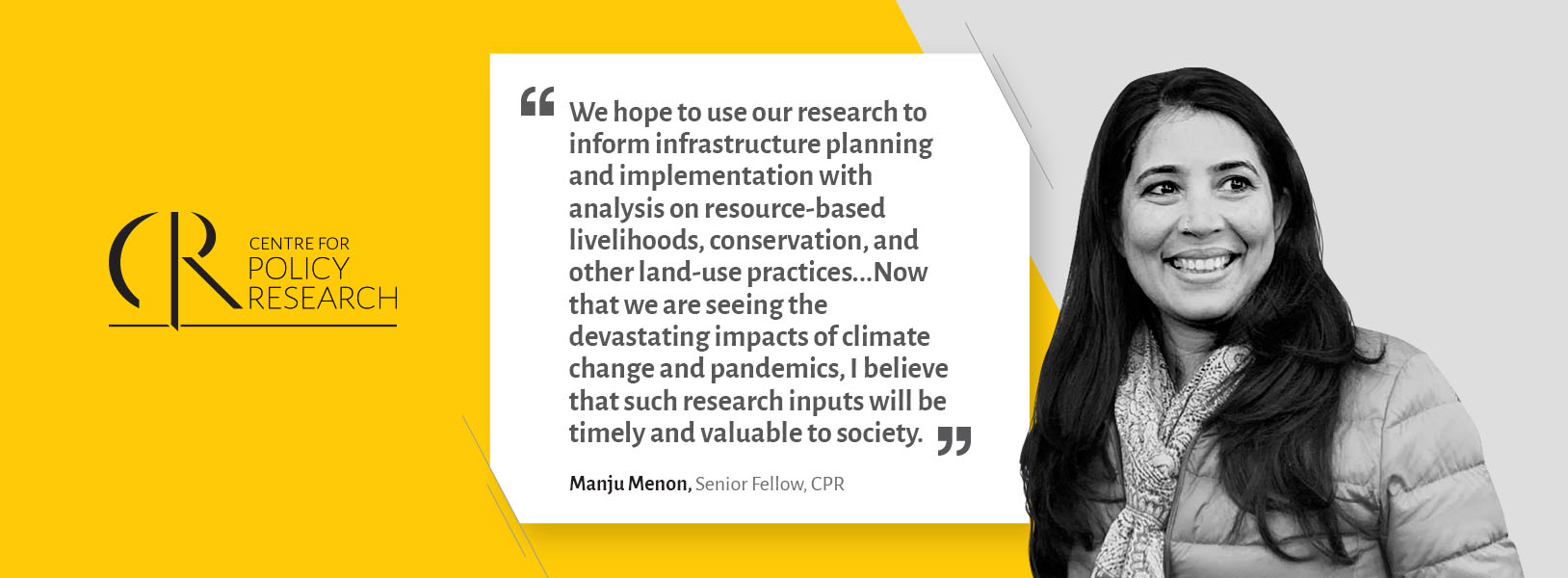
We hope to use our research to inform infrastructure planning and implementation with analysis on resource-based livelihoods, conservation, and other land-use practices. These aspects are usually assumed as easy to accommodate, but there are enough examples to show that it is easier said than done. Now that we are seeing the devastating impacts of climate change and pandemics, I believe that such research inputs will be timely and valuable to society.

What does a typical day look like for you at CPR?
These days, it is all about being virtually in touch with our community partners, government offices and field researchers in different places. As the COVID-19 pandemic spread in India, this has been very hard to do with many of the places we used to work in. The lockdown last year disrupted several ongoing monitoring exercises and remediation processes.

A typical day involves research activities like data collection, literature review and analysis. Our work involves reading a lot of government documents on projects and policies. Since we produce a lot of materials in the form of academic papers, articles, training manuals, case studies and policy reports, a lot of time is spent in individual or group writing sessions. We also spend time in research meetings and discussions with colleagues within and outside CPR. Finally, this work is possible because of organisational administration and support which is why we spend quality time on planning, administering our projects and managing collaborations well so that work can be done smoothly.

What are you currently working on and why is it important?
I am currently researching a terrible case of evictions of a large informal migrant workers housing basti at the border of Delhi and Haryana. The basti is being demolished because it is on municipal corporation land that is categorised as forest land. The demolitions have been on for nearly a month now in the middle of the monsoon and a pandemic. It is one of the worst evictions I have seen. This example shows how the urban poor are made to pay the costs of massive environmental and urban planning disasters.

My colleagues at CPR are presently engaged in the Masterplan process for Delhi. Their contribution is very important because if the planning agencies do things right at the planning stage itself, such cases could be avoided.

To know more about Manju Menon’s work and research, click here.

CPR Faculty Speak: Avani Kapur


READ THE FULL INTERVIEW
CPR

Avani Kapur is a Fellow and Director at the Accountability Initiative (AI) at CPR. The focus of her work has been in building evidence for policy advocacy to strengthen transparency and accountability in public financial management for service delivery. As part of her work, she leads research studies on health, sanitation, nutrition and education financing and has also been anchoring the publication of the annual Budget Brief series and implementation of fund tracking surveys on key social sector schemes. She has an MSc in Development Studies from the London School of Economics, UK and a BA cum laude from Smith College, Massachusetts, USA.

In this edition of CPR Faculty Speak, Kapur talks about her work and interests at CPR, why they matter, what impact she hopes to achieve and more.

Tell us about your research work and interests at CPR.

I lead a research group within CPR known as Accountability Initiative which works on enabling responsive governance. As the name suggests, we believe that for public welfare services such as health, education, nutrition, sanitation, social safety nets etc. to work well, one needs a strong, transparent governance system that is responsive to citizen needs.

Over the last 13 years, we have been trying to align citizens, service providers and decision-makers in this area using a combination of research, dialogue and experiential learning programmes. For instance, through our research work, we identify and analyse the reasons that work against efficient public services delivery in India. We then provide the evidence to policymakers, development practitioners, academics and the media. We work on building capabilities of both government and citizen groups to engage with each other and on increasing citizen engagement in policymaking and implementation.

My personal research interests are in understanding the design and implementation of India’s welfare system from the lens of public finance.

Why do these issues interest you?

For AI, it comes from an understanding that a mature environment for accountability requires two things to co-exist. From the government side, you need institutions to be designed well and in a manner that allows spaces for them to be held accountable and responsive. At the same time, you also need citizens to understand how the government system works better. It’s only if they have the information capacity and can navigate the governance system, that citizens are able to effectively draw on platforms for engagement.

My personal interest is in public finance, and it’s amazing how much information can be revealed by just following the money! Who makes expenditure decisions and how are they made? What do people prioritise and why? How are budgets for interventions designed and how and when do funds flow? The most interesting is the centre-state dynamic in this. Sometimes, one feels like a fiscal detective – trying to use fiscal forensics to understand the state, the people and the processes that make it work.

How have these issues evolved in the country and globally over the years?

Accountability as a concept used to be in vogue in the early 2000s. There was the Right To Information (RTI) movement, in 2006 MGNREGS came through civil society mobilisation, and social audits gained prominence. There were several studies trying to understand the accountability mechanisms that were in place, including at invited spaces such as School Management Committees, Institutionalised Social Audit Units, citizen report cards, performance budgeting, etc.

Unfortunately, over the years, the word has acquired negative connotations – as a fault finding mission or often, as just trying to find corruption. Consequently, one has mistaken accounting for accountability. Instead of asking what’s constraining the government to do their job well, the thrust, even internally across government hierarchies, was on creating checklists, rules and regulations or asking for reports and accounts (like hisaab). This automatically constrains autonomy and doesn’t allow for innovation or accountability. It’s clearly visible in the dynamics of centre and state or state and local government, or even the public finance management and data systems that are designed.

Going forward it’s going to be important to again change the narrative towards one of accountability for outcomes rather than the inputs that go into achieving that outcome. I am hopeful. Recently, there has been a recognition that citizens need to understand the constraints a state faces and the state, in turn, requires a vibrant civil society. While the language may no longer be of accountability, there is a consensus that there is a need for greater trust-building and dialogue on both sides.

What impact do you aim to achieve through your research?

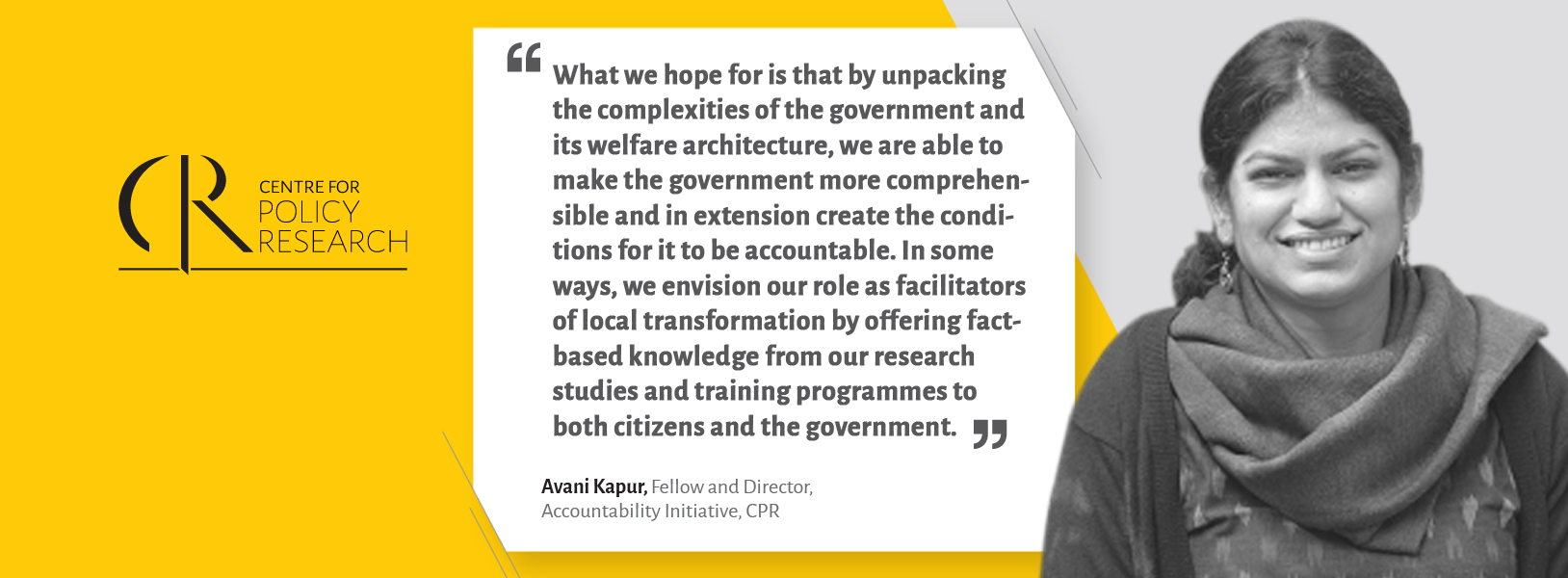
What we hope for is that by unpacking the complexities of the government and its welfare architecture, we are able to make the government more comprehensible and in extension create the conditions for it to be accountable. In some ways, we envision our role as facilitators of local transformation by offering fact-based knowledge from our research studies and training programmes to both citizens and the government. This, we hope, will not only develop a deeper understanding of the Indian state but increase dialogue and public discourse leading to more avenues of engagement.

At a macro level, success for me would be the design and implementation of policies where people are at the front and centre, including the acknowledgement of their needs, incentives, motivations and capacities. At the most basic level, I hope that our research reaches the right person at the right time so that the government can use it to design solutions.

What does a typical day look like for you at CPR?

Usually chaotic, but rarely dull! We work in six states and so our teams are spread across the country – from Bihar or Maharashtra to Himachal Pradesh, and soon we will have a presence in Meghalaya and Andhra Pradesh too. Moreover, our work is also spread across three streams. The first is research, which includes both primary and secondary research – collecting and collating government data including state budgets. The second is our learning and development work as part of which we run capacity-building programmes. The third is finding creative ways of sharing our learnings and communicating back with the government and citizens.

During the COVID-19 pandemic, when most of our fieldwork and even government meetings were on hold and we were working from home, we focussed a little more on trying to boost morale through learning workshops and coffee chats for the staff. We also continued to capture insights and evidence on policies and priorities, including the likely impact of the pandemic on sectors such as nutrition, education, etc. and also state finances.

In non-pandemic times, it would be similar, but add in a few more brainstorming conversations which are best done face to face over the lunch table, to actually understand the disconnect that happens between the intent of policies and actual on-ground implementation.

For me personally, a typical day includes reviewing AI’s projects and building collaborations and external engagement. If I am lucky, I manage to sneak in some more reflecting and writing time as well.

What are you currently working on and why is it important?

We are just starting some work on health financing. The pandemic has made it even more critical to look more closely at how money for health is allocated and spent, as well as differences across states which led to variations in the ability of states to respond. That spending on public health in India is abysmally low is well established but given that revenues are constrained for states and likely to remain so, understanding how to improve the quality of spending will be key going forward too.

I’ve also been looking more closely at the frontline including local citizen-state engagement during COVID-19. In a recent piece I co-authored, we looked at hundreds of grassroots accounts from citizen journalists and government workers embedded in communities across rural India to identify areas of divergence and synergy in the experiences.

To know more about Avani Kapur’s work and research, click here.

CPR recognised as a leading climate think tank

CPR RANKED 11TH GLOBALLY, AND HIGHEST AMONG DEVELOPING COUNTRIES IN 2015
CLIMATE RESEARCH

We are pleased to let you know that the Centre for Policy Research has been ranked as the leading climate think tank in India, highest among developing country think tanks, and 11th globally by the International Centre for Climate Governance (ICCG) in its standardised global climate think tank ranking for 2015.

The ICCG produces a ‘standardised’ ranking of climate think tanks every year, adjusted for the number of researchers. They also produce an ‘absolute’ ranking, which ranks think tanks independent of size. In both rankings, ICCG uses 15 indicators organised around three categories: Activities, Publications and Dissemination. For details on the rankings for 2015 and methodology used, click here.

CPR’s ranking of 11th globally, and highest among developing country think tanks in the standardised ranking, is based on the output of the 11 researchers at CPR working only on environment and climate related areas among a total staff of about 100. In the absolute ranking, which is not adjusted for size of the environment/climate-related team, CPR is the second highest rated Indian think tank and in the top 100 (34th) globally.

We are pleased to receive this high ranking, which recognises the quality of the work done by our relatively small team. We wish to acknowledge and thank our funders, partners at think tanks and academic institutions, and interlocutors in government, private sector and civil society who have enriched our work.

Navroz K. Dubash
Senior Fellow and Coordinator, Climate Initiative

CPR Election Adda: ‘Modi and Millennials – Who will India’s Young Voter Choose?’

FULL VIDEO OF THE DISCUSSION
ELECTION STUDIES POLITICS

Watch the full video of the third CPR Election Adda discussion on‘Modi and Millennials – Who will India’s Young Voter Choose?’ featuring Snigdha Poonam and Vivan Marwaha, moderated by Rahul Verma.

The 2019 election will see 84 million people vote for the first time. What can we infer about this group’s voting choices? Do they vote along the same issues as their elders or will their aspirations dictate who they choose?

Snigdha Poonam is a journalist with the Hindustan Times and author of Dreamers. Vivan Marwaha is a policy consultant and has a forthcoming book on millennials. Rahul Verma is a Fellow at CPR.

CPR Election Adda: ‘Elections 2019 & the Future of the Indian Party System’

FULL VIDEO OF THE DISCUSSION
ELECTION STUDIES POLITICS

Watch the full video (above) of the fourth CPR Election Adda discussion on ‘Elections 2019 & the Future of the Indian Party System’ featuring Yamini Aiyar and Rahul Verma.

When can an election be declared a ‘wave’? Is the status quo of politics in India a ‘new normal’ or will we see the political landscape evolve further post the 2019 election result. Watch Rahul Verma and Yamini Aiyar debate these issues and many more in the fourth CPR Election Adda.

Yamini Aiyar is the President and Chief Executive at CPR. Rahul Verma is a Fellow at CPR.

CPR Election Adda: ‘Taking Stock: A Mid Poll Evaluation of the 2019 Elections’

FULL VIDEO OF THE DISCUSSION
POLITICS ELECTION STUDIES

Watch the full video (above) of the fifth CPR Election Adda discussion on ‘Taking Stock: A Mid Poll Evaluation of the 2019 Elections’, featuring Surjit Bhalla, Sunetra Choudhury, Dhananjai Joshi, Philip K Oldenburg and moderated by Rahul Verma.

It has been a long campaign, political parties and their leaders have spent tremendous energies so far to win the confidence of Indian voters and form the next government in Delhi. More than three-fourth of India has voted, and it seems we are in the midst of an election, which has undoubtedly been one of the most polarised so far. The discussion reflected on the 2019 election story, the emerging scenarios possible post-May 23, and what the country has gained or lost in this electoral battle.

Surjit Bhalla is a Contributing Editor at The Indian Express, and Consulting Editor at Network 18. Sunetra Choudhury is the National Political Editor at Hindustan Times. Dhananjai Joshi is the Managing Director at Cicero Associates and Consultants Private Limited. Philip K Oldenburg is a Research Scholar at the South Asia Institute, Columbia University. Rahul Verma is a Fellow at CPR.

The question and answer session that followed can be accessed here.