Unpacking the ‘informal’ summit at Wuhan between India and China in April, 2018

CPR FACULTY ANALYSE THE SUMMIT AND THE WAY FORWARD


With growing tensions between India and China, which reached a critically low point with the prolonged military stand-off at Doklam in the summer of 2017, the ‘informal’ summit between Prime Minister Narendra Modi and President Xi Jinping held on 27-28 April, 2018, raised considerable interest. Especially since Jinping invited Modi to his hometown in China in an unprecedented manner. CPR faculty analyse the summit and the way forward in the curated media commentary below.

  • Shyam Saran writes in the Scroll that the summit indicates that ‘Doklam may have triggered a rethink on India-China relations going beyond tactical compulsions.’ According to Saran, even though the summit is a response to ‘growing uncertainty in both the regional geopolitical landscape in Asia and the world’, it is only likely to provide a ‘brief breathing space’ to India, unless India builds up her economic and military abilities rapidly.
  • Zorawar Daulet Singh published a series of articles and appeared in media interviews on the summit. In The Hindu, he writes that the summit is ‘a mutual recognition in both India and China that a posture of hostility has undermined their interests.’ He reiterates this in an interview for The Wire, also unpacking in detail how the geopolitical uncertainty negatively impacted both countries at different levels spurring this course correction, even though it may not mean the end of all hostilities. He also made a television appearance on CGTN America, one of the international language channels run by Chinese state broadcaster, and wrote in Hindi in Live Hindustan.
  • G Parthasarathy writes in The Hindu Business Line that the Wuhan summit has come in the wake of growing international pressures on China, and India must use the opportunity to resolve border issues and secure market access, while continuing to strengthen its military preparedness.

Unpacking the Consequences of Donald Trump’s Multiple Trade Wars

CPR FACULTY ANALYSE THE US TRADE POLICY
INTERNATIONAL POLITICS

In what was seen as the beginning of a trade war, US President, Donald Trump recently imposed tariffs on goods from countries including Canada, Mexico, China and the European Union. The move saw immediate retaliation from US allies, with countries imposing heavy duties on a number of imports from the US. This policy of protectionism reflected Trump’s ‘America First’ agenda, however it derailed trade relations with several allies. CPR faculty analyse this move of the US President in the curated media commentary below.

Brahma Chellaney writes in the ‘Asian Review’ about the risk of alienation India faces as the US imposes punitive sanctions on Iran and Russia, both of which have been ‘long-standing economic and political partners for India’. The challenge for New Delhi is going to be ‘how to balance those interests with its growing strategic partnership with the US, a top trading and defence partner of India’. Chellaney reiterates this in the ‘Times of India’, detailing how India should safeguard its interests by partnering with other key democracies in order to push back with full diplomatic strength. In an interview with ‘Radio Sputnik’ he details the effects of the sanctions imposed on Iran.

Shyam Saran writes in the ‘Hindustan Times’ analysing the trade war between the US and China, detailing how by alienating allies, Trump’s China policy has failed as China gets an opportunity ‘to make common cause with American allies both in Asia and Europe’. He writes in ‘India Today‘ about the tumultuous relationship of the US with China, Korea, Canada and Russia and the implications this has for India, highlighting that ‘spaces have opened up for India to enhance its external position’.

G Parthasarathy writes in ‘The Indian Panorama’ highlighting the destabalising impacts of Trump’s ‘America First’ approach. He further elaborates on this in ‘The New Indian Express’ detailing how the US President has completely turned the foreign policy upside down, from his UK visit where he was critical of Theresa May, to his behaviour at the G7 Summit and his trade policies that have warranted retaliation from allies.

Unpacking the central concepts and guiding principles of the Paris Agreement

TWO NEW BOOK CHAPTERS BY LAVANYA RAJAMANI.
PARIS AGREEMENT CLIMATE RESEARCH

Recently published by the Oxford University Press, The Paris Agreement on Climate Change features two book chapters written by Lavanya Rajamani, including i) Central Concepts in the Paris Agreement and How They Evolved and, ii) Guiding Principles and General Obligation (Article 2.2 and Article 3).

An edited volume of essays, the book provides an analysis of the legal requirements of the Paris Agreement, and clarifies the content of the provisions, placing them in context and elaborating on key issues surrounding the Agreement.

In the first of the two chapters, Rajamani charts the evolution of the central concepts in the Paris Agreement. She and her co-author argue that the Paris Agreement relies on a few key concepts to ensure its acceptability, namely those of ambition of a global effort to reduce the emission of greenhouse gases, differentiation between developed and developing countries, and, the provision of support towards climate change efforts.

These concepts underpinned the four years of negotiations that led up to the Paris Agreement. An examination of these concepts, and how they play out in the text of Agreement, reveals the delicate balance the Agreement manages between a sincere commitment to climate change efforts while remaining sensitive to political, scientific and technical advances, and national circumstances and capabilities.

In the second chapter, Rajamani focuses more specifically on guiding principles of the Agreement articulated in Article 2.2 and Article 3 of the Paris Agreement. These include equity and common but differentiated responsibilities and respective capabilities in light of different national circumstances.

The chapter traces the difficult history of these principles at previous negotiations, and provides insight into the carefully chosen language that has critical significance. It also analyses how these principles have been operationalised across mitigation, adaptation, transparency, and, support.

For more details on the book, please visit the publisher page.

Additionally, Lavanya Rajamani has written extensively on the Paris Agreement for Annuaire Français De Droit International, the Journal of International Environmental Law, and, International and Comparative Law Quarterly, to name a select few. Her co-authored book, International Climate Change Law, published in May this year, discusses the Paris Agreement in depth.

Watch out for her article with Jutta Brunnée on ‘The Legality of Downgrading Nationally Determined Contributions under the Paris Agreement: Lessons from the US Disengagement’, which will be out in the next issue of the Journal of Environmental Law.

More information on her work can be accessed here.

Understanding the Strategies used to address the impacts of Land Use Change

BLOG SERIES BASED ON A CROSS COUNTRY STUDY ACROSS INDIA, INDONESIA AND MYANMAR


People facing/likely to face the negative impacts of land use change may not communicate their grievances immediately. When these impacts are communicated to the project entity or the media or the government and collective action is taken towards addressing the impacts, they become cases of conflicts. The strategies that communities deploy during the course of a conflict could range from a single one-time action for a single remedy to engaging with multiple strategies for one or different remedies.  For instance, an affected community may choose to go to court to seek directions for increasing compensations or addressing pollution harms. Another group of affected people may approach one government agency for addressing water contamination and/or take to the streets to resist additional acquisition of land and/or engage the media to create awareness about the loss of livelihoods. These can take place all at the same time or at different stages of the conflict and the project. Below is a tabular synthesis of key strategies used in the 75 cases of conflicts, as reported in the media, analysed for each of the study countries- India, Indonesia and Myanmar.


* T: Total number of cases in which a particular remedy has been used; S: Used singly; C: Used in combination

The above analysis makes it clear that most often communities deploy multiple strategies. Presented below are examples of how these strategies have been used in the three countries. The examples demonstrate that there are only a few instances when a strategy can be linked with a clear success. Most often they stop short at certain interim outcomes such as an inquiry or an investigation or they start to head towards a specific outcome only to be turned around at a later stage.

Protests

India: The proposed amendments to the new 2013 Land Acquisition Act in December 2014 led to a nationwide farmers’ protest in India. In August 2015, in light of protests and ahead of the Bihar state elections, the government of India held back the proposed amendments and referred the matter to a Joint Parliamentary Committee (JPC).

Myanmar: In Shan State in 2016, 100 farmers from Ye Pu village in Taunggyi planted on 2,000 acres of confiscated land. Between 2010 and 2015, despite the land being confiscated the farmers were allowed to plant on the land on a payment of 10,000 Kyats per acre. In May 2016, the farmers were asked to sign documents transferring the land to the army. These 100 farmers didn’t sign the document and continued planting. The army filed a lawsuit against them for trespassing.

Litigation

Indonesia: Responding to a civil suit, the Bandung administrative court decided in April 2017 that expansion plans for the Cirebon coal-fired power plant in West Java were in violation of the local spatial planning law. The court ordered the project’s environmental license to be revoked.

India: A case against the Parsa East Ketan Besan (PEKB) coal mine was filed before the National Green Tribunal, the special court for environmental cases, and a judgment suspending the forest diversion approval was given. This was challenged by the operating company before the Supreme Court, where the court allowed mining to continue even as the environment ministry was to review its recommendation. The matter has been subjudice since 2014.

Administrative complaints and appeals

Indonesia: In the case of BNJM coalmine in East Barito in Central Kalimantan, the local environment agency on request from communities, collected samples from the river being polluted by the mine refuse. However, this was done after the community of Lalap and Bentont villages had filed multiple complaints with photographs and media reports on the siltation of the river. In this case, strong evidence of the violation of environment laws helped in getting the government to take action.

India: In the case of the proposal to construct the Tadadi port in Uttara Kannada district of Karnataka, local villagers and environmentalists primarily engaged with the District Collector and the regulatory institutions to influence the decision on whether the port should be granted approval. Although the environment ministry’s expert committee recommended approval in December 2016, the project had not been issued a formal clearance letter and has not initiated construction activity.

International Redress

Myanmar: Thilawa is one of the few projects from the delta region in which international redress has been tried. The Thilawa Social Development Group (TSDG) contacted the Japan International Cooperation Agency (JICA) seeking rehabilitation and relocation facilities as per its guidelines. In response, JICA increased the compensation and improved facilities at the relocation site. Although the relocation site still falls short on many of JICA’s own prescriptions, the efforts resulted in certain corrections.

Indonesia: An example of seeking international redress is the case of Batang Thermal Power Plant. In December 2016, the community approached the Japan Bank for International Cooperation (JBIC), the key financer with a petition against the plant. In response, the JBIC visited the site and met with the community but claimed that there was no evidence supporting people’s complaints.

Media campaigns/reporting

Indonesia: Media reporting has always been seen in combination with more than one strategy. Because of constant media scrutiny of Batang Thermal Power Plant and Jakarta Bay Reclamation Project along with the protests against the two, the work on the projects has been slow.

India: This has been an important strategy for affected people, especially when they are working with national and international NGOs and researchers. Two prominent examples of this are visible in the strategies used to address conflicts in the Vedanta bauxite mine in Niyamgiri, Odisha and the actions against setting up of the coal mine in Mahan, Madhya Pradesh. Local struggles were supported by national and international media reporting and public campaigns seeking support against setting up of these projects.

Myanmar: Both the local and international media have kept the issue of land confiscations alive. Big cases such as the Letpadaung mine and Myitsone dam and campaigns against the thermal power projects have been on the radar of the media. Media has been key in influencing certain court cases as well.

While these are only a few strategies, affected communities combine these with several other strategies. Political advocacy, participation in administrative procedure such as public hearings, approaching the project owner, are other ways to seek redress. The study, Understanding Land Conversion, Social Impacts and Legal Remedies in Asia, through the country reports, provides an extensive account of how and when each of the strategies has been used. Through the case studies it tries to explore the question of why certain strategies are chosen and how factors such as stage of the conflict, desired remedies, communities’ capacity and agency and political and policy developments influence this choice.

This is the second blog based on the study carried out by the CPR-Namati Environmental Justice Program, and supported by a grant from IDRC, Canada.

The other pieces in the series can be accessed below:

Understanding Out of School Children (OOSC) in India: the Numbers and Causes

NEW WORKING PAPER CO-AUTHORED BY KIRAN BHATTY


The number for out-of-school children [OOSC] put out by various official sources in India, show wide variations. The Ministry of Human Resource Development (MHRD) survey (IMRB-SRI, 2014) estimate of this figure is 6 million, while for the same year, the National Sample Survey (NSS) figure is 20 million.

Each figure is based on an estimate of ‘never enrolled’ and ‘dropped out’ children. A closer look reveals that problems exist not just in the definitions, especially of drop out used by each source, but also in the methods of estimating ‘never enrolled’ as well as ‘dropped out’ children. In addition, discrepancies and inefficiencies in the overall system of collecting and collating data compound the problems.

This study by Senior Fellow Kiran Bhatty attempts to address these issues through developing a more direct approach to calculating ‘never enrolled’ children based on a child census, as well as identifying OOSC using a broader understanding of absenteeism or ‘dropped out’ children based on irregular attendance.

It also analyses the links between attendance and socioeconomic and school factors. In doing so, it fills an important gap in the literature by questioning the definition/understanding of an ‘out-of-school’ child, as well as by using methodologies not employed before to estimate children not enrolled in school and to track attendance of those enrolled over an academic year.

The findings of the paper are divided into two sections – the first section describes the survey findings and estimates of OOSC and attendance patterns of students and teachers; while the second section provides an analysis of the links between child attendance and various household and school level factors.

The full working paper can be accessed here.

Understanding Subaltern Urbanisation in India and its Impact

A SERIES OF INTERPRETATIONS DRAWING ON A NEW BOOK ON SMALL TOWNS


Context

This first piece introduces a series on Subaltern Urbanisation in India that aims at understanding the dynamics of small towns, their place and role in the Indian urban transition process. It summarises the origins, the rationale and the methodology of a collective research project that involved a team of around 25 researchers, including the urbanisation team at CPR. The series will detail some of the results produced in a recently published edited volume, point towards future directions for research, and open up debates on public policy.

The background of this project is located both in empirical and theoretical concerns. One out of 10 urban dwellers in the world lives in India and small towns (less than 100,000 population) account for 90% of Indian cities and over 40% of the urban Indian population. Therefore understanding India is necessary to understanding global urbanisation, and understanding Indian urbanisation requires an all-round view beyond the overwhelming attention given to metropolitan and large cities. There is therefore a need to return to a more complete idea of the urban and this includes the study of the dynamics of small towns.

Defining subaltern urbanisation

Coining the term Subaltern Urbanisation can be seen as polemical but it seeks to embody two important strands that shape a common thinking around the potential role of small towns.

  • First, it attempts to make small places intelligible in contrast to their current level of invisibility in India and at the international level;
  • Second, it tries to think of small towns as sites endowed with some level of autonomy and agency while the dominant paradigm, in particular in the New Economic Geography school of thought, sees small urban spaces as dependent on large metropolitan economies.

Methodology

From a methodological point of view, the project was launched by a collective formed around 2009 assembling researchers from different disciplines, in order to engage in a multidisciplinary dialogue combining both GIS (Geographic Information Systems), quantitative data and qualitative methodologies. Nevertheless, this mixed method approach has not only been used to capture diversity and multiscale analysis but also in order to understand small towns as abstracts entities. It goes deep into capturing the varied types of interactions that produce the diversity of these urban environments.

Redefining urban, its scope, and the urban transition process

The point of departure of this research and its content was to interrogate anew the definition of the urban, the scope of the urban world and the urban transition process itself.

Our research questions were shaped both from theoretical debates and from a prior research project that aimed to refine the UN’s (United Nations) efforts to build comparative data sets to measure urbanisation worldwide. It is grounded in a questioning of the existing restricted representations, measures and explanatory models of urban expansion.

For India, this data base enabled us to build data at the lower urban settlement level. It demonstrated the importance of small settlements, which was confirmed by the 2011 census. It aimed at bringing to the fore issues involved in defining the frontier of the urban and its political dimensions as well as raising the important (and to some extent increasing) role small towns play in the urban transition process. From a more theoretical point of view, our aim was to add to a growing body of work that reclaims the diversity of the urban phenomenon beyond the global metropolitan cities and highlights the range of national and regional trajectories.

Small towns and economic growth

An important aspect of the research was also concerned with the relationship between small towns, the larger employment story and growth. Indeed, small towns have remained an important feature of the Indian urban system. They might or might not account for a large share of the GDP but they represent a large and growing market and they also act as important service centres to the rural population. In a context of limited rural to urban migration, job destruction in the agricultural sector and very limited job creation, our results show how small towns are, inter alia, places of adjustment where people cope with poverty, uncertainty through the mobilisation of their kinship networks and family resources. This result, in particular, is confirmed by additional work carried out in Bihar and funded by the World Bank, which will be elaborated upon in a forthcoming podcast.

We have also been interested in the nature of economic activities that range from traditional activities (such as the collection of Tendu leaves in Abu Road in Rajasthan), to natural resource extraction (such as coal mining in Barjora, in West Bengal), manufacturing, services and trade; as well as real estate and the private and education institutions (in Tamil Nadu and Haryana in particular). Ethnographies of a variety of sites located in different States confirm the role of favourable land prices and regulation and cheap labour for the development of small towns. However, they also document how innovations and entrepreneurship are based on an ability to tap local resources and adapt to a very rapidly changing market condition, that include exploring international markets (such as the furniture industry in Kartarpur or drilling rig assembly industry in Tiruchengode).

The social dimensions of small towns’ economies

To answer this question, the project has also been concerned with understanding the kind of capital (human, land, social networks, etc.) that actors mobilise. It has observed small towns as sites of social changes and not looked at these spaces as frozen in time or as places of entrenchment of parochial societies. On the contrary, many case studies underscore the dynamism and the innovation taking place in some of these small towns, an innovation based on the harnessing of transnational networks (as in the case of the fishing industry in Udipi, in Karnataka), or the embeddedness of symbolic and religious dimensions in handling land and financial capital (as seen in the temple towns of Tamil Nadu). These interrelated dimensions are inscribed in a field of social relations, or historically trade relations. In other words, by paying attention to the multiplicity of interactions and the multiscale shape of networks, this project attempts to reclaim an embedded view of economic and social changes.

Small towns, governance and the politics of classification

Another research theme has dealt with the questions of governance and the politics of urban classification, as to whether it is important or not to have an urban status. This question is particularly acute for Census Towns that are classified as urban by the Census of India but remain rural settlements in terms of governance. Beyond analysing the linked benefits and costs of an urban status, the focus on the governance issue is critical to engage with public policies regarding cities and urban development.

The questions that the Subaltern Urbanisation book has raised and some of the answers it has provided is not only relevant for India but for other global contexts as well. By giving flesh and emphasising the diversity of urban processes, it can open up or contribute to a dialogue with other countries and continents for instance China, Asia and Latin America where the process of in-situ urbanisation is discussed, or even with Europe where interest in the place and the role of small towns has been renewed.

The next piece will discuss the nature and the extent of urbanisation in India and its evolution based on Census data analysis.

This piece has been authored by Marie-Hélène Zérah.

The other piece in the series can be accessed below:


Understanding working migrant women’s narratives of ‘mobility’ in Delhi

BOOK CHAPTER CO-AUTHORED BY EESHA KUNDURI
URBAN ECONOMY

Context:
Women’s migration has typically been understood as a relational phenomenon, where women are generally seen to be migrating for marriage or as accompanying family members (according to data from the Census and the National Sample Survey). This has been acknowledged as a key shortcoming in the way macro-data captures women’s migration, owing to the nature of the data which attributesonly a singular reason for migration.

Recent studies, however, have suggested that even if women migrate with families or due to marriage-related reasons, livelihood options at destination are factored into by households as part of their migration decisions.

Therefore, migration in general and women’s migration in particular, is complex and multi-faceted, and there is a growing recognition to unpack the nuances of people’s lived experiences of it. In light of this literature, and in the context of low workforce participation rates for women in Delhi (about 10.7 % as per 2011-12 data from the National Sample Survey), researchers Eesha Kunduri and Sonal Sharma decided to engage more deeply with work-life histories of women migrants. The objective of the research was to provide insights into women’s own assessment of their work in the city, and their hopes and expectations from it, since often these apsects are paid scant attention in meta-narratives of gendered work, occupations and migration.

How was the research conducted?
The research draws upon fieldwork among 40 women workers in informal housing settlements around two industrial estates in Delhi: Patparganj in East Delhi and Wazirpur in North-West Delhi. The qualitative data is complimented by insights from a sample survey of 317 workers: 77 female and 240 male workers.
Key findings:

The women interviewed mostly migrated with their husbands or a male household member, and started working out of the realisation that one member’s earnings were not sufficient to sustain in the city.
Typically, the women’s earnings averaged between 4000 and 5000 rupees a month, about a half of what male workers earn.
Women were found to be relegated to tasks on the lower end of the occupational hierarchy, such as removal of excess thread from clothes, in packing, labelling, etc. and as home-based workers (industrial outworkers) undertaking work such as sewing on the sides of jeans, taping of speaker components, putting threads into bookmarks, etc.
While these are precarious employment scenarios, what was notable was a strong sense of self-perception that women expressed with regard to their work and earnings, and a sense of freedom in city spaces. They commented on the sense of independence that their earnings, howsoever meagre, allowed them to have, including meeting small, everyday expenses by themselves, and in some cases, extending support to their children’s education in the city.
Interpreting the findings:
Kunduri and Sharma argue that women’s strong self-perception is related to the opportunities to be mobile in the city. The women workers in the study looked at the city as a space of freedom, especially when compared to the strict norms that governed their movements back in the village. Particularly, for the upper caste women guided by customs of ‘veiling’ (ghunghat) in the village, being able to step out of their home for work, to go to the market, and so on, was an enabling experience.

Women also reported about being able to enjoy leisure time in the city, which included activities like watching television, and chatting with other women in the neighbourhood. Home-based workers especially were seen to be working together in groups in courtyards or outside of tenement settlements, indicating the opportunities for socialisation.

Such everyday practices, the authors argue, also enabled women to cultivate networks that helped them to cope with the uncertainties of urban living, and also served as entry points for finding work opportunities.

However, it was also seen that localities that were relatively more homogenous in term of residents’ regional origins, caste and community backgrounds often reproducedvillage-alike restrictions on women’s mobility, in comparison to more heterogeneous localities which women found liberating.
An overall analysis suggests that mobility as a concept needs to be understood in its subjective dimensions cutting across social, spatial, economic aspects. The micro-narratives of freedom in the city, in relation to the village, particularly offer critical insights in this regard.

The book, Land, Labour and Livelihoods: Indian Women’s Perspectives, which includes the chapter by the authors, ‘Here, We Are Addicted To Loitering’: Exploring Narratives of Work and Mobility Among Migrant Women in Delhi, can be accessed at the publisher link here.

Union Budget 2017

CURATED ANALYSIS BY CPR FACULTY
BUDGET ECONOMY

As Budget 2017 was announced by the Union government on 1 February, find below a curated analysis by CPR faculty.

Pratap Bhanu Mehta writes in The Indian Express that through this budget the government is trying to steady the ship after the demonetisation shock, explaining how it ‘is an exercise in forward-looking but cautious prudence’.

In an article in Hindustan Times, Rajiv Kumar writes that the budget is what the ‘doctor ordered for the economy’, as it addresses the critical tasks of ‘generating employment, promoting private investment, pushing up consumption, improving delivery of subsidies and public services’. He further writes in The Hindu on how the budget fulfills the three principle goals of reviving domestic investment; generating employment opportunities; and cleansing the economy of black money flows.

Yamini Aiyar writes in Livemint and in a Hindi article in Amar Ujala that the budget has maintained the status quo, as far as social sector schemes are concerned, and has been ‘remarkably silent’ on restructuring the ‘financing architecture for social policy post the 14th Finance Commission’. Avani Kapur reiterates this in another article in Deccan Herald, writing that despite riding high on expectations, Budget 2017 did not offer any major changes in majority of social sector schemes.

Kiran Bhatty writes in The Wire that the ‘attention deficit’ towards education remains unchanged in this year’s budget.

Sanjaya Baru and Rajiv Kumar also debate the budget on CNN News18 and Times Now (above) respectively.

Understanding the Curse of Air Pollution

THE FIRST ARTICLE IN A FOUR-PART SERIES ON INDIA’S AIR POLLUTION IN THE HINDUSTAN TIMES
AIR POLLUTION ENVIRONMENTAL JUSTICE

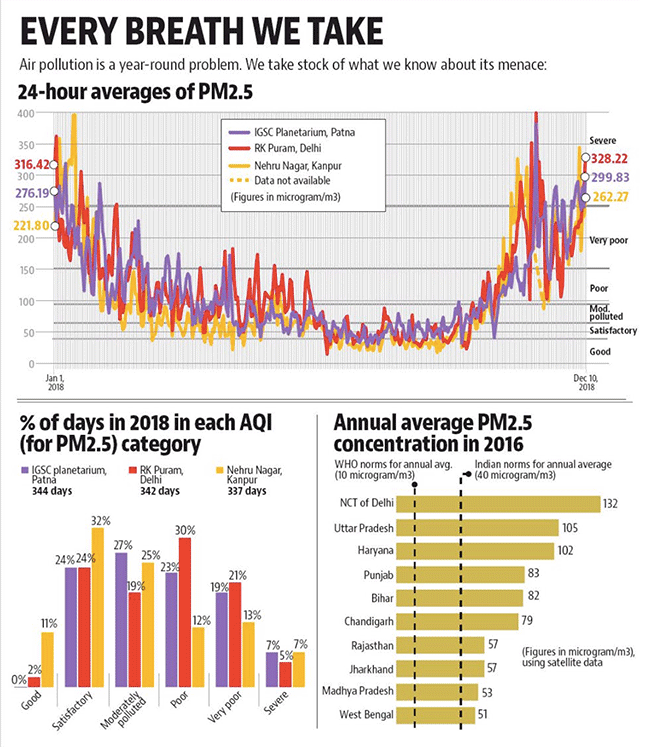
The quality of India’s air needs to be addressed as a pan-India public health emergency. Air pollution was responsible for 12.5% of the total deaths in 2017, as per the most recent iteration of India State Level Burden Assessment. The World Health Organization reports nearly 100,000 deaths in infants to be attributable annually to air pollution in India. But deaths form only a part of the story — there is growing evidence of how it causes illnesses in nearly every organ of our body. It affects the elderly and babies still in their mothers’ wombs – newborns show traces of particulates in their blood stream. It affects all of us.

This article is the first of a four-part series by researchers at the Centre for Policy Research written in collaboration with leading air pollution researchers. We take stock of what we know about air pollution, and what we could do to improve the air quality in India. In this series, we focus on fine particulate matter (or PM2.5), a useful proxy indicator for air pollution. These particles — a complex mixture of solid and liquid particles, originating from different sources and comprising multiple chemical substances — are the most damaging, as they can penetrate the lung barrier and enter the systemic circulation. In this article, we will lay out four foundational facts about when, how much, and where we should worry about air pollution. In short, the answers are: most of the time, a lot, and all over India.

First, air pollution is a near year-round problem, even though we notice pollution much more during periodic spikes especially in winter (see figure). Many parts of India, especially in the Indo-Gangetic belt record poor air quality levels across the year. In 2018 (so far), PM2.5 levels were ‘poor,’ ‘very poor’ or ‘severe’ 56% of the time in Delhi (RK Puram), 49% in Patna and 32% in Kanpur. Conversely, it was ‘good’ for six days in Delhi, one day in Patna and 37 days in Kanpur. While it is understandable that we focus on the visible peaks, adverse health outcomes result primarily to high long-term exposure, not just pollution spikes. To understand the severity of the problem, we have to look at annual average levels of emissions.


Second, annual average emission levels in much of India are multiple times safe levels (see figure). Three quarters of India’s population lives in areas where levels of PM 2.5 exceed the Indian national standard of an annual mean of 40 microgram/m3. These norms themselves are four times the far lower levels recommended by the WHO (see figure). Big western cities such as London, New York City and Paris have air quality nearly at these levels, and make the news when some of their neighbourhoods exceed the WHO norms by a few microgram/m3. Our levels are not just somewhat higher but many multiples higher: 72 of 640 districts in India, primarily in Delhi, UP, Bihar, and Punjab, have annual averages 10 times the WHO levels. Even Beijing, infamous for its air pollution, had PM2.5 levels about half of Delhi’s in 2016. We often hear that India suffers from inadequate data and knowledge of air pollution. While India does indeed need much better data and more sensors – much of the data reported here is from satellite data – this uncertainty should not be a reason for inaction, since new monitors will only tell us what multiple above safe standards we are.

Third, air pollution is not just a city or industrial area problem but a regional problem. Satellite data shows that air pollution levels are especially poor across the entire Indo-Gangetic Belt stretching from Punjab and parts of Rajasthan in the west to Bihar in the east. To an extent, this is a curse of geography. Sandwiched between the Himalayas in the north, and the Vindhyas in the south, this belt becomes a virtual valley where outward dispersion is difficult. Thus, while cities contribute to their own air pollution through traffic, industry, and waste burning, they are also affected by emissions from the broader regional ‘airshed’. As a result, rural areas are frequently also polluted. In addition, emissions from cookstoves using solid fuels not only lead to high levels of indoor air pollution, but also account for an estimated quarter to a third of outdoor pollution. India is dealing with both modern sources of pollution such as industries and vehicles, as well as pollution from traditional practices such as cooking with firewood, and we need to tackle both.

Finally, PM2.5 levels have been growing. Across Punjab, pollution levels nearly doubled between 1998 and 2016. It is sobering that India’s air quality is worse than China’s even while its GDP (PPP) per capita is less than half that of China. Clearly, the environmental quality of India’s growth is not sustainable.

Any serious plan to mitigate air pollution has to be long-term in nature, target multiple sources, operate year-round, and focus on regions rather than cities. In subsequent articles, we describe the impact of air pollution on health, explore the different sources of air pollution and conclude with a reflection on an approach to air pollution across India.

Santosh Harish is a Fellow at the Centre for Policy Research. Navroz K Dubash is a Professor at the Centre for Policy Research. 

This article is the first in a four-part series on India’s air pollution. The original article, which was published in the Hindustan Times on December 19, 2018, can be found here. For more information on CPR’s work on air pollution, visit the Clearing the Air? project page

In this Series:

Understanding the curse of air pollution (1/4)

Public Health in India a Casualty of Air Pollution (2/4)

Delhi Has a Complex Air Pollution Problem (3/4)

Air pollution: India’s waking up, but there’s a long way to go (4/4)

Understanding the Emergence of India’s Census Town: A Policy Research Working Paper

CO-AUTHORED BY PARTHA MUKHOPADHYAY AND MARIE-HÉLÈNE ZÉRAH
URBAN GOVERNANCE

This policy research working paper presents the results of an investigation of selected census towns in northern India. Census towns are settlements that India’s census classifies as urban although they continue to be governed as rural settlements. The 2011 census featured a remarkable increase in the number of census towns, which nearly tripled between 2001 and 2011, from 1,362 to 3,894. This increase contributed to nearly a third (29.5 percent) of the total increase in the urban population during this period.

Only part of this evolution can be attributed to the gradual urbanisation of settlements in the vicinity of larger towns. Instead, the majority of census towns appear as small ‘market towns,’ providing trade and other local services to a growing rural market. The case studies of representative census towns in Bihar, Jharkhand, Orissa, and West Bengal show the role of increased connectivity and growing rural incomes in driving the demand for the small-scale and non-tradable services, which are the main sources of non-farm employment in these settlements.

The case studies also reveal that the trade-offs between urban and rural administrative statuses are actively debated in many of these settlements. Although statistical comparisons do not show a significant impact of urban or rural administrative status on access to basic services, urban status is often favored by the social groups involved in the growing commercial and services sectors, and resisted by the residents still involved in the traditional farming sectors.

The full policy research working paper can be accessed here.