The Indus Waters Treaty and the Climate Crisis It Was Never Built For

The Indus Waters Treaty (IWT) of 1960 survived three wars and decades of political hostility between India and Pakistan. That record of durability, however, should not be mistaken for relevance to today’s environmental needs.  The basin the Treaty governs is warming. Glaciers are retreating at rates unimaginable to its negotiators. Hydrological patterns are shifting. Yet political discourse surrounding the IWT remains focused almost exclusively on sovereignty, security, and legal disputes, while climate change, the most consequential long-term threat to the basin, is consistently treated as secondary.

Climate-Blind by Design 

The Treaty’s limitations on climate are structural, not incidental. At the time of signing, comprehensive studies on glacier mass balance did not exist. The assumption embedded in negotiations was that the Himalayan glaciers feeding the Indus system were broadly stable, and future changes due to climate variability were not factored into the design.  The result is a framework that was built to allocate fixed water shares between two countries, not to manage a river system undergoing environmental transformation. There are no provisions for periodic review, no adaptive mechanisms, and no formal process for incorporating scientific advances into governance.  The Permanent Indus Commission, the Treaty’s primary cooperative body, is a data-exchange and dispute-management mechanism, never designed for the world the Indus Basin is now entering.

What the Climate Record Shows 

The Intergovernmental Panel on Climate Change (IPCC) Sixth Assessment Report (2022)  projects, with high confidence, that by the mid-21st century, the Indus, alongside the Amu Darya and Ganges, will face severe water scarcity challenges as climatic variability acts as a stress multiplier across the basin.  Himalayan glaciers currently supply 60 to 70 per cent of the Indus River’s summer flow and are estimated to be losing eight billion tons of ice annually. The World Meteorological Organization’s (WMO) 2024 State of Global Water Resources confirmed that 2024 was the third consecutive year of record glacier mass loss globally.  Projections indicate a water deficit of up to 50 per cent in both countries’ portions of the basin by 2030.  For Pakistan, which depends on the Indus for approximately 96 per cent of its average annual renewable water resources, the implications are particularly acute.  These are not distant projections. They are documented trends occurring within a governance framework that has no mechanism to respond to them. 

How Geopolitics Displaces Climate 

The pattern is consistent. After the Uri attack in 2016, Indian  Prime Minister Narendra Modi asserted that “blood and water cannot flow together.”   After the 2019 Pulwama attack, India proposed diverting the Indus River. In February 2024, Pakistani media and political figures accused India of “water terrorism” over infrastructure projects on the Ravi River. In each episode, climate governance was either absent or invoked instrumentally within existing political arguments. April 2025 marked the most consequential instance. Following the Pahalgam attack, India placed the Treaty in abeyance and suspended the exchange of hydrological data, including flood warnings, river flow measurements, and glacier melt records, and halted the Permanent Indus Commission’s inspections. Pakistan responded by declaring any diversion of its Treaty-allocated water as an act of war. What was suspended was not merely diplomatic cooperation but the data infrastructure both countries need to manage a basin undergoing accelerating climate change. As WMO Secretary-General Celeste Saulo has observed: “Without data, we risk flying blind.”  In the Indus Basin, that is now the institutional reality. 

A Structural Problem, Not an Isolated One 

The IWT’s climate blindness is not anomalous in South Asia. None of the region’s existing water-sharing arrangements incorporate climate considerations, with the sole exception of a 2023 Bhutan-India flood forecasting scheme. Climate change, however, does not observe bilateral boundaries. Altered monsoon patterns, glacial retreat, and increasing glacial lake outburst floods (GLOFs) affect entire basins regardless of how their waters are divided on paper. The challenge is compounded by the fact that climate-related risks operate at a basin-wide scale, while water governance in South Asia remains predominantly organised through bilateral arrangements. India’s August 2024 modification notice acknowledged climate-related pressures among its rationales, a notable shift from earlier arguments centred on hydroelectric disputes. Whether this signals a genuine reconceptualisation of climate as a governance priority remains unclear. Although climate considerations have entered the discourse surrounding the IWT they have not yet begun to drive it. 

Conclusion 

The IWT’s survival across six decades is a genuine institutional achievement. The question now is whether that durability can be converted into adaptability. The Indus Basin is warming, its glaciers are retreating, and the 1960 framework was not designed for these conditions. The suspension of hydrological data exchange in 2025 has removed the empirical basis on which any climate-responsive governance would depend. As long as climate change is processed through the categories of geopolitical competition rather than shared environmental governance, the Treaty’s defining challenge will remain unaddressed, and the cost will be borne not by the States negotiating over it, but by the hundreds of millions who depend on the river for their livelihoods. 


“Not Dilli, Not Pindi, No Other Country, Bangladesh Comes First”: Is the BNP Now a Prisoner of Its Own Rhetoric?

The historic 30-year Ganga Water Sharing Treaty is set to expire on 12 December 2026. For the last three decades, the Treaty has operated uninterrupted, despite occasional strains in the diplomatic relationship between the two countries.

Unlike the relatively favourable political context of 1996, in which the Treaty was signed–when the Awami League had just returned to power in Bangladesh, and India’s United Front was keen to strengthen ties with Dhaka, giving both sides strong political incentives to resolve the long-standing dispute—the political circumstances surrounding the upcoming negotiations are now fundamentally different, unfolding in a far more polarised climate.

This shift has been driven largely by the political upheaval in Bangladesh following the collapse of Sheikh Hasina’s Awami League (AL) in late 2024 and the Bangladesh Nationalist Party’s (BNP) landslide victory in the February 2026 general elections. The return of the BNP has brought a far more nationalist and confrontational tone to water diplomacy, reflected in the party’s rallying cry during the elections: “Not Dilli, Not Pindi, No Other Country, Bangladesh Comes First.”

The party’s February 2026 election manifesto backed this stance by laying out a foreign policy centred on the principle of “Bangladesh Before All.” It also pledged that the new government would take immediate and effective steps to secure Bangladesh’s fair share of water from major transboundary rivers, particularly the Teesta and the Ganga.This aligns with the party’s history of dodging bilateral cooperation with India, specifically by withholding critical river flow data.

To understand this shift in water diplomacy, one must look at the domestic narrative that brought the BNP back to power. For years, the BNP’s core political strategy was built on a relentless accusation: that Sheikh Hasina’s Awami League was systematically “mortgaging” Bangladesh’s sovereign interests to satisfy its upstream neighbour. While sovereignty has long been a central theme in Bangladeshi political rhetoric, with the two major parties repeatedly accusing each other of compromising or “selling out” the country’s interests to India, the historic, though not unprecedented, collapse of the Awami League completely upended this symmetrical tug-of-war. Because the widespread public sentiment turned so fiercely against Sheikh Hasina, her ousting effectively validated the BNP’s long-standing narrative in the eyes of the public.

This deep-seated domestic friction is rooted in a fundamental ideological battle over who truly protects the legacy of the nation. While the 1971 Liberation War was undeniably a fight for absolute state sovereignty led by the Awami League, the two factions interpret the preservation of that independence in radically different ways. AL’s Bengali nationalism viewed sovereignty through the lens of the 1971 war; freedom from Pakistani military hegemony fought in the name of a Bengali cultural identity that it had always shared with India. Hasina’s regime saw friendly ties with New Delhi as a pillar of regional stability, not a “compromise of independence.” On the other side, BNP’s Bangladeshi nationalism viewed sovereignty through the lens of territoriality, defined by those within the borders, not the cultural affinities that lay beyond them. They argued that by becoming too close, too dependent, and too accommodating to New Delhi, the Awami League was slowly surrendering the very independence won in 1971.

Given that Bangladesh shares 54 rivers with India, disputes like Farakka and Ganga water-sharing
become deeply entangled with broader anxieties over dependence, control, and national sovereignty.
This rhetoric is driven by a zero-sum battle for domestic power, where any international water compromise is instantly weaponised by political rivals as a betrayal of national interests. In such a political climate, a middle-ground treaty becomes entirely unpalatable at home.

Now that the BNP has transitioned from opposition to governance under Prime Minister Tarique Rahman, it must also govern within the political expectations created by its own rhetoric in order to maintain domestic legitimacy. As party leaders have repeatedly declared, Bangladesh is “not seeking mercy from India”—they are demanding their “rightful share.”

If talks hit a wall, the BNP is highly likely to pull out its ultimate weapon: internationalising the dispute. India has always insisted on strict bilateralism, preferring to negotiate one-on-one where it holds natural upstream leverage. But during electoral campaigning, Tarique Rahman warned that if India ignores their demands, Bangladesh will take its water rights claims to international organisations.

This is not empty rhetoric; it is a proven BNP strategy. In 1976, party founder Ziaur Rahman raised the Farakka dispute at both the UN General Assembly and the Non-Aligned Movement (NAM) summit in Colombo. Prime Minister Begum Khaleda Zia also used the same playbook: in her address to the UN’s 50th Anniversary session in 1995, directly accusing India of committing human rights violations through its upstream operations at Farakka, claiming the diversion was pushing millions of Bangladeshis toward poverty and destruction.

Recent developments like the approval of the Padma Barrage project, marketed as an alternative to India’s Farakka “death trap”, and the accession to the UNECE Water Convention show that the BNP is actively trying to build a multi-layered defence to survive its own hardline stance. The UNECE Water Convention accession allows Bangladesh to ground its water claims in internationally recognised legal terms, giving its demands a diplomatic legitimacy that goes beyond what bilateral negotiations alone can offer. Neither move resolves the underlying dispute, but both expand the BNP’s room for manoeuvre without requiring it to publicly soften its position.

By spending years turning every water dispute into a test of national sovereignty, the BNP has raised the domestic price of compromise to a point where no workable deal can be sold as anything other than defeat. Sovereignty rhetoric, once a powerful opposition weapon, has become a governing constraint. That said, they are far from passive prisoners—with enough room to act and shape narratives. The infrastructural investments and legal positioning it has pursued since returning to power represent an attempt to build genuine leverage without publicly softening its stance. The Treaty deadline will not just test Bangladesh’s negotiating position, it will also test whether the BNP can distinguish between the promises that win elections and the terms that keep rivers flowing.


Why are Indian Elections so Unpredictable?

“Data forces you to think, and how you think about elections in India.”

With these words, Professor Pradeep K. Chhibber invited the audience to go beyond the surface-level explanation of what dictates Indian elections and confront a fundamental question: why are elections in India so unpredictable?

That question brought a packed audience to the Indian International Centre (IIC) on July 15, for a discussion on why nearly a quarter of India’s electorate shifts its vote from one election to the next, and what this reveals about the country’s democratic politics. The discussion challenged conventional assumptions about Indian elections, to deep dive into how village-level electoral volatility and the weak political mobilisation of poorer classes create shifting voting patterns.

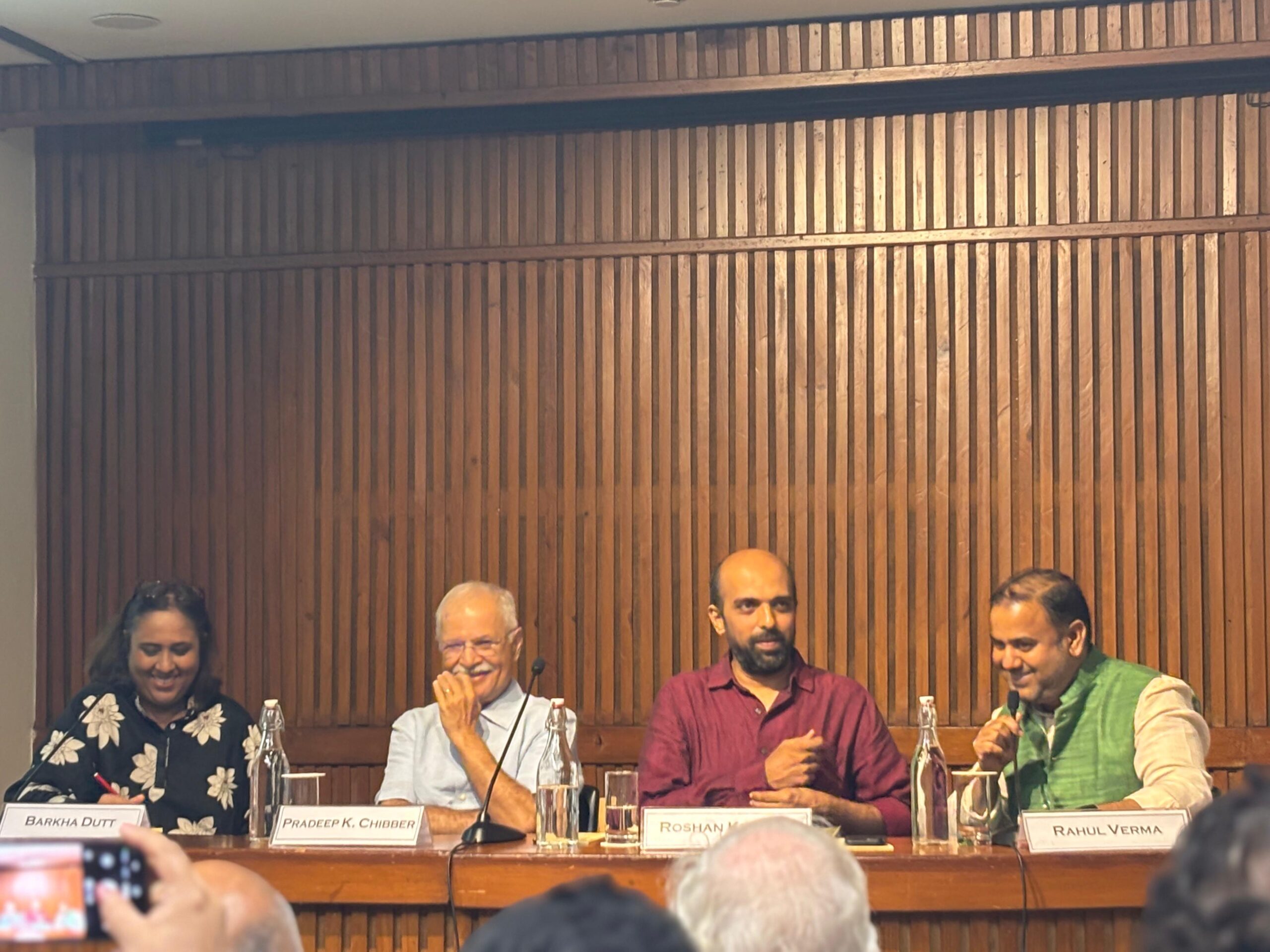
Organised by the IIC in collaboration with the Centre for Policy Research, the discussion featured Professor Pradeep K. Chhibber (University of California), Barkha Dutt (Senior Journalist and Founder, MoJo Story), Roshan Kishore (Political Economy and Data Editor, Hindustan Times), and Rahul Verma (Fellow, CPR). Drawing on Chhibber’s forthcoming book, “The Reciprocity Trap: Weak Parties, Elite Networks, and the Marginalization of the Poor in India”, co-authored with Francesca Jensenius (Professor of Political Science, University of Oslo) and village-level election data, national surveys, and extensive fieldwork, the panel explored why Indian elections continue to defy prediction.

While caste, religion, and community remain central to electoral politics, frequent vote swings and shifting party loyalties suggest that identity alone cannot explain voting behaviour.

Data presented by Chhibber shows that India’s electoral volatility. defined “as the net change within the party system resulting from individual vote transfers”, remained remarkably high between 1952 and 2004 compared with many other large democracies. The evidence raises a compelling question: what drives these persistent shifts in voter behaviour?

Electoral Volatility and Political Stronghold

Polling booth data from the 2009–2019 Lok Sabha elections suggests that electoral volatility originates in the “villages” because of two major reasons, which Chhibber attributes to: lack of local political strongholds, and patterns of identity-based political mobilisation.

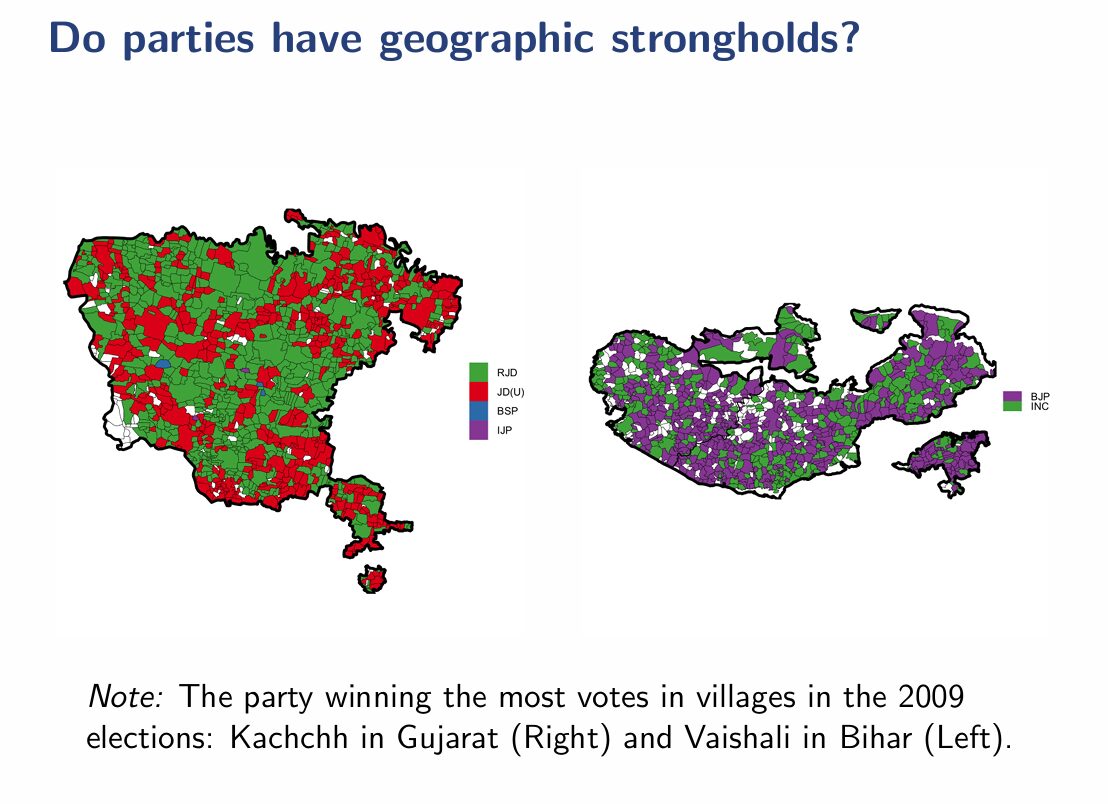
An analysis of the Election Commission of India’s polling booth data for the 2009 and 2014 Lok Sabha elections reveals an interesting trend. While many villages gave a clear majority of votes to a single party in each election, very few consistently backed the same party over time.

Chhibber argued that this challenges the conventional wisdom that Indian political parties enjoy stable village-level “strongholds”. A party may win a village by a large margin in one election, but that does not mean voters will support it again in the next. The data shows that electoral loyalties at the village level are far more fluid than is often assumed, making genuine long-term party strongholds relatively rare.

The same trend is visible even during the BJP’s sweeping victory in Uttar Pradesh during the 2014 and 2019 Lok Sabha elections. Despite the party’s perceived national dominance, support at the village level remained more volatile indicating that local voting patterns continue to shift from one election to the next.

“And that’s something you need to think about. So even for the case of the BJP in 2014-2019, the same pattern appears — definitely more strongholds, but not as many strongholds as we like to think there are,” Chhibber noted.

As against the popular belief of “geographical strongholds”, Chhibber also challenged the idea that political parties enjoy geographically entrenched support bases. Comparing village-level voting patterns across states such as Gujarat and Uttar Pradesh, he analysed that different political parties dominate neighbouring regions despite their geographic proximity.

While the BJP and the Indian National Congress (INC) dominated most villages in Kutch, parties such as the Rashtriya Janata Dal (RJD), the Janata Dal (United) (JD(U)), the Bahujan Samaj Party (BSP) and the Indian Justice Party dominated villages in Uttar Pradesh during the 2009 Lok Sabha elections.

Teasing one to think, he said, “So in other words, there’s very little evidence that parties control nationally that parties control these geographies.”

Drawing on additional data analysis, such as the spatial distribution of BJP votes in Uttar Pradesh between 2014 to 2019, the speaker returned to his central argument on how Indian voting patterns are often based on weak political strongholds at the village level and the persistent disconnect between poor and political parties.


How EV Affects Vote at Village Levels


Chhibber argued that voters in poorer areas are more likely to change their voting preferences from one election to the next.

Drawing on National Election Studies (NES) and CSDS survey data from 1996 to 2024, he found that poorer voters across all major social groups are less likely to be contacted by political parties during election campaigns. As a result, they are more likely to switch parties, vote for smaller parties or NOTA, and are less likely to turn out to vote.

His forthcoming book argues that these patterns are driven not by voters’ preferences, but by political parties’ failure to engage and mobilise poorer communities during elections, leaving them less politically connected and more open to changing their vote.

The question that follows is why is this the case? Why aren’t the poor mobilised? Well, the answers are multifactored.

Local Influencers and Reciprocity Trap 

Indian elections are infamous for their immensity. In order to self-finance large political campaigns, and with limited grassroots infrastructure and vast constituencies to cover, parties increasingly outsource campaign mobilisation to “local influential figures”, who tend to engage only their own caste- and community-based elite networks. As a result, large sections of poorer voters remain outside the reach of party campaigns, making electoral support more fluid and weakening the emergence of durable local strongholds. 

“What this means is a party system based on caste and community identity politics can coexist with vote volatility. When parties mobilise only a part of each caste and community, they’re only mobilising the elites. This is what we call the reciprocity trap,” Chhibber noted.

To break it down, the ‘reciprocity trap’ is what follows when political parties need votes and funds for winning and political gains. Due to their organisational weakness, local candidates rely on local influencers to provide access to both. These local influencers extract resources from parties, gain wealth, status and impunity. These elite networks are class biased. A reciprocity trap locks parties and influentials into this arrangement. In some cases, this deepens ties between parties and influentials. And therefore the under mobilisation of the poor “is a structural equilibrium of Indian politics.”

Reviewing Chhibber’s analysis, Roshan Kishore observed that funding elections requires wealthy intermediaries, reinforcing patronage networks and limiting the state’s ability to address deeper structural problems. Hence, despite ideological differences, major political parties broadly converge in their relationship with capital.

Class, Caste, and Identity over Populism and Welfarism

An important question, however, remained: what role do welfare schemes and populism play?

Drawing on three decades of covering elections, Barkha Dutt asked whether welfare schemes could mobilise poorer voters by bypassing local power networks. “Is a welfare scheme a form of mobilisation that bypasses the local influential network? This has been known to mobilise masses from weaker economic sections,” she observed.

This returned to the book’s central argument that while welfare schemes and populist measures may temporarily strengthen the relationship between political parties and poorer voters, they do not eliminate parties’ dependence on local elites. As a result, class continues to play a significant role in shaping electoral politics.

Kishore argued that class is often masked by talks of identity politics, even though economic interests continue to shape political behaviour in crucial ways. Recognising this changes how we understand Indian democracy. If stronger party organisations are essential to representing poorer citizens, then the relationship between class, political parties and democratic participation deserves nuanced attention.

He emphasised that democracy is not just about elections, but also about how effectively political parties organise and mobilise people. Parties that are better organised at the village levels are more likely to reach, engage and represent a wider section of society, particularly those who are often left out of the political process.
Looking at India’s political history, Kishore noted that class-based politics was once a significant force, as seen in the early success of the Communist Party of India (CPI). Reflecting on its decline, Roshan argued that communist parties struggled because they failed to effectively address caste alongside class. Outside the states of West Bengal and Kerala, he said, their inability to navigate caste politics limited their electoral appeal and contributed to their decline.

The Case for Bengal and Kerala Stand aside

However, the research also establishes that states, such as West Bengal and Kerala, which have greater political outreach to poorer voters, have lower electoral volatility. This suggests that stronger party structures can reduce dependence on local intermediaries and produce more consistency in voting patterns and durable strongholds. Kerala and Bengal continue to hold local-level Panchayat elections, an important avenue to engage poorer voters directly.

Kishore noted, “West Bengal, Kerala, and Tamil Nadu have partisan tribal elections and party mobilisation is the lever. Our survey data shows that this is not because the poor are poor. But the poor, who are contacted and politically included, their attitudes and political behavior indeed changes.”

For Chhibber, the implication is clear: the political exclusion of the poor is not a structural consequence of poverty, but a consequence of how political parties are organised. Where parties invest in grassroots mobilisation, poorer voters are more likely to participate, remain politically engaged and exhibit more stable voting behaviour. 


Six Words and a Sixty-Year Treaty

How ‘blood and water cannot flow together’ became a political and diplomatic doctrine

The Indus Waters Treaty (IWT) of 1960 survived three full-scale wars between India and Pakistan—the 1965 war, the 1971 war, and the 1999 Kargil conflict, as well as major diplomatic crises, including the 2001 Indian Parliament attack and the 2008 Mumbai bombings. For over five decades, the Permanent Indus Commission met annually, exchanging hydrological data even when diplomatic communication between the countries was limited. Then, on 27 September 2016, cooperative mechanisms under the IWT were suspended for the first time. The rupture was driven less by hydrology or engineering constraints alone, and more by politics and rhetoric.

Nine days earlier, on 18 September 2016, militants attacked an Indian Army base at Uri in Jammu and Kashmir, resulting in 19 fatalities. The Indian government linked the attack to a Pakistan-based militant group. At a government review meeting in New Delhi, Prime Minister Narendra Modi stated that “blood and water cannot flow together,” linking water cooperation to the broader security environment. On the same day, India announced it would not convene the next annual meeting of the Permanent Indus Commission until Pakistan ended support for cross-border terrorism.

This statement, while metaphorical, altered the relationship between water management and security. It did not threaten abrogation, announce a legal position, or outline immediate action. Its significance lay in signalling that water would henceforth be tied to political and security considerations. Pakistan depends primarily on the three western rivers of the Indus Basin—the Indus, Jhelum, and Chenab—which were allocated to it under the Treaty. India has limited infrastructure to block or divert these rivers. Statements by the Indian Prime Minister Modi and, later, the Indian Union Minister, Nitin Gadkari, referring to stopping water to Pakistan, largely concerned the eastern rivers (Ravi, Beas, and Sutlej) that India already utilises domestically. Technically, there was no new water to withhold; politically, however, the statements generated concern in Pakistan. Yet the Treaty’s legal architecture provides important constraints on such possibilities, requiring disputes to proceed through established mechanisms involving the Permanent Indus Commission, Neutral Expert review, and arbitration procedures, with the World Bank playing a facilitating role.

Pakistan’s public and political response was immediate. Addressing the National Assembly, Sartaj Aziz, Adviser to the PM Nawaz Sharif on Foreign Affairs, stated that any attempt to revoke the Treaty could be regarded as an “act of war.” This position was subsequently reinforced through a unanimously adopted parliamentary resolution. Pakistani leaders portrayed India’s actions as a potential instrument of water coercion and stressed that any unilateral measures would be challenged legally.

The doctrine quickly became a tool in India’s domestic political arena. Two months after the 2016 meeting, in November 2016, PM Modi, campaigning in Punjab six weeks before state assembly elections, promised that “every drop of this water will be stopped and given to the farmers of Punjab.” The Shiromani Akali Dal (SAD) – Bharatiya Janata Party (BJP) alliance was in power in Punjab during that time. Though the alliance ultimately lost the election, competing parties adopted similar positions, making water rights a recurring theme in state-level electoral politics. In subsequent years, the Aam Aadmi Party (AAP) also maintained that no water from Punjab should be diverted to Haryana. Such statements show how water-related issues increasingly became part of domestic political contestation, extending beyond India-Pakistan relations to inter-state debates within India.

In February 2019, after the Pulwama bombing, Gadkari reiterated that “not a single drop of water will be allowed to go to Pakistan,” signalling resolve amid domestic electoral and public pressure. These statements followed a pattern: a security event occurs, elections approach, and water-related rhetoric intensifies.

Pakistan’s domestic response and counter-rhetoric

Pakistan Peoples Party (PPP) Chairman Bilawal Bhutto-Zardari issued a direct threat to India after New Delhi suspended the Indus Waters Treaty in response to the Pahalgam terror attack that killed 26 civilians. In a provocative speech at a public rally in Sukkur, Bhutto-Zardari said, “I want to tell India that the Indus is ours and will remain ours. Either our water will flow through it, or their blood will.”

Between 2022 and 2024, as disputes over the Kishanganga and Ratle dams were referred to international arbitration, Pakistani political rhetoric increasingly framed India’s dam construction as a threat to Pakistan’s water security and as a form of water weaponisation.

This mirrored earlier rhetoric in India, where political actors similarly portrayed the other side as an aggressor in order to mobilize domestic political support.19 Pakistan also emphasised legal recourse, stating that any unilateral action violates the Treaty and is subject to international adjudication.

Cumulative effects of rhetoric

By 2025, after a militant attack in Pahalgam, India effectively placed the Treaty in abeyance, echoing the original 2016 phrasing: “terror and talks cannot happen; water and blood cannot flow together.” Pakistan responded that this constituted an “act of war,” constrained by the prior unanimous parliamentary resolution.

The significance of this development lay not only in its immediate impact on India-Pakistan relations, but also in the broader questions it raised about the future of the Treaty. As political rhetoric increasingly translated into policy decisions, concerns emerged regarding the consequences of such a shift, extending beyond the bilateral relationship to the future of the Treaty itself.

Commentators interpreted this shift in different ways. Former diplomat Syed Akbaruddin argued that the Treaty’s durability should be viewed in the context of India’s long record of upholding it despite wars, terrorist attacks, and prolonged political tensions. From this perspective, the growing linkage between water cooperation and security reflected accumulated frustrations that had become increasingly difficult to separate from the Treaty’s operation. Regardless of interpretation, repeated rhetorical signalling on both sides contributed to a political environment in which compromise became increasingly difficult.

Conclusion

The significance of “blood and water cannot flow together” lies not in the statement itself, but in what followed. Invoked after the Uri attack and recurring after Pulwama and Pahalgam, each a distinct act of cross-border terrorism, the phrase evolved from a crisis response into a recurring reference point in India-Pakistan relations, gathering weight with each repetition rather than fading after the crisis that produced it. Similar rhetoric later emerged in Pakistan, indicating how water increasingly came to occupy a more prominent place in political and diplomatic contestation, with each side’s language reinforcing the other’s over time. As this rhetoric becomes more embedded on both sides, it raises a structural question for the Treaty’s future: whether the technical, depoliticised cooperation that sustained it for over six decades can be restored once water has been so closely tied to security in the public discourse.