Watch the full video (above) of the panel discussion between Dr Sunil Abraham, Osama Manzar and Yamini Aiyar, chaired by Ambassador Shyam Saran, as part of the ‘Metamorphoses-Talking Technology’ series.
The aim of the discussion is to explore how advances in technology are impacting social interactions and human behaviour particularly in a country with strong traditions and deeply ingrained patterns of thinking. Digital technologies carry the promise of democratising societies, empowering marginalised sections of society and opening up new opportunities for women. However, there are also certain negative aspects to the use of these technologies that may strain the social fabric and even undermine the institutions and processes of a democratic state.
Dr Sunil Abraham is Vice-President at Mozilla Foundation.
Osama Manzar is Founder and Director of Digital Empowerment Foundation.
Yamini Aiyar is President and Chief Executive at Centre for Policy Research.
Ambassador Shyam Saran is Life Trustee at India International Centre and former Foreign Secretary.
Metamorphoses is a modest effort to try and bridge the gap between digital technologies, which are transforming our lives, and our understanding of their multiple dimensions. The series is a joint initiative between NITI Aayog (the Government of India’s think tank), India International Centre (IIC) and Centre for Policy Research (CPR).
Watch the full video (above) of the panel discussion between Amba Kak, Dr Avdesh Sharma, and Dr Nand Kumar, chaired by Ambassador Shyam Saran, as part of the ‘Metamorphoses-Talking Technology’ series.
Our modern age is characterised by the pervasive use of digital technologies, which may spawn the internet and the World Wide Web. We now have the widespread use of social media, such as Twitter, Facebook and Instagram among others. These are instrumental of democratising the political and social space of vastly improving access to knowledge and enabling quick and efficient communications. Along the benefits, however, come a number of serious concerns, both social and psychological, including phenomena such as trolling the use of bots and internet-addiction. Our challenge lies in using digital technologies for the benefit and welfare of mankind, while mitigating, if not eliminating the negative consequences.
Amba Kak is Public Policy Advisor at Mozilla Corporation.
Dr Avdesh Sharma is a Senior Psychiatrist.
Dr Nand Kumar is a Professor at the Department of Psychiatry, AIIMS.
Ambassador Shyam Saran is a former Foreign Secretary and Life Trustee at the India International Centre.
The audience feedback of the session can be accessed here.
Metamorphoses is a modest effort to try and bridge the gap between digital technologies, which are transforming our lives, and our understanding of their multiple dimensions. The series is a joint initiative betweenNITI Aayog (the Government of India’s think tank), India International Centre (IIC) and Centre for Policy Research (CPR).
Watch the full video (above) of the panel discussion between Dr J Satyanarayana, Chinmayi Arun, Ananth Padmanabhan and Vrinda Bhandari, chaired by Justice BN Srikrishna, as part of the ‘Metamorphoses-Talking Technology’ series. Metamorphoses is a modest effort to try and bridge the gap between digital technologies, which are transforming our lives, and our understanding of their multiple dimensions. The series is a joint initiative between NITI Aayog (the Government of India’s think tank), Indian International Centre (IIC) and Centre for Policy Research (CPR).
The panel discusses concepts like receptive technology, glacial government, response of regulators to the pace of technological advancements, era of blockchain and bitcoins, artificial intelligence, big data and forecasting.
Justice BN Srikrishna is Chairman of the Financial Sector Legislative Reforms Commission (FSLRC).
Dr J Satyanarayana is Chairman of the Unique Identification Authority of India (UIDAI).
Chinmayi Arun is Assistant Professor of Law at the National Law University.
Ananth Padmanabhan is a fellow at Carnegie India.
Vrinda Bhandari is an advocate.
Opening remarks were delivered by Yamini Aiyar, President and Chief Executive, CPR.
Watch the full video (above) of the panel discussion between Abhishek Pitti, Dhruv Arora, Mahima Kaul and Prof Gagandeep Kang, chaired by Prof K Vijay Raghavan, as part of the ‘Metamorphoses-Talking Technology’ series.
The aim of this talk is to demystify terms associated with our online presence. In order to meaningfully participate in the current debate around how the Internet intersects and in many ways directs various aspects of our lives, it is critical to understand the digital terminology that has now become commonplace. Informed user understanding of this language can empower the person to take control of the narrative versus being controlled by the same narrative.
Prof K Vijay Raghavan is Principal Scientific Adviser to the Government of India.
Abhishek Pitti is the co-founder and CEO of Nucleus Vision.
Dhruv Arora is Manager, Digital and Strategic Communications at the Centre for Policy Research.
Mahima Kaul is Head, Public Policy and Government Partnerships, India at Twitter.
Prof Gagandeep Kang is Executive Director at the Translational Health Science Technology Institute (THSTI).
Opening remarks were delivered by Ambassador Shyam Saran, Life Trustee, IIC and former Foreign Secretary.
Metamorphoses is a modest effort to try and bridge the gap between digital technologies, which are transforming our lives, and our understanding of their multiple dimensions. The series is a joint initiative between NITI Aayog (the Government of India’s think tank), Indian International Centre (IIC) and Centre for Policy Research (CPR).
Watch the full talk (above) by Pratap Bhanu Mehta on ‘Metaphysics of Avoidance Self and History in Aurobindo’, delivered as part of the fall 2016 OP Jindal Distinguished Lecture Series titled ‘The Nietzschean Moment in Indian Intellectual History’, organised by the Brown-India Initiative at Brown University.
This is the second lecture in a the two part series, and the first one can be accessed here.
Watch the full video (above) of the special talk on ‘Leading Digital Transformation and Innovation’, featuring Prof. Soumitra Dutta and Prof. Ambuj Sagar as part of the ‘Metamorphoses-Talking Technology’ series. This talk analysed how digital technology has enabled a more widespread start-up culture with reference to India and the US; its impact on public goods like health, education and micro-finance; the viable business models in this space; and digital technology as an enabling and empowering instrument for women.
Prof Soumitra Dutta is Professor of Management at the Cornell SC Johnson College of Business and Chair of Board of Directors Global Business School Network (GBSN), Washington DC. Prof Ambuj Sagar is the Vipula and Mahesh Chaturvedi Professor of Policy Studies at the Indian Institute of Technology, Delhi.
Opening remarks were delivered by Air Marshal (Retd.) Naresh Verma, Director, India International Centre.
Metamorphoses is a modest effort to try and bridge the gap between digital technologies, which are transforming our lives, and our understanding of their multiple dimensions. The series is a joint initiative between NITI Aayog (the Government of India’s think tank), Indian International Centre (IIC) and Centre for Policy Research (CPR).
This year Uttarakhand’s state electricity distribution company (discom) was awarded an A+ by the Ministry of Power for its strong performance. This is an impressive achievement. Every year the Ministry of Power evaluates the financial and technical performance of India’s state discoms, giving each a rating between A+ and C. The Uttarakhand Power Corporation Limited (UPCL) was the only discom outside of Gujarat to secure an A+ rating. Only five of forty-one state discoms in India were given the top mark.
Uttarakhand’s power sector has undergone a remarkable transformation over the last two decades, to arrive at the position today where the state’s lone public discom is able to out-perform most of its peers around the country. At the root of this transformation have been two crucial elements: plentiful cheap hydro power coupled with rapid industrialisation in the state. Together these have been a golden combination for Uttarakhand. With cheap power and plentiful industry revenue, the UPCL has been able to improve its financial performance. This has happened even while the UPCL continues to report high commercial losses among non-industrial consumer groups.
When setting out as a newly formed state in 2000, Uttarakhand was under-developed, with low levels of industry and subpar electricity transmission infrastructure. Shortly after the state was formed, the UPCL’s industry users made up 21 percent of consumption, and the discom was reporting aggregate technical and commercial (AT&C) losses of 54 percent. The consumer mix and loss levels were akin to neighbouring Uttar Pradesh, from which Uttarakhand was carved-out. Yet while Uttar Pradesh has seen little change in its power sector situation in the years since, Uttarakhand’s power sector was soon to be on a path of transformation.
First, Uttarakhand had inherited a large amount of hydro power generation capacity. In 2003, the total energy available to Uttarakhand was 5,300 million units, while the state’s requirement was just 3,900 million units. In 2003, the newly set-up Uttarakhand Electricity Regulatory Commission (UERC) capitalised on this advantage, ordering a reduction in electricity tariffs. In its first tariff ruling, it significantly reduced the tariff that the UPCL had to pay the state’s hydro power generation company, which allowed it to then order the UPCL to reduce the tariffs that it charged to all consumer groups, except farmers. This firmly established Uttarakhand as a low tariff state, attractive for industry.
Second, in 2003 the Government of India launched an industrial policy for Uttarakhand and Himachal Pradesh, which included generous tax and central excise benefits to industry investing in the state. The policy was a huge success. Between 2000 and 2011, the number of factories in the state more than tripled. The result of this was that a favourable consumer mix was won for the UPCL. By 2011, industrial consumers contributed 63 percent of the UPCLs revenue, even while they only made up 1.1 per cent of its customers. Industry revenue is important, because industry users pay higher tariffs, cross-subsidising discom losses made supplying domestic and agricultural consumers at lower tariffs.
Plentiful cheap hydro power and a large revenue stream from industrial consumers transformed the position of the UPCL. In 2016-2017 the UPCL’s reported AT&C losses of just 16.28 percent. Power cuts in Uttarakhand are limited, universal electrification has been achieved, and the state government does not subsidise electricity tariffs.
Figure 1: Revenue Mix in 2016-17
The UPCL has been able to secure its A+ rating even as clear problems remain. Beyond industry consumers, AT&C losses associated with all other users in the state were 27 percent in 2016-2017. In seven distribution divisons, AT&C losses are in excess of 30 percent, including Roorkee where they are 36 percent. For years the UPCL has moved slowly to deal with these losses. Every year the UERC orders the discom to act on high levels of provisional billing, to replace mechanical meters and defective meters, and to claim outstanding arrears. Each year the UPCL makes little progress on these problems.
Having a state discom ranked A+ for its performance makes Uttarakhand an outlier state in terms of its power sector. Looking to the future, several road bumps lie in view. Rapid economic growth and industrialisation in the state has meant that electricity demand has risen fast. Yet there has been insufficient cheap hydro power capacity added to meet this demand. Instead, the UPCL is increasingly purchasing much more expensive gas-based generation. This is feeding through to higher tariffs. Coupled with this, central government incentives are now expiring which brought many industry players to the state. Industrial consumption over recent years has decreased marginally in Uttarakhand. The UERC puts this down to growing use of open access mechanisms that allow industry to buy power from generators outside the state, the installation of rooftop solar, and the effects of energy efficiency programs. If Uttarakhand fails on providing quality and reliable supply of power at competitive rates then industry consumption may fall further. In such a scenario, the UPCL’s performance is likely to suffer, and its A+ rating will be at risk.
Jonathan Balls is a New Generation Network (NGN) Post-Doctoral Scholar at the Australia India Institute, University of Melbourne, Australia. This research is based on work presented in full in the book Mapping Power, edited by Navroz K Dubash, Sunila S Kale, and Ranjit Bharvirkar.
The electricity sector in Tamil Nadu has the third highest generating capacity, has achieved near total electrification of all its households, and can boast of the highest capacity for renewable electricity generation among the Indian states. At the same time, in terms of financial performance, Tamil Nadu’s power sector has been among the worst performing three utilities in the country in recent years.
During the fifties and sixties, in spite of having significant expansion of rural electrification and also subsidising the consumption of rural consumers, the utility was able to generate a modest surplus without any subvention from the state government. However, since 1970 -71 it has been incurring losses on account of the subsidised rates for electricity to certain consumer groups, as required by the state government. The state government’s subvention provided to the utility was adequate to compensate for this till 2000 – 01 after which it has been inadequate.
Between 2008 and 2012 severe power shortages were witnessed and the utility was able to meet only two-third of the maximum demand. The industrial sector bore the brunt of this shortage and while Chennai suffered two hour power cuts for a period of time other areas faced 12 to 14 hours of power cut. A higher proportion of the energy sold to the consumers came from power purchased at a higher cost compared to the cost of TNEB’s own generation. For the period 2002-03 to 2014-15 the subvention from the government covered only 29 per cent of the utility’s losses, on an average. The cumulative amount of uncovered losses at the end of 2014-15 was close to Rs. 90,000 crores. TNEB’s debt burden was about 50 per cent of the state’s debt in 2013-14.
Figure 1: Average Cost of Service and Average Revenue Realised (Source: Power Finance Commission Reports).
After the legislation of the Electricity Act in 2003, TNEB was among the last states to unbundle and the unbundling is only cosmetic. The Tamil Nadu Electricity Regulatory Commission (TNERC) was constituted in 1999 but was without a Chairman till 2002. The members and staff of the Commission have mostly been chosen from ex-TNEB employees. The TNERC its first tariff order issued in 2003, directed TNEB to get all consumption metered, including those of agricultural pumps and huts, within three years and to issue new connections only on a metered basis. As of 2017 this has not yet been implemented. Between 2003 and 2010, TNEB did not seek any tariff revisions and did not submit the mandatory Annual Revenue Requirements. The regulatory process is thus subject to ‘state capture’ and the deeply ailing state utility is protected from any effective competition.
The continuously deteriorating financial position of the utility has adversely impacted the cost and the quality of access in the state. In addition, the indiscriminate subsidies have created significant negative externalities by promoting unsustainable use of groundwater and have also eroded the competitiveness of the industrial sector due to the double burden of cross subsidies and power cuts imposed on them.
Why and how did all this come to pass in a sector whose financial performance was good till the seventies, within a state that had good economic and human capabilities? The answer requires an understanding of the evolution of the power sector in Tamil Nadu as institutionalised through the provisions in India’s Constitution, its Directive Principles for State Policy and relevant legislations, and as shaped by state level political economy aspects relating to its governance. In particular, the interplay between group interests, political aspirations, technological factors, and the nature of control afforded to the state government over this sector have influenced, and in turn have been influenced by the performance outcomes in this sector.
The problems started in the sixties when the green revolution happened. The increased risks and unequal economic impact of green revolution on the farming community gave rise to a well organised peasant movement that managed to avail a lot of concessions from the state governments. Subsequently, the sector became a means to gain political popularity and financial rents at the same time, by subsidising consumers in an indiscriminate manner, while the utility went deeper and deeper in the red. There is a path dependency in this process that seems to be difficult to escape. Having gone down this path, both vested interests and competitive politics constrain the political will to reverse the trend and the sector seems to be caught in a subsidy trap.
Hema Ramakrishnan is a faculty Member at the Madras School of Economics. This research is based on work presented in full in the book Mapping Power, edited by Navroz K Dubash, Sunila S Kale, and Ranjit Bharvirkar.
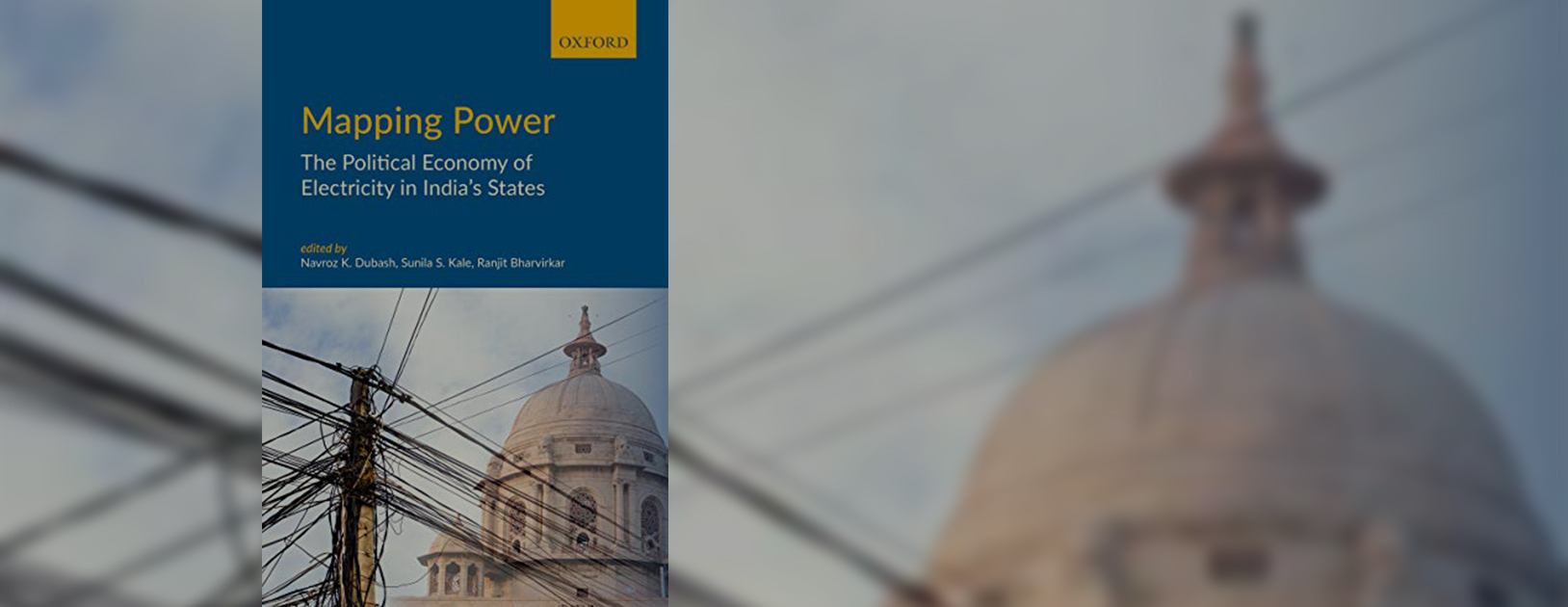
Mapping Power: The Political Economy of Electricity in India’s States, edited by Navroz K Dubash, Sunila S Kale and Ranjit Bharvirkar, provides the first comprehensive analysis of the politics of electricity distribution across fifteen Indian states. The book examines why, despite several decades of reform, India’s electricity sector remains marked by financial indebtedness and an inability to provide universal, high quality electricity for all. In chapters written by scholars of politics and electricity, the book traces the power sector in states as diverse as Andhra Pradesh, West Bengal, and Jharkhand. Through these state narratives, the authors argue that attempts to depoliticise electricity reforms are misplaced. Instead, they argue, successful electricity reforms in India depend on linkages with electoral gains.
The book was launched in September 2018 by Suresh Prabhu (former Union Minister of Commerce & Industry and Civil Aviation), Jairam Ramesh (Member of Parliament), Narendra Taneja (National Spokesperson, BJP), and Dr Pramod Deo (former Chairman, Central Electricity Regulatory Commission). Since then, it has been reviewed by:
“The 15 articles serve as a one-stop shop for information about the power sector’s tryst with politics and are quite interesting… In as much as it zooms-in into the relationship between politics and the power sector in fifteen big states, the book is timely and useful, because the Electricity Act is going nowhere.”
“This book is an ambitious and substantial contribution to current day thinking on the challenges of India’s power sector. It is methodologically well-grounded in relevant theory and data… The focus on states contributes to bridging a crucial gap that exists in literature today, as most existing studies on India’s electricity sector address the country level. This work is a vital contribution towards not just informing India’s policy pathways, but also towards a methodological blueprint to understand the levers that drive electricity sector development across much of the developing world.”
“The editors have done commendable pioneering work in bringing the “political economy” to the centre of the analytical framework, which is an overdue course correction in the study of the electricity sector in India.”
The launch of Mapping Power was followed by a technical panel discussion with Professor D V Ramana (Professor, Xavier Institute of Management Bhubaneshwar), Aditi Phadnis (Political Editor, Business Standard), and Shantanu Dixit, the Group Coordinator of Prayas (Energy Group). Read more about the Mapping Power book discussion event hosted by the Centre for Policy Research and Oxford University Press here.
To learn more about the state-level politics of electricity in India, check out the Mapping Power blog series:
In the last week, Jharkhand’s state government inaugurated its first fleet of electric cars for official government use. Launched with much fanfare and coverage, the chief minister, energy secretary, and JBVNL (the state’s main discom) MD were all in attendance at an event in which Ranchi joined the ‘energy revolution’. Yet the installation of charging stations around JBVNL offices and the procurement of electric vehicles is a strange ambition for a city which is still plagued by regular power cuts, even in some of its most affluent neighbourhoods. In a state where almost half of all households are still without power, this event is yet another public relations exercise overshadowing the state’s more fundamental energy problems. Jharkhand’s power problems originate from three key areas: financial distress, capacity problems and out-of-state conflicts.
Jharkhand has had a history of low tariffs, high technical and commercial losses, and high external dependency due to a lack of in-state generation. Almost seventy percent of JBVNL’s power purchase costs come from Central generators, or entities like the Damodar Valley Corporation (DVC). From the latter, the cost of power tends to be unusually high, accounting for a large portion of JBVNL and the Energy Department’s overall expenditure. While the PPAs with DVC will expire in a few years, for now JBVNL has been stuck with both high-power procurement costs and major problems in recovering dues and preventing theft. A severe shortage of working capital over the last decade has led to the state’s discom frequently defaulting on or delaying dues to generators; it is barely capable of maintaining manpower, procurement pipelines and the existing grid infrastructure.
In the last six months, the JSERC approved major increases (between Rs. 1.90-3.15) in retail tariffs across almost all categories of domestic and commercial consumers, both rural and urban. In a departure from almost a decade of JSERC rulings, the most recent tariff orders sweepingly simplified JBVNL’s existing tariff schedule and also declared its intent to eventually dispense with the massive cross-subsidies that had been in place from industry to domestic and agricultural consumers. Not surprisingly, the government soon stepped in with a large financial compensation package to JBVNL so that rural customers would be minimally affected by these hikes. While this is a commendable move towards improving the financial situation of the JBVNL, much like the previous UDAY scheme all it really does is move liabilities from the discom to the state government; a temporary bandage as opposed to the deep surgery needed to fix the state’s power problems.
The crisis in the state’s electricity bureaucracy is just as worrying. Despite the many promises made to the Central government associated with UDAY, accusations of meter tampering, graft, and preferential treatment in the granting of industrial power connections are rife among the state’s power bureaucracy. Not long ago, an open and shut case of industrial power theft was dismissed in the Ranchi High Court because JBVNL engineers failed to collect sufficient evidence, leading to the discom MD admitting that “[O]ur engineers lack proper training and skills to gather evidence to prove industrial power thefts. This combined with the rapid spread of subcontracting for many basic functions has left the state discom with little credibility of actually accomplishing the grandiose expectations of the Central government’s electrification schemes before the next election.
To be fair, the state’s discom has not been the sole cause of electricity problems in Jharkhand. Because of the language of the DVC Act, 1948, the DVC is responsible for power supply to seven districts in Jharkhand for more than 11 million residents. Because of the protracted financial disputes with Jharkhand leading to the withholding of power, and its underinvestment in distribution infrastructure, the DVC was recently hauled up by the National Human Rights Commission for failing to perform its statutory duty in those seven districts. Such overlapping jurisdictions and the inability for the state government and its politicians to resolve these disputes over the last decade and a half has meant that much of Jharkhand is still very far from the utopian vision of Power for All.
Unless Jharkhand is able to shed (or renegotiate) its legacy contracts, complete its within state generation projects, and generate some reserves of working capital for JBVNL, it is difficult to see the light at the end of the tunnel. Until then, selling dreams of electric cars seems like a cruel joke to the tens of millions of citizens who watch the car zooming by at speed, ignoring them as they are left in the dark.
Rohit Chandra recently completed his doctorate at the Harvard Kennedy School. His work focuses on state capitalism and energy policy, and he is currently writing a book on India’s coal industry. This research is based on work presented in full in the book Mapping Power, edited by Navroz K Dubash, Sunila S Kale, and Ranjit Bharvirkar.
More details about the Mapping Power Project can be accessed here.
STATEMENT
January 17th, 2024
On 10th January 2024, CPR received a notice from the Ministry of Home Affairs cancelling its FCRA status. The basis of this decision is incomprehensible and disproportionate, and some of the reasons given challenge the very basis of the functioning of a research institution. This includes the publication on our website of policy reports emanating from our research being equated with current affairs programming.
During the tenure of our suspension, we sought and obtained interim redress from the honourable Delhi High Court and will continue to seek recourse in all avenues possible.
This cancellation comes after a decision to suspend the FCRA status in February 2023. These actions followed an Income Tax “survey” that took place in September 2022. The actions have had a debilitating impact on the institution’s ability to function by choking all sources of funding. This has undermined the institution’s ability to pursue its well established objective of producing high quality, globally recognised research on policy matters, which it has been recognised for over its 50 years’ existence. During this time the institution has been home to some of the country’s most distinguished academics, diplomats and policymakers.
CPR firmly reiterates that it is in complete compliance with the law, and has been cooperating fully and exhaustively at every step of the process. We remain steadfast in our belief that this matter will be resolved in line with constitutional values and guarantees.