Comments to the proposed amendment by Environment Ministry to include third party monitoring

LIMITING DEFINITION OF THIRD PARTY TAKES AWAY FROM THE POTENTIAL OF THIS UNIQUE OPPORTUNITY
ENVIRONMENTAL JUSTICE

On September 10, 2018, the Ministry of Environment, Forests and Climate Change issued a draft amendment to the Environment Impact Assessment (EIA) Notification, 2006. Through this the ministry has acknowledged that the compliance status of implementation of environmental conditions needs to be improved, and to do so it has proposed to include a randomised third party monitoring system. The ministry has proposed to carry out this third party monitoring through government institutions of national repute.

In response to this draft amendment, CPR-Namati Environmental Justice Program made a submission with the ministry. The submission highlights that such a process is still limited to the original two parties involved in environmental compliance i.e. government agencies and project developers. It emphasises on the need for a monitoring framework that addresses impacts and is not limited to routine inspections. To fill this lacuna the submission suggests that affected people be made part of third-party monitoring mechanism. This mechanism should enable them to collaborate with regulators towards better monitoring and compliance with environmental safeguards. It also raises questions regarding the credibility of the government institutions of national repute and urges the Ministry to disclose the funding details proposed for such an amendment. Read the full submission here.

Countdown to 2019: A Conversation on Politics, Elections, and Money

SECOND DISCUSSION OF THE CPR-TCPD (TRIVEDI CENTRE FOR POLITICAL DATA, ASHOKA UNIVERSITY) DIALOGUES ON INDIAN POLITICS
ELECTION STUDIES POLITICS

Watch the full video (above) of the talk by eminent political scientist, Dr Milan Vaishnav on the current state of Indian politics in the run up to the 2019 national elections.

The talk focused on the seedy underbelly of electoral politics — how candidates are chosen, how parties and campaigns are financed, and how it all affects electoral outcomes.

Milan Vaishnav is Director & Senior Fellow, South Asia Program, at Carnegie Endowment for International Peace.

The question and answer session that followed can be accessed here.

About the CPR-TCPD Dialogues

This was the second event in the CPR-TCPD Dialogues on Indian Politics series, launched in a partnership between Centre for Policy Research and Trivedi Centre for Political Data (TPCD) at Ashoka University. This is a monthly event that brings together academicians, policy and political practitioners, and civil society actors to grapple with important social and political issues in India. It provides a forum for intellectually rigorous, non-partisan commentary to strengthen public discourse on politics in India. In these polarised times, debates on politics in India have tended to be increasingly noisy, blurring the lines between critical engagement and partisan endorsement. This dialogue series is an effort to carve out a space for critical, nuanced engagement to understand the changing dynamics of Indian political parties, the impact of new and emerging social movements and the use of new instruments of mobilisation in our polity.

CORP Webinar on ‘Informal Settlements and COVID-19: Water and Sanitation as a Frontline Response’

WATCH THE FULL VIDEO OF THE WEBINAR
HEALTH SANITATION

Watch the full video recording of the CORP webinar on ‘Informal Settlements and COVID-19: Water and Sanitation as a Frontline Response’, organised by the Scaling City Institutions for India (SCI-FI) at CPR. In this webinar, speakers and presenters contributed towards understanding the aspects of WASH related inequities in informal settlements in South Asian countries and how they are deepened in emergencies like the COVID-19 pandemic.

Urban informal settlements are ubiquitous across the Global South – housing from 24% of the urban population in India to more than 50% in Nepal, Bangladesh, and several African countries. Residents of urban informal settlements perennially contend with insecurities in water and sanitation, housing, and livelihoods. Relying on underprovided and shared infrastructure for water and sanitation and cramped to the hilt within living accommodations, social distancing is an untenable proposition for those in these settlements during the ongoing pandemic. Moreover, the disproportionately lower density of water and sanitation infrastructure, compared to the population density, also constrains the ability of the residents to exercise proper and frequent handwashing. Yet, the epidemiological vulnerabilities of urban informal settlements are not endemic only to the ongoing crisis but have manifested time and time again during epidemics, like the Ebola outbreak.

With the continuing upward trajectory of urbanisation and globalisation facilitating the spread of infectious diseases, governments, planners, practitioners, and researchers must respond with not only emergency measures for immediate relief in informal settlements but also strategies for creating more resilient cities that can effectively prevent and arrest emerging and remerging diseases in the future.

Watch out for upcoming CORP webinars in this new series, Informal Settlements and COVID-19: New Urban WASH Priorities for South Asian Governments, that will bring together researchers and practitioners from across South Asia to deliberate upon the urban Water, Sanitation, and Hygiene (WASH) sector needs to achieve these dual goals.

Presentations of speakers can be accessed below:

Ananda Jayaweera
Hasin Jahan
Lajana Manandhar
Marije Broekhuijsen
Anindita Mukherjee & Neha Agarwal

CORP Seminar: Towards Furthering Action Research for Sanitation Workers’ Safety

FULL VIDEO OF SEMINAR
SANITATION URBANSANITATION

Watch the full video (above) of the session ‘Socio-legal, technical and financial knowledge base: Evidence and practice’ featuring Ravikant Joshi, Raj Bhushan Roy, Nirat Bhatnagar, Tripti Singh, Manish, Devashish Deshpande, Nilanjana Bhattacharjee and Marie-Hélène Zérah.

The seminar had two thematic sessions. The first session discussed insights from the field to build an understanding of social, legal, technical and financial issues and challenges sanitation workers face, and also deliberated on the ground challenges of bringing sanitary workers into alternative livelihood options. This was followed by a session that focussed on developing an Action Research Agenda for Future for the Indian context and explore possible solutions to improve sanitation workers’ safety. Through this CORP seminar, we aimed to build a shared understanding of the issues and challenges faced by sanitation workers’ and developed future research agenda for furthering action research in order to identify gaps and strengthen evidence to improve sanitation workers’ safety.

The session brought together senior researchers, practitioners and experts to share their insights on various aspects of action-based research pertaining to the issues and challenges that the sanitation worker faces.

Speakers for the session:

Ravikant Joshi, Urban Management Centre

Raj Bhushan Roy, WaterAid India

Nirat Bhatnagar, Dalberg Advisors

Tripti Singh, Centre for Policy Research

Manish, Centre for Policy Research

Nilanjana Bhattacharjee, PRIA

Devashish Deshpande, Centre for Policy Research

The session was moderated by Marie-Hélène Zérah, IRD, and Centre for Policy Research.

The second session on ‘Solutions and Action Research Agenda for Future to Improve Sanitation Workers’ Safety’ featuring Ravikant Joshi, Raj Bhushan Roy, Ambarish Karunanithi, Anahitaa Bakshi, Devashish Deshpande, Shashi Shikha, VR Raman and Anju Dwivedi can be accessed here.

About the Series

This is the 18th in a series of the Community of Research and Practice (CORP) seminar hosted by the Scaling City Institution for India: Sanitation (SCI-FI: Sanitation) initiative with the support of Bill and Melinda Gates Foundation (BMGF). This seminar series seeks to provide a platform for discussing the experiences of the researchers and practitioners on urban sanitation.

Access the other CORP sessions below

• 17th CORP Seminar
• 16th CORP Seminar
• 15th CORP Seminar

CORP Seminar: Malaysian Perspective on River Pollution, Sanitation & Sewerage Management

FULL VIDEOS OF PRESENTATIONS
SANITATION

Malaysia has developed an integrated approach to management and treatment of waste from sewered and non-sewered areas that is considered very successful. It is estimated that around 65% of the urban population of Malaysia is covered by network sewerage, while the rest rely on Faecal Sludge Management (FSM) services provided by the same agency that provides network sewerage services.

Through these presentations, Dorai Narayanan discusses the causes and remedies associated with river pollution and their link to the sanitation sector, and contextualises Malaysia’s success story, analysing the associated problems and challenges.

The two presentations can be accessed here:

Rivers and Pollution: Causes and Remedies, and its Link to the Sanitation Sector (above)
Sanitation and Sewerage Management in Malaysia: A Case Study of Reform and Sector Transformation
This is the 11th in the series of the Community of Research and Practice (CORP) seminars planned by the Scaling City Institutions for India: Sanitation (SCI-FI: Sanitation) initiative. More information can be found at the event page.

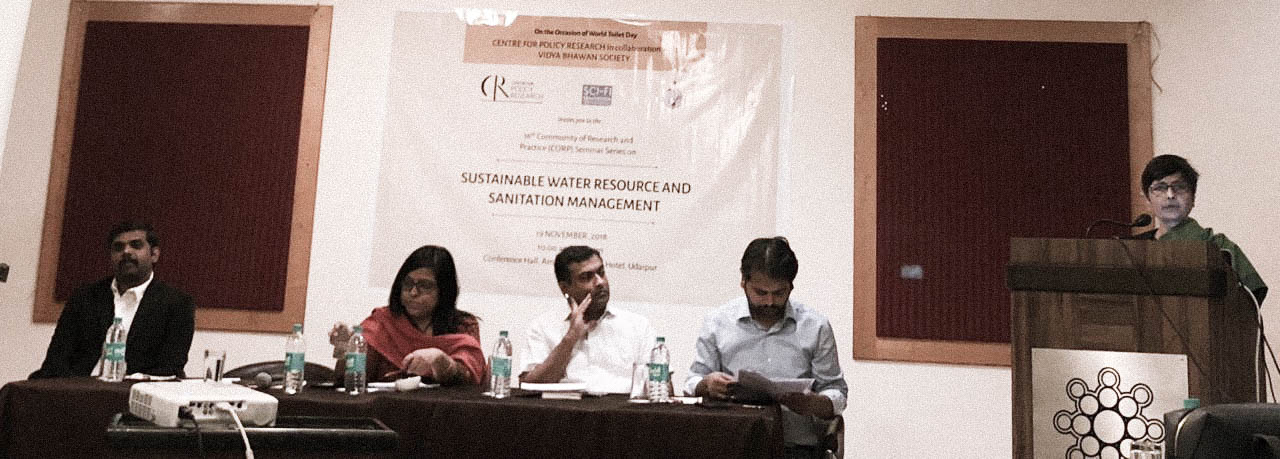
CORP seminar on ‘Sustainable Water Resource and Sanitation Management’

READ HIGHLIGHTS HERE
SANITATION MANAGEMENT WATER RESOURCES

On the occasion of World Toilet Day on 19th November 2018, Centre for Policy Research (CPR) in collaboration with Vidya Bhawan Society organised a seminar on ‘Sustainable Water Resource and Sanitation Management’ in Udaipur. This was the 16th seminar in the Community of Research and Practices seminar series organised by the SCI-FI project.

This seminar was attended by researchers, practitioners, CSOs, and private partners including representatives from Udaipur Municipal Corporation, Urban Improvement Trust and Town Planning Department.

The seminar had two thematic sessions. The first session focused on safe sanitation and waste water reuse. Neelima Khetan, Group CSR Head for Vedanta Resources, Vice President, CSR, Hindustan Zinc Limited (HZL) highlighted that the strength of corporates lies in managing waste water and partnering with competent bodies. This can be leveraged to build capacities of Urban Local Bodies through strategic interface of private partners, government, civil society actors, and community stakeholders. She emphasised on the fact that corporates can strengthen ties with the grassroot community. Considering that Udaipur has a high dependence on on-site sanitation system, Ambarish Karunanithi, Senior Research Associate, CPR emphasised on the need for sustainable solution for non-sewered networks in Udaipur. He also discussed about the partnership with HZL to support Udaipur Municipal Corporation (UMC) to improve sanitation systems in Udaipur. Abhinav Kumar, Research Associate from Vidya Bhawan Society sighted that norms and beliefs play a critical role in determining sanitation choices of the household. He stated access to toilet is not the same as access to sanitation, taking in account the sanitation market scenario in particular. Anju Dwivedi, Senior Researcher, CPR highlighted the need to involve community to improve urban sanitation.

In the second session titled ‘Sustainable Urban Water Management’, Dr Anil Mehta, Principal, Vidya Bhawan Polytechnic presented on Integrated Water Resource Management in Udaipur. He defined Integrated Water Resource Management as a mechanism that promotes the coordinated development and management of water, land and related resources in order to maximise the resultant economic and social welfare in an equitable manner. Dr PK Singh, Professor, Maharana Pratap University of Agriculture and Technology shared lessons of empowering communities through participatory Ground water management at village level through Managing Aquifer Recharge and Sustainable Groundwater Use through Village-level Intervention (MARVI) project. Drawing lessons from the rural landscape, he focused on participatory water shed management and hoped this model can be upscaled in the urban context as well.

Coastal Regulation Zone Disputes before the National Green Tribunal

India’s long coastline of close to 8000 kilometres covers nine states and five union territories. Not only is it home to wetlands, several species of fish, reptiles, crustaceans, corals, mangroves, it also supports the livelihood of around 3300 fishing villages.

An important law that seeks to regulate and manage this diverse stretch, is the Coastal Regulation Zone (CRZ) Notification. A Notification was first issued in 1991, under the Environmental Protection Act (EPA), 1986 that regards 500 metres from the High Tide Line (HTL) all along the coast as CRZ. Certain changes were made to the Notification of 1991 and a new Notification was issued in 2011. The amended law of 2011 continues to enable the concerned Coastal Zone Management Authorities (CZMAs), District Level Coastal Committees (DLCCs), and the Ministry of Environment Forests and Climate Change (MoEFCC) to protect and conserve these areas.

A breach of this notification can be challenged before the National Green Tribunal (NGT), both as an appeal as well as seeking remedies on the grounds of it being a substantial question related to the environment. Since its establishment in 2010, the NGT is the primary judicial body for all adjudication under the CRZ.

Since 2012, the principal and zonal benches of the NGT have heard numerous cases concerning violations of the CRZ law. The CPR-Namati Program has attempted to identify the more common disputes, limiting it to three sets of disputes. These have been elaborated upon and substantiated with the help of seven judgments from the NGT, below:

Determining the regulatory authority for certain activities in the CRZ area

One set of disputes which were argued before the NGT is determining whether the State Coastal Zonal Management Authority (SCZMA) is the appropriate regulatory authority for the coastal zones.

The case which best highlights the NGT’s position in this regard is that of Alexio Arnolfo Pereira v. State of Goa (2014 SCC OnLine NGT 6655). In 2013, the State of Goa passed the ‘Tourism Policy for construction of temporary seasonal structures, beach shacks, huts and others 2013-2016’, which is commonly known as the ‘Shack Policy’. This policy was challenged by Alexio Arnolfo Pereira, a resident of Goa, as being contrary to the provisions of the CRZ Notification of 2011. Pereira stated:

The CRZ Notification empowers the Goa Coastal Zone Management Authority (GCZMA) to regulate activities in the CRZ areas.
He also argued that the Tourism Department of Goa, under the guise of the Shack Policy, was usurping the regulatory powers of the Goa Coastal Zonal Management Authority (GCZMA) by granting permission for shacks/huts on the beaches for tourism purposes.
Thus, the questions before the NGT were: i) whether the temporary seasonal structures in the CRZ areas would require the GCZMA’s permission or not, and ii) whether the current practice for granting No Objection Certificates was as per the CRZ Notification, 2011 or not? Though the NGT decided that the Shack Policy was correct since it did necessitate the organisers of the temporary structures to take necessary permissions from the GCZMA, there were still innumerable shacks in the area which had been set up without any necessary permissions.

Similarly in Kamburam Dharma Paripalana Araya Samajam vs. Kozhikode Corporation and Others ( (22.09.2015 – NGT) : MANU/GT/0160/2015)), the petitioners, a society representing traditional fisher folk brought forth a complaint against certain indiscriminate and illegal constructions on the Kamburam beach. The contention was that since the total investment in the project was in excess of Rs. 5 crores, the project would thus need clearance not only from the Kerala Coastal Zonal Management Authority (KCZMA) but also from the MoEFCC. This argument was advanced on the basis of the 1991 Notification. The 2011 Notification however had no such provision, and as per the 2011 Notification, permission of the MoEFCC would only be required in cases where the built up area of the project exceeded 20,000 square metres. Thus, the petition was dismissed since the constructions had been done only after taking the necessary permissions from the appropriate authority, i.e., the KCZMA.

Another such situation arose when, in the case of Libertina Fernandes v. Goa Coastal Zonal Management Authority (2015 SCC OnLine NGT 61), the appellant’s main contention was that the GCZMA had no authority to direct the demolition of a property, which was admittedly constructed in the CRZ. The contention in the case was that the Village Panchayat was the competent authority to direct demolition of the property by following the course of action contemplated under the Goa Panchayat Raj Act, 1994. The permissions for the property had been taken in the years 1986-1987 under the Goa, Daman and Diu Village Panchayat (Regulation of Building) Rules, 1971. These rules allowed the Village Panchayat to issue regulations only in case of a non-permanent building, the cost of which did not exceed Rs. 20,000. The disputed building, however, was made of steel and concrete and the cost ran into crores. The NGT was of the opinion that the 1971 Act and the CRZ Notification, 2011 are not necessarily conflicting legislations and can operate simultaneously. This is because the object and purpose of the Acts were quite different. Since the construction was in the CRZ area, permission of the GCZMA was required under the law. The absence of any such permission was seen a blatant violation of the CRZ law and the property was ordered to be demolished.

Developmental Activities vs. Livelihoods Rights of Coastal Communities

The second kind of dispute, which emerged from the thicket of NGT decisions, pertained to a clash between historical livelihood use of coastal areas by communities and developmental activities on the coast.

For instance, in Ramdas Janardan Koli and Others v. Secretary, MoEFCC and Others ((27.02.2015 –NGT):MANU/GT/0056/2015)), the traditional fishermen from villages situated in the Uran and Panvel Talukas of Raigad district sought compensation from the City & Industrial Development Corporation of Maharashtra Ltd (CIDCO), Jawaharlal Nehru Port Trust (JNPT) and Oil and Natural Gas Company (ONGC). Their claim was that the widening and deepening of the sea for an additional fourth berth in the JNPT area was impairing the regular tidal water exchanges and in turn affecting the egress and ingress of the fishermen’s traditional boats to the sea through a creek near the JNPT. Further, land reclamation in the area had led to removal of mangroves and this large scale destruction of mangroves had reduced the breeding of fish in the area. Both of these affected their traditional right to catch fish and on this basis the fisher folk claimed compensation. The NGT came to the conclusion that the JNPT, CIDCO and ONGC were responsible for damaging the environment and affecting the livelihood of the fishermen in that area, and ordered the organisations to pay an amount of Rs. 95,19,20,000 to 1630 families.

In Wilfred J. v. MoEFCC ((02.09.2016 – NGT) : MANU/GT/0113/2016)), the MoEFCC issued an Environmental Clearance (EC) and CRZ clearance for the Vizhinjam International Deepwater Multipurpose Seaport on 3 January 2014. This clearance order was challenged in four different petitions. The petitioners ranged from people concerned about the environment, and social workers to local fishing communities and individual fisher folk. The petitions were clubbed and heard collectively. The proposed site for the seaport was south of the Vizhinjam fishing harbour. The coastal and offshore waters of the area was used by the fishermen in the district. These fishermen had been using the existing harbour to venture out safely into the sea during the rough monsoon months for almost 40 years. The establishment of the port thus threatened the basis of their livelihood. With respect to the the CRZ clearance, the main contention of the appellants was that the site where the port was to come up was ‘an area of outstanding natural beauty’ as per the Kerala Coastal Zonal Management Plan of 1995, and was thus classified as CRZ-I (ecologically sensitive areas and other geomorphological features which are important to maintain the integrity of the coasts are classified as CRZ-I) under the 1991 Notification. The NGT however recognised that the 2011 Notification had superseded the 1991 Notification. They thus examined the 2011 Notification, and observed that the categories of classification as referred to by the appellants had been specifically excluded from the 2011 Notification. The appeal was thus dismissed. The NGT however recognised the importance of strict compliance to the EC and CRZ Clearances and an expert committee was set up to guarantee that the project proponents ensure compliance.

The nature and extent of permissible activities within the No Development Zone

The scheme of the CRZ Notification is such that it demarcates the area upto 500 metres from the coast into four distinct zones. Of these, in CRZ III (areas which have not been substantially built up, are relatively undisturbed and do not fall under CRZ-I or II, are earmarked as CRZ-III), the area of 200 metres from the High Tide Line on the landward side is the No Development Zone (NDZ) (Clause 8 (III) (A) of the CRZ Notification of 2011). The third set of disputes is related to activities in the NDZ where only repairs and reconstructions of existing structures are usually permitted. Further, it is stated that the repairs and reconstructions must not exceed the authorised floor space index, plinth area and density (Clause 8 (III) (A) (ii) of the CRZ Notification of 2011). For traditional coastal communities, however, the construction and reconstruction of dwelling units is permitted between 100 and 200 metres of the NDZ (Clause 8 (III) (A)(ii) of the CRZ Notification of 2011).

In the cases of Kashiram Jairam Setye v. Anil Hoble (2015 SCC OnLine NGT 117) and Marie Christine Perdriau v. Goa Coastal Zonal Management Authority and Others (2015 SCC OnLine NGT 23), the legality of certain structures constructed within the NDZ were challenged before the NGT. In Kashiram’s case, the initial permission granted for the purposes of the re-roofing and re-tiling was instead used to carry out expansions and set up a bar and restaurant. The bar and restaurant were in turn polluting a nearby river by way of sewage discharge. In Marie Christine’s case, the GCZMA had granted permissions to repair and renovate a particular structure in the NDZ area. The case of the applicants was that the structure did not exist before 1991 and that the permission was being misused by one of the respondents to set up a resort. In both these cases, the NGT was of the opinion that the constructions were in violation of the CRZ Notification since they had been set up for commercial purposes, which is not permissible in the NDZ.

Conclusion

The three kinds of disputes point out that:

The NGT has recognised that the CRZ Notification empowers the SCZMAs to regulate the nature and extent of permissible activities within the CRZ. To that effect, it has ensured that the authority bestowed upon the SCZMAs is not replaced by any other authority.
While the NGT has not restricted or reversed large-scale land use change within the CRZ, it has emphasised that the projects must adhere strictly to compliance norms and not affect the livelihood rights of coastal communities.
The NGT has also made it clear that heavy penalties can stem from non-compliance of conditions and safeguards specified in the clearance conditions.
With respect to permissible construction activities within the NDZ of the CRZ III, the NGT has not allowed constructions for commercial purposes.
The previous pieces in this series can be accessed below:

Coastal commons for private tourism and entertainment?
Is it the end of participatory coastal planning?
States ask Review Committee to loosen up the Coastal Regulation
Crucial aspects of proposed Marine Coastal Regulatory Zone Notification revealed
In conversation with Dr Shailesh Nayak – the man who led the review of coastal regulation
The proposed Marine Coastal Regulation Zone (MCRZ) Notification
A tale of two reviews: How two governments amended a coastal land use law
The Supreme Court’s guiding principles for coastal regulation
CRZ drives a wedge between communities in Mumbai
To learn more about the National Green Tribunal, read this piece by Shibani Ghosh, here.

Coastal commons for private tourism and entertainment?

Coastal commons for private tourism and entertainment?
PART 1 OF A SERIES ON ‘COASTAL REGULATION’ BY THE CPR-NAMATI ENVIRONMENT JUSTICE PROGRAM
ENVIRONMENTAL JUSTICE COASTAL GOVERNANCE RIGHTS

More projects on the coast will put public beach space and fishing and coastal communities at risk

In the last week there have been two news reports on an impending new Marine and Coastal Regulation Zone (MCRZ) Notification replacing the existing Coastal Regulation Zone (CRZ) Notification, 2011. As per the news reports, two big changes in the offing are to open the ecologically sensitive areas of the coast for tourism projects, and lift the ban on reclamation for commercial and entertainment purposes. These changes will have a significant negative impact on millions of locals whose lives are dependent on the coast and its ecological health. They are already paying the price for current illegal violations, captured in narratives below, but the proposed changes will completely sideline their interests.

Background of the CRZ Notification, 2011

CRZ Notification, 2011 governs development on the 7500 km long coastline of India. It notifies 500 metres of land from the sea all along the coast as CRZ, and prescribes a different set of regulations for rural, urban, ecologically sensitive and water areas that are demarcated within this zone. CRZ Notification, 2011, in its original form, allowed tourism in urban and rural areas but not in ecologically sensitive areas of the CRZ. It also put in safeguards such as:

not allowing tourism related structures to be constructed within the first 200 metres of the high tide line (HTL) – this zone is termed as No Development Zone (NDZ) in view of coastal vulnerability;
a 20 metres wide gap between two structures to allow public access to the beach;
and no withdrawal of groundwater within the first 200 metres of the HTL to avoid saltwater intrusion into the groundwater aquifers.
However, these safeguards were removed for urban areas through an amendment to the Notification in February, 2015.

Reclamation for commercial and entertainment purposes is a prohibited activity under the CRZ Notification, 2011. But in 2015, the Ministry of Environment Forests and Climate Change (MoEFCC) allowed reclamation of sea for construction of roads, memorials and monuments.

Voices from the ground

As per the latest news reports, the MoEFCC is looking to lift the ban on reclamation completely and permit tourism in coastal areas that are ecologically sensitive. Opening up areas for additional activities makes sense only when the existing activities and demands are being handled well. The CPR Namati Environmental Justice Program has recorded several cases of CRZ violations that are related to illegal reclamation and tourism activities. These violations pose significant impacts on people living around such activities. These cases, as described by CPR-Namati’s enviro-legal coordinators below, illustrate how millions of fisherfolk, artisanal salt producers and bivalve collectors are forced to alter their lives in order to make room for ‘new development opportunities’. Reduced income, longer distances to access their sites of work and water sources, or even shifting their sites of work are examples of alterations they are pushed to make. They also find themselves at the receiving end of the negative environmental impacts that are a fallout of the operations of these projects. Thus, their lives and livelihoods, which are closely tied to the ecological health of the coast and unrestricted access to common spaces such as beaches, creeks and estuaries are put to risk with policies that undermine their existence and need for coastal space. The stories below highlight the impacts of tourism projects and reclamation activities for commercial purposes on the coast and the locals.

In the first story Vinod Patgar talks about the inconveniences faced by the coastal communities of Uttara Kannada, Karnataka because of some inherent biases in the CRZ Notification that have given a push to tourism and development.

Government response to coastal violations

These three stories show how commercial activities and tourism projects sidestep the traditional livelihoods of coastal people by committing gross violations of the Notification. These violations go unchecked because the violators have political connections, enjoy favours from government agencies or are seen as symbols of development. Enforcement mechanisms of CRZ law seem to be unable to deter violations on the coast.

CPR-Namati’s enviro-legal coordinators have spent two years bringing well drafted complaints to the notice of district level coastal committees and coastal zone management authorities at the state level, and seeking remedial actions in close to 20 cases. They meticulously build evidence of violations and produce it with these complaints, and yet have to write to these institutions incessantly, and visit their offices at least 3-4 times before they even get an official recognition of the problems faced by the communities. Even after obtaining an official acknowledgment of the problems and their links with the CRZ violations, remedies are not easy to come by.

All the above stories underline the challenges faced in extracting enforcement and remedies from institutions – more stories on impacts of CRZ violations and efforts of the communities at mitigating those can be found in the recent report on effectiveness of environmental laws. If this is the current situation, opening the coasts for more such activities will mean bigger costs and risks for the fishing and coastal communities.

This piece can also be accessed in हिंदी

The other pieces in this series can be accessed below:

Is it the end of participatory coastal planning?
States ask Review Committee to loosen up the Coastal Regulation
Crucial aspects of proposed Marine Coastal Regulatory Zone Notification revealed
In conversation with Dr Shailesh Nayak – the man who led the review of coastal regulation
The proposed Marine Coastal Regulation Zone (MCRZ) Notification
A tale of two reviews: How two governments amended a coastal land use law
The Supreme Court’s guiding principles for coastal regulation
Coastal Regulation Zone Disputes before the National Green Tribunal
CRZ drives a wedge between communities in Mumbai

Closing the Enforcement Gap: Groundtruthing of Environmental Violations in Bodai-Daldali, Chhattisgarh

Janabhivyakti, the Centre for Policy Research-Namati Environmental Justice Program and Oxfam India have jointly conducted a groundtruthing study of environmental violations in the Bodai-Daldali bauxite mine located in the Kabirdham district of Chhattisgarh. A groundtruthing study is the process of comparing the facts as mentioned in official documents with the impacts being reported by affected communities.

The methodology included undertaking group discussions with the affected communities. During the group discussions, impacts which the communities were facing were discussed first. This was followed by brief discussions on the various laws and institutions which are available for dealing with impacts arising out of environmental violations.

Based on that, the major observations of this study were:

Prevalence of dust pollution due to transportation of uncovered trucks, blasting and drilling.
Poor status of land reclamation and afforestation of reclaimed land.
Non-compliance with health and safety of the workers engaged in mining operations.
Incomplete and inadequate process of Rehabilitation and Resettlement.
These were also confirmed by government reports and independent research studies. These reports and studies date back to the year 2007, and some of the impacts have been in existence since the beginning of the mining operations, and have been recorded in the aforementioned reports.

The full groundtruthing report can be accessed here.

Closing the Enforcement Gap: Community-Led Groundtruthing of Environmental Violations in Mormogao, Goa

The Mormugao Port is located at Vasco bay in the Mormugao taluka of Goa at the point where the Zuari river meets the Arabian Sea. This region is home to thousands of fisherfolk from the Karvi community who live along the beaches of Mormugao, Salcete and Tiswadi talukas. It is a natural harbour that provides safe haven for ships and fishing vessels during storms, like it did in 2017 when cyclone Okchi hit this coast. The lives and livelihood of these fisherfolk are intrinsically linked to the activities of Mormugao port as they have had to share their customary livelihood areas – the sea and the beaches – with the port. This has resulted in them competing for space for their daily activities like fish landing, boat parking, net mending, and even housing with the port and its infrastructure development on the landward side, and competing with larger shipping vessels for navigation space and access to certain parts of Vasco bay.

The Mormugao Port was commissioned by the Portuguese in 1885 and over many years developed 5 berths for import and export of oil, cashews, wine, iron ore, etc. Iron ore export gained importance after 1948. After liberation in 1961, the Mormugao Port was declared a Major Port by the Government of India in 1965. It was after this that major infrastructure developments began at the port and by 1994, the port had built its 11th Berth and soon after this coal handling began in earnest. Mormugao Port Trust (MPT) is now one of India’s oldest and largest ports with 11 berths of which 6 are leased out to third parties. The port handles cargo like coal, iron ore, woodchips, steel coils, gypsum, bauxite, ammonia, other dry bulk, petroleum, oil and lubricants (POL), and also services cruise ships.

In March 2017, it came to light that the MPT was in the process of seeking environment clearance (EC) for three proposals to expand and modernise its existing facilities. Residents of Vasco and the fishing villages around the site realised this when notices for public hearing under the Environment Impact Assessment (EIA) Notification of 2006 were issued in local newspapers. Of these, two proposals were for coal handling capacity enhancement and modernisation of existing Berth 5a 6a and Berths 8 & 9 and barge berths respectively. This was despite long standing resistance from the people of Vasco da Gama in Mormugao taluka and other citizens of Goa against coal handling and resultant pollution.

It was in this backdrop, that a community led groundtruthing study was initiated in April 2018 by Old Cross Fishing Canoe Owners Co-op Society Ltd, Baina Ramponkar, Fishing Canoe Owners Society, Destierro Fisherman Association – Vasco, Goenchea Raponkarancho Ekvott (GRE) and the Centre for Policy Research (CPR)-Namati Environmental Justice Program with support from concerned citizens of Vasco and the Federation of Rainbow Warriors. Impacts that community members were facing due to coal handling at MPT were identified through multiple discussions and the main issues that emerged were:

Increased coal dust in the homes and other areas near the port as a result of open coal handling at the berths, open transportation by trucks and wagons.
Respiratory issues like asthma attacks especially in children and the elderly.
Water pollution from spillage during transport of coal through waterways in barges and washing of barges. Runoff from the stockyard into Vasco bay was also cited, where the fisherfolk of Kharewado, Baina and Desteiro primarily go fishing on a daily basis.
Threat of eviction of fisherfolk living along the beaches abutting MPT in Kharewado, Baina and Desteiro areas for expansion of port activities and road connectivity.
This grountruthing study is also an attempt by the affected community members to understand the environmental impacts of these berths, link them to the regulatory requirements and push for the compliance of the same.

The findings of the study can be accessed here.