Standard economic geography assumes a linear demographic transition from rural agriculture to urban industrialisation. India’s spatial trajectory, however, aggressively defies this orthodox blueprint. Utilising longitudinal plant-level data (ASI) and enterprise-level surveys (NSSO), this paper identifies a profound
spatial decoupling driven by severe factor market distortions. Paralysed by fragmented urban property rights and land assembly costs, capital-intensive formal manufacturing is actively de-urbanising to the rural periphery, leveraging national highway infrastructure for spatial arbitrage. Conversely, functionally locked
out of formal banking, the labour-intensive informal economy is rapidly hyper-urbanising to forge the physical proximity required for informal credit and localised agglomeration.
Furthermore, this urbanisation diverges regionally, manifesting as capital-driven “engineered” clusters in leading industrial states and remittance-fuelled “organic” hubs in lagging agrarian states. To harness its demographic dividend and achieve the $30 trillion developed-nation status of Viksit Bharat by 2047, India must dismantle the rigid rural-urban binary. This paper proposes the structural blueprint for a Second Republic: proposing a “Transitional Hold-Harmless” fiscal mechanism to break the current political economy deadlock, underpinned by a new “4F” governance architecture—Foundations, Functions, Finances, and Functionaries—designed explicitly to formalise, finance, and empower the missing rurban middle.
This paper investigates public accountability in Public-Private Partnerships (PPP), for transport projects in India. So far, urban and regional studies scholars examining liberalisation in India have mainly critiqued structural macro-level shifts in policy to argue that an entrepreneurial Indian state, seeking private investment in large-infrastructure projects through mechanisms such as PPPs, has withdrawn from its role as a provider, reducing its accountabilities to performance control and fragmented governance. But this literature rarely views accountabilities of public and private partnering agencies as mutually constitutive in PPPs. Shifting attention to micro-level of projects and by carefully examining state-business relationships in long-term PPP contracts, this paper shows how the state’s deep entrenchment with its private partner’s risks produces not fixed, but contingent accountabilities. Champaka Rajagopal employs the incomplete-contracts lens, to examine how contracting parties in transport infrastructure projects claim residual control rights when specific contractual conditions are absent in long-term PPP contracts. Through five litigation cases in airport and national highway modernisation projects, Rajagopal questions perspectives on simplistic binaries of public versus private interest within PPPs where self, organisational and public interest are often intertwined. The paper demonstrates how third-party interference, bureaucratic resolution, competition, control and risk-hedging in contractual governance, shape a variety of state-business responses to public accountability. Rajagopal concludes by arguing that ‘contingent accountability’ produced in incomplete-contracts leads to contentious outcomes where not just the state, but all parties, public, private and the tax payer, tend to lose. The paper offers litigation as a compelling research methodology for examining state-business relations in opaque contractual governance of PPP projects.
This paper discusses that while mature firms are becoming “net job destroyers” as they automate, it is the young, agile “Ojazelles” — firms less than five years old — that are currently breathing life into the economy, creating 45% of all new jobs. Yet, these young job creators are being strangled by “Structural Brakes”: a Collateral Trap that prizes ancestral land over fresh ideas, and a Regulatory Tax that punishes firms for growing. The paper proposes a New Social Compact to release these brakes. By leveraging India’s world leading Digital Public Infrastructure (DPI), we can bypass the old “Land Finance Nexus” and move to Information Based Lending, where a young person’s talent and data become their new collateral.
Financing a Green ‘Viksit Bharat’ India’s national goal of becoming a developed economy by 2047 is inextricably linked to achieving its Net Zero commitment by 2070. This twin ambition requires an investment of an estimated $10 trillion, primarily in green infrastructure and industrial modernization. This paper argues that this colossal sum cannot be met by public funds alone. The central economic challenge for India over the next two decades is to build the institutional capacity to mobilize and direct trillions of dollars in private and global capital towards this green transition.
This paper looks at the “Institutional Efficacy Puzzle” that lies at the heart of India’s development challenge and provides a deep, systemic diagnostic of these key institutions—the Ministry of Finance (MoF), the Reserve Bank of India (RBI), financial regulators (SEBI, IRDAI), tax authorities (CBDT, CBIC), and crucial oversight bodies like the Finance Commission and the National Statistical Commission (NSC). It moves beyond analysing symptoms to uncover root causes embedded in flawed designs, capacity deficits, or political economy constraints. It then proposes a comprehensive, actionable roadmap for profound reform aimed at building the Resilient, Agile, Accountable, and Inclusive (RAAI) institutional foundations essential for transforming the Viksit Bharat vision into a tangible reality.
This working paper serves as a useful reference for understanding the River Basin Management (RBM) trajectory of Germany vis-à-vis India through a comparative analysis. The paper further argues for acknowledging structural differences and contextual factors to enable meaningful knowledge exchanges and critical policy diffusion. It also proposes Indo-German collaborations at the subnational scale to reinforce their existing water-related partnerships and identifies possible entry points for strengthening India-EU water cooperation.
The paper seeks to understand (i) the role of National Health Mission (NHM) in defining/resetting health priorities in States and addressing horizontal inequalities; (ii) the constraints faced by States within the federal structure for delivering effective healthcare services; and (iii) the mechanisms through which States manage these constraints. The NHM helped reverse the declining trend in health spending by States by providing them with non-wage resources in the context of their low own revenues. However, health continues to be a low priority in state budgets, with the share of health spending in the total expenditure of State budgets remaining broadly unchanged over the past 30 years. Political leadership often plays a key role in determining health as a priority. Post-NHM, horizontal inequalities have reduced to a small extent. Generally, States feel constrained by the Union government taking the lead in designing health schemes and setting priorities, with their role being reduced to mere delivery and implementation bodies. They also face uncertainty in fund flows, and there are no clearly defined platforms for communication. States address these constraints by exercising flexibility within the broader NHM framework, relying on their own funds using different platforms for communication. This, however, often occurs in an ad hoc manner, based on needs and issues faced.
This analysis attempts to address a pressing problem at the heart of India’s plans to combat extreme heat: finance. Indian Heat Action Plans (HAPs) contain a welcome diversity of adaptation solutions spanning many sectors, but generally fail to identify viable sources of public and private finance to implement these solutions. In a previous study published in March 2023, we found that only two of the 37 state, district and city heat action plans reviewed had cited specific sources of finance for at least some of their interventions.
In this analysis, we map heat-resilience solutions proposed across 37 Indian HAPs against interventions in India’s Centrally Sponsored Schemes (CSSs), Central-Sector Schemes (CSs), and an Act, all implemented by states with significant financial support from the Union government. These cover areas as diverse as the creation of low-cost affordable housing, the construction of artificial water bodies, urban greening, and changing the way settlements are built, among others.
CSSs carry a lot of financial firepower and if creatively utilised, could help solve some of India’s climate finance shortfalls. In Financial Year 2023-2024 (FY 2023-24), CSSs were allocated ₹ 4,76,104.59 crores or 10.57% of the total Union budget (₹ 45,03,097 crores).
We reviewed a total of 72 schemes which includes 67 CSSs, one CS, one Act and three national missions/action plans related to heat action and with budgetary allocations for FY 2023-24. We found that a quarter (18 schemes) contained interventions that directly correspond to heat resilience solutions identified in the HAPs. Overall, these 18 schemes (16 CSSs, an Act and a CS) could potentially support the implementation of 16 different types of heat solutions.
An example of how these synergetic solutions look:
Suggested citation: Shekhar, S., T. Dalal, S. Santhosh, A. V. Pillai & B. Krishna. 2023. “Finding the finance: A guide on identifying Centrally Sponsored Schemes to fund heat resilience solutions.” Working Paper. Initiative on Climate, Energy and Environment, Centre for Policy Research, New Delhi, December 2023.
Background on National Ambient Air Quality Standards (NAAQS)
Air quality standards are primarily health-based standards that define the ambient concentration of air pollution to which the public can be exposed without suffering harm to their health. In India, the Central Pollution Control Board (CPCB) is tasked with setting the National Ambient Air Quality Standards (NAAQS) under the Air (Prevention and Control of Pollution) Act of 1981.
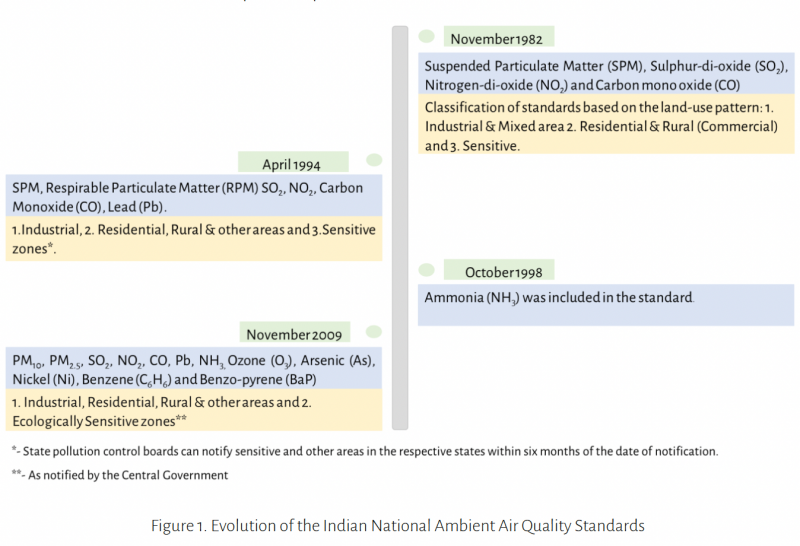
The NAAQS were first established in 1982 for four pollutants (suspended particulate matter, nitrogen dioxide, sulphur dioxide and carbon monoxide) and subsequently revised in 1994 and 1998 to include several more. The current iteration of the NAAQS were notified in 2009 and were aligned with the World Health Organization’s (WHO) interim air quality guidelines. The most recent revision of the WHO guidelines for ambient air quality in September 2021 rendered the NAAQS as substantially weaker in comparison. The alignment of the NAAQS with these global guidelines will require integration of the wealth of new health data generated since 2009 on the deleterious effects of air pollution on health both locally and globally.
The 2009 NAAQS revisions were notified through the Gazette of India with no contextual information provided on the composition of the committee tasked with the revisions, or on the kind of data or information used by the committee to draw its conclusions on the acceptable levels of exposure to various pollutants. In August 2021, the CPCB convened a committee to review and update the NAAQS. The committee’s wide-ranging remit includes an assessment of the health risks of air pollution, establishing guidelines for monitoring, identifying non-attainment areas, and revising the Air Quality Index (AQI) through which health risks are communicated to the public.
Proposed framework for revising the NAAQS
While the proposed revision of the NAAQS is a step in the right direction, at the time of this paper’s publication it remains unclear how evidence on the harmful effects of air pollution to health would be weighed by the committee, whether the committee has adequate disciplinary diversity, how it would consider economic and social factors in its decision-making, and how it would engage with the public.
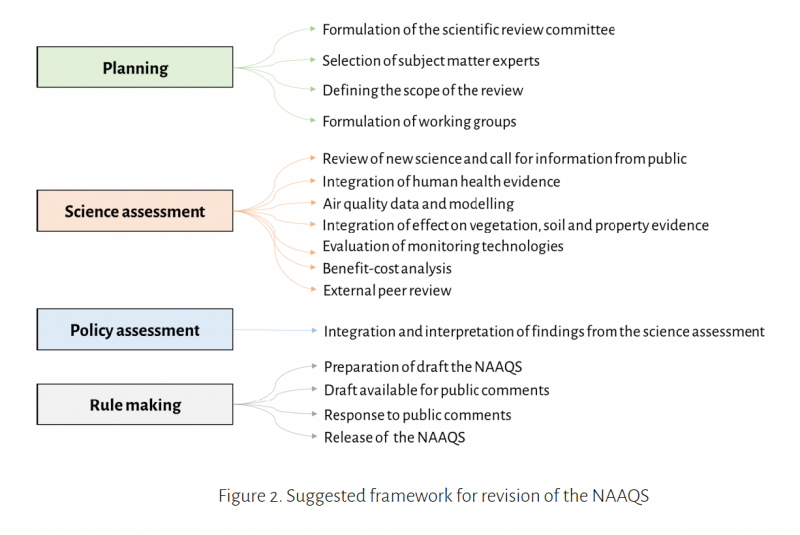
Based on the need to establish scientifically robust health-based standards, this working paper evaluates the global best practices for setting or revising air quality standards. Through this, the authors suggest a structured approach to revising the current and future NAAQS – through an inclusive, expert-driven institutional process, with appropriate timelines, evidence integration, and public participation for the Indian context.
The authors propose a broad framework for revising the NAAQS with four significant steps i.e., planning, science assessment, policy assessment, and rulemaking. The approach laid out in this paper aims to enshrine a set of core principles in the revision process including periodicity, interdisciplinarity, and transparency while centering health in the setting of any new standards.
Air pollution is a pan-India problem, and whether viewed in terms of pollution sources or exposure, there is no reason to continue an urban-focus in air pollution mitigation measures. It is imperative for air quality governance in India to transition from a city-centric approach to an airshed approach. As resources to address the pollution crisis are scarce, a coordinated effort across a region, that supports consistent and uniform measures against similar pollution sources, is likely to lead to greater gains in terms of air quality.
In this Paper, we unpack some of the key issues relating to airshed-level governance and what is required to make that transition in India. The current regulatory set-up is designed to primarily focus on point sources, and the jurisdictional mandate of regulatory bodies aligns with state or city boundaries. To effectively regulate pollution and reduce pollution exposure, changes need to be introduced to this regulatory architecture, making it adopt an airshed-level approach. To begin with, airsheds have to be demarcated based on several criteria. However, there is sufficient literature available to initiate necessary reform measures, and the transition to an airshed or regional approach is not contingent on perfect airshed demarcation.
We propose that airsheds be notified under the Air Act by the State Governments as ‘air pollution control areas’, and the Union Government may constitute, through notification, multi-stakeholder institutions for each airshed under the EP Act. We have outlined the composition of such an institution, its powers, roles, and responsibilities. It will be a focal point for standard setting, policy guidance, planning and knowledge generation for the airshed, while not being involved in enforcement. A key ingredient for successful airshed-level governance is effective accountability mechanisms that ensure compliance by actors across the region. We envisage a role for the Union Government under the EP Act as well as for the National Green Tribunal in this regard.
STATEMENT
January 17th, 2024
On 10th January 2024, CPR received a notice from the Ministry of Home Affairs cancelling its FCRA status. The basis of this decision is incomprehensible and disproportionate, and some of the reasons given challenge the very basis of the functioning of a research institution. This includes the publication on our website of policy reports emanating from our research being equated with current affairs programming.
During the tenure of our suspension, we sought and obtained interim redress from the honourable Delhi High Court and will continue to seek recourse in all avenues possible.
This cancellation comes after a decision to suspend the FCRA status in February 2023. These actions followed an Income Tax “survey” that took place in September 2022. The actions have had a debilitating impact on the institution’s ability to function by choking all sources of funding. This has undermined the institution’s ability to pursue its well established objective of producing high quality, globally recognised research on policy matters, which it has been recognised for over its 50 years’ existence. During this time the institution has been home to some of the country’s most distinguished academics, diplomats and policymakers.
CPR firmly reiterates that it is in complete compliance with the law, and has been cooperating fully and exhaustively at every step of the process. We remain steadfast in our belief that this matter will be resolved in line with constitutional values and guarantees.