Agricultural Households and Farming Income: An initial analysis of variations in income from farming and other sources among agricultural households in India

The Agriculture Census for 2015-16 placed the number of “operational holdings” at 146.45 million. The farmer here is somebody cultivating land without necessarily owning it. The land may be a single piece or multiple plots owned or taken on lease; what matters is the entire area (“holding”) being managed (“operated”) by the same person (“cultivator”) alone or with others.

The National Statistical Office’s (NSO) recently released ‘Situation Assessment of Agricultural Households and Land and Livestock Holdings of Households in Rural India, 2019’ report has a different definition. The SAS doesn’t focus on operational holdings as the basic unit or on the number of farmers but identifies “agricultural households.” Agricultural households are defined as households having at least one member self-employed in farming and whose annual value of produce from such activity exceeds Rs 4,000. Farming or “agricultural activity” includes cultivation of crops (field, horticultural, plantation and fodder) as well as animal husbandry (dairying, poultry, goat/sheep-rearing, piggery, inland fishery, beekeeping, sericulture, etc.). Self-employment in agriculture can further be either in “principal” or even “subsidiary” status not less than 30 days during the survey reference period of six months (in this case, July-December 2018 for visit-1 and January-June 2019 for visit-2). India, as per this report, had 93.09 million “agricultural households” in 2018-19 (July-June) and 101.98 operational holdings. Of these, 89.58 million holdings were possessed by agricultural households, while 12.40 holdings were possessed by non-agricultural households (i.e., even if the plot was put towards some agricultural production, the household itself was not classified as agricultural by the definition above.

There might be a number of reasons that explain the huge variation—53.36 million – between the Agriculture Census’ and the NSO’s estimates.

The Agricultural Census is collected on a complete enumeration basis. This exercise involves re-tabulation of data from village land records that most states maintain for collating individual field and crop-wise area statistics. The NSO estimates of agricultural households, by contrast, are based on a survey design. The survey sample size for 2018-19 covered 58,035 households (45,714 agricultural) in visit-1 and 56,894 (44,770) in visit-2.

As long as some part of a plot of land has been used towards agricultural production, it is classified as an operational holding. The Agricultural Census begins with the status of the plot, whether it is owned by urban or rural, agricultural or non-agricultural households. The SAS begins with classifying rural households.

Members within a household may operate multiple holdings. While the Agricultural Census treats each of them as separate operational holdings, the NSO’s focus is on the agricultural household. All lands operated individually or jointly by all members of a household are taken as a single production unit or holding. So, if you used the Agricultural Census to estimate the number of farmers, you would consider each operational landholding as representing a farmer. But if you used the SAS, you would be working with the category of agricultural household, even though there might be more than one operational landholding and more than one ‘farmer’ residing in that household.

Given the expansive definition of “agricultural household” used by the SAS, it would follow that agricultural households would likely have multiple sources of income. In this note, we seek to try to understand what this data reveals in terms of the degree of dependance that agricultural households have on different sources of income, how this varies by land possessed and by state, and what the implications of this might be for agricultural, economic and social policy.

For this analysis, we consider net receipts (after deducting paid-out expenses) from crop production plus farming of animals as a percentage of the agricultural household’s total income from all sources. The latter includes income from wages/salary and leasing out of land, net receipts from non-farm business, and earnings from pension/remittance. A ratio above 50 per cent can be construed as significant agricultural dependence.

According to the SAS, the average total monthly income of an agricultural household in India during 2018-19 was Rs 10,829. Out of that, the share of farm income – Rs 3,798 from crop and Rs 1,582 from animal agriculture – was 49.7%. For the average agricultural household, the largest single-source of income was wages/salary (Rs 4,063). This has been cited by a number of analysts to conclude that the average Indian farmer is more of a labourer today (https://bit.ly/3i9Kws3).

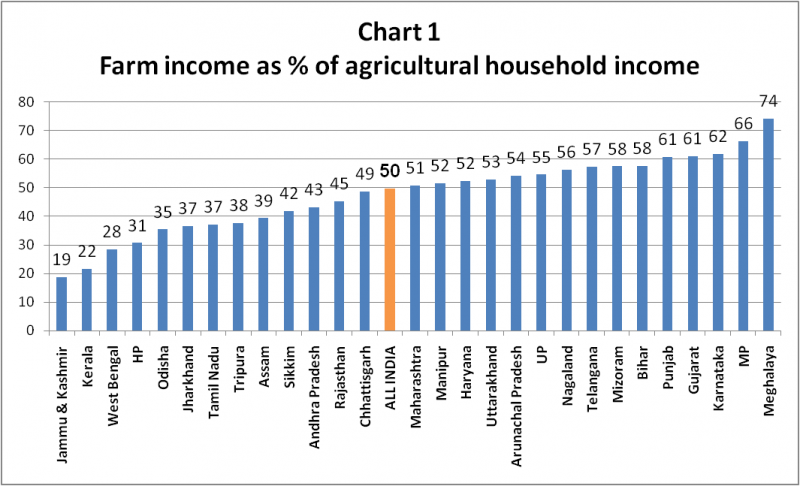
Any all-India average, though, hides considerable differences between states and also between landholding sizes. Chart 1 shows the average farming income dependence among agricultural households to be below a third or even a fifth in Jammu & Kashmir, Kerala, West Bengal and Himachal Pradesh, while amounting to over 50% for Maharashtra, Uttar Pradesh and Bihar, and crossing 60% in Punjab, Gujarat, Karnataka, Madhya Pradesh and Meghalaya. (A recent analysis suggests the Meghalaya data may require a closer look and that tasks remains to be undertaken).

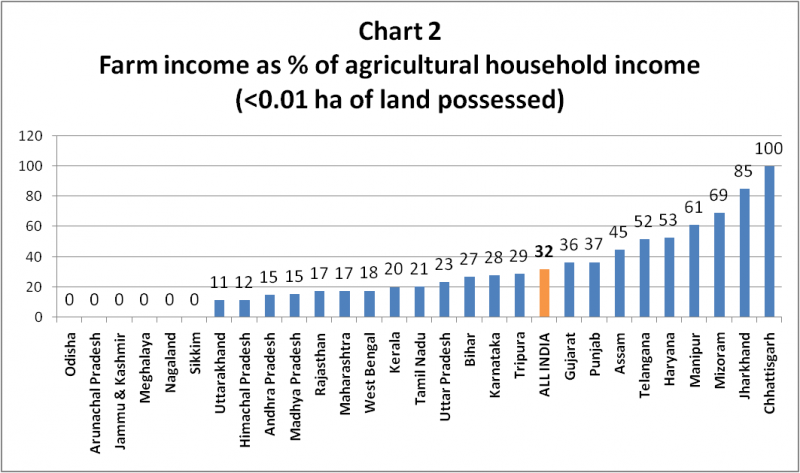
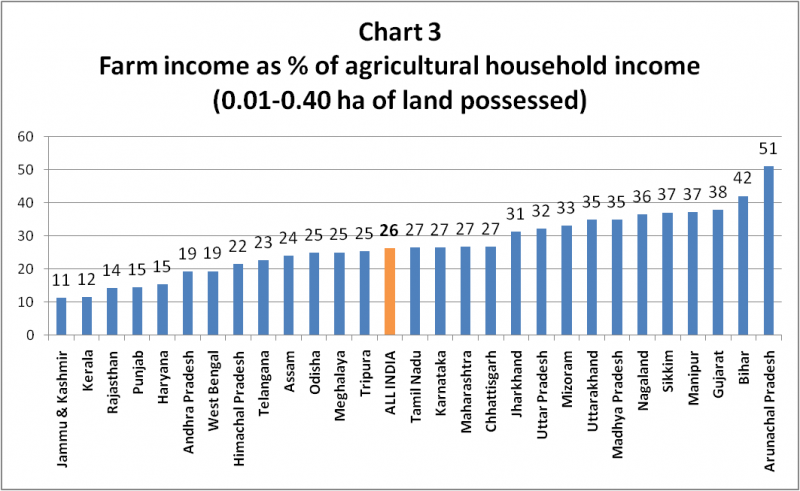
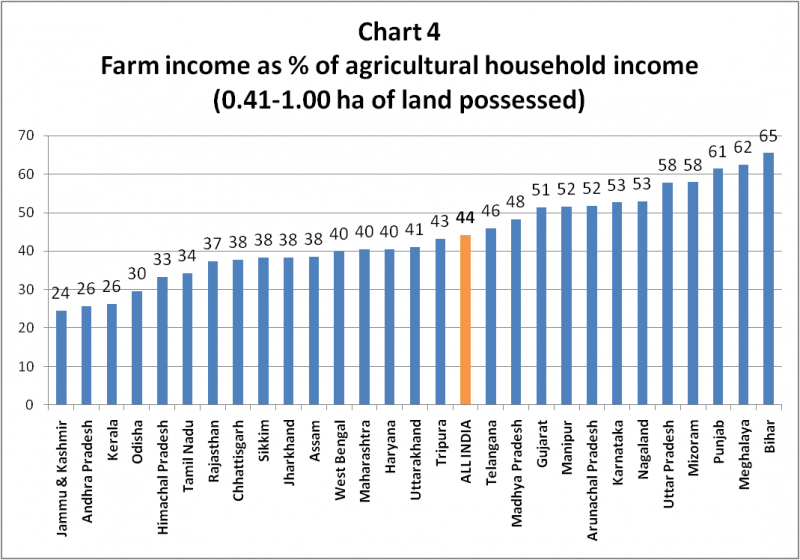
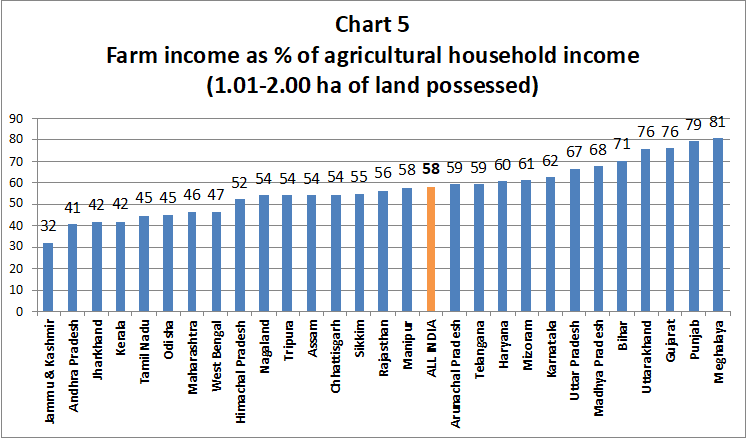
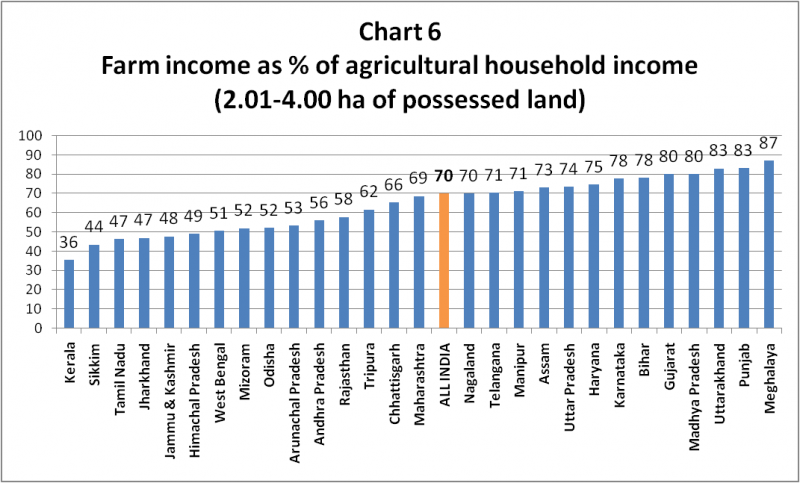
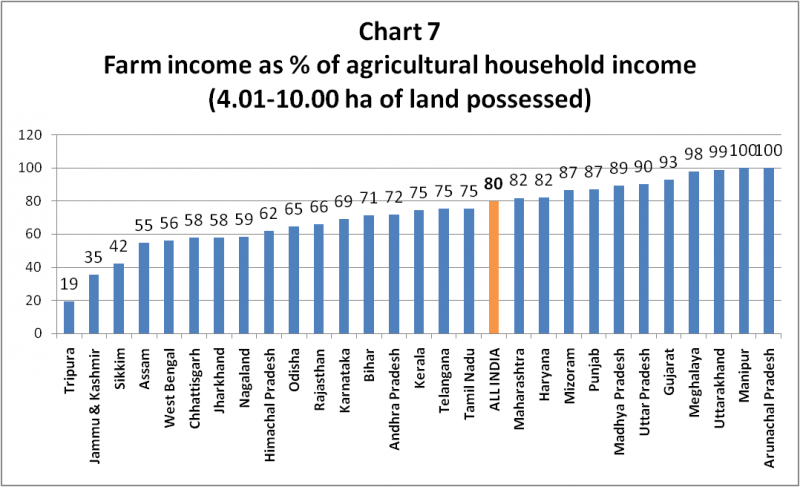
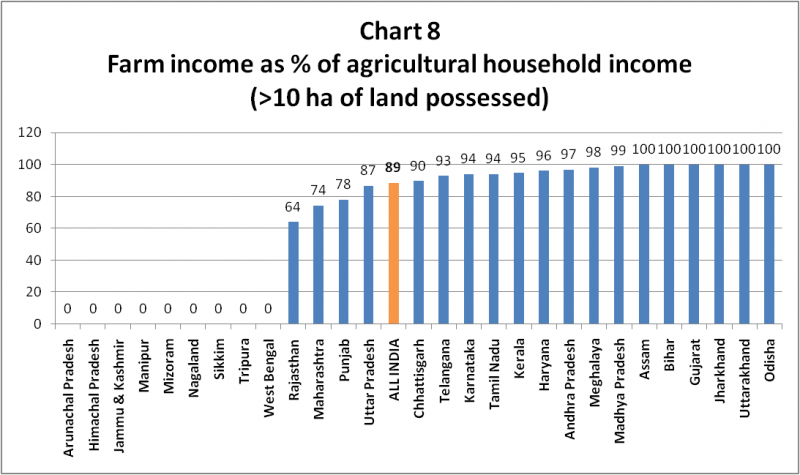
Farm income dependence is, moreover, a function of landholding size too. The following charts shows state-wise ratios of net farm receipts (from crop cultivation plus animal husbandry) to total agricultural household incomes across seven size classes of land possessed: <0.01 hectare, 0.01-0.4 hectare, 0.41-1 hectare, 1.01-2 hectares, 2.01-4 hectares, 4.01-10 hectares and above 10 hectares. “Land possessed”, it may be noted, is defined as land owned plus land leased-in minus land leased-out plus public/institutional land encroached upon without ownership/occupancy right. A farmer, by this definition, needn’t own any land. An agricultural household can “possess” land by growing crops or raising animals entirely on other’s land taken on lease.

What clearly emerges from our charts is that farming income dependence is less – between 26% and 44% at an all-India level – when holdings are one hectare and below. But the 50% threshold is surpassed thereafter, rising to 70% in the 2.01-4 hectares land possessed size class and almost touching 90% for above 10 hectares. The 50% threshold is crossed for a majority of states even when land possessed size exceeds one hectare. In the top two size categories – four hectares and above – income from farming contributes over 50 percent of all income for agricultural households in nearly all states. The variations across all charts are of course significant and striking, a point to which we will return later.

In terms of numbers, how many agricultural households in India are primarily dependent on farming income as the largest source of their overall household income?

The NSO Situation Assessment report has state-wise estimates of agricultural households for different size classes based on total land possessed. We have already worked out the ratios of farm income to total agricultural household income for all states across each of these size classes (Charts 2 to 8). Taking only those land size classes for which the farm income dependence ratios are 50% or higher, and adding up the corresponding estimated number of agricultural households, gives us a figure of farming income-dependent households in each state. For instance, Andhra Pradesh has 31.59 lakh agricultural households in all. But the 50% farm income threshold is crossed only for households having more than two hectares of possessed land. They number just 7.46 lakh, or 23.6% of the total agricultural households in the state.

Using the above methodology, we have calculated the number of significantly farming-income dependent households for all states. To repeat, agricultural households deriving a significant share of their income – 50% or more – from farming activity per se. It can be seen from the table below that this population is just over 36 million, which is approximately 39% of the total 93 million-odd agricultural households estimated by the NSO. It is, of course, even lower compared to the 146.5 million operational holdings in the country, as per the Agricultural Census for 2015-16. A previous estimate made by one of the authors of the present note had suggested that there are 47-50 million farmers that derive a significant part of their income from agriculture.

(https://bit.ly/3CLmc7S).

State-wise estimates of Farming income dependent farmers (in thousands)

Farming income dependent

households

Total agricultural households % of Farming income dependant households
Jharkhand 6.6 2808 0.24
Kerala 8.1 1466.9 0.55
West Bengal 75.7 6626.2 1.14
Jammu & Kashmir 12.3 658.3 1.86
Tamil Nadu 60.3 2597.7 2.32
Odisha 283.7 4815.3 5.89
Tripura 25.3 289.3 8.75
Himachal Pradesh 140.5 1034.2 13.59
Sikkim 10.4 65.2 15.95
Uttarakhand 172.9 983.4 17.58
Assam 637.6 3099.7 20.57
Andhra Pradesh 745.5 3159.4 23.60
Haryana 710 1906.7 37.24
Chhattisgarh 1302.6 2985 43.64
Rajasthan 3267.4 7041.5 46.40
Bihar 3351.6 7011.3 47.80
Madhya Pradesh 3489.9 7276.3 47.96
Uttar Pradesh 8746.5 17789.5 49.17
Maharashtra 3646.6 7289.3 50.03
Telangana 1528.2 2668.5 57.27
Punjab 884.3 1473.8 60.00
Gujarat 2499.9 4037.1 61.92
Manipur 166.4 241.2 68.99
Meghalaya 272.2 364.7 74.64
Karnataka 3664 4251.6 86.18
Mizoram 71.5 76.4 93.59
Nagaland 181.6 191.8 94.68
Arunachal Pradesh 152.40 152.4 100
ALL-INDIA 36114 92360.7 39.1

Note: All-India figures are sum total of all states. The total agricultural households are slightly less than the 93.09 million given in the main NSO Situation Assessment report.

Policy conclusions and recommendations

 This note has attempted to make a few key points. First, that estimates for the number of farmers in India based on available national statistical data varies depending on whether you count and base your assumptions on the number of “operational landholdings” or the number of “agricultural households.”

Second, as per the SAS 2019, among the 93 million agricultural households estimated to live in rural India in 2018-19, there is significant variation in the degree of dependence that households have on farming income. The degree of dependence varies across the size of landholding possessed. The NSO Situational Analysis report shows that the 50% farm income-to-total agricultural household income threshold is crossed at an all-India level only when the land possessed size exceeds one hectare or 2.5 acres. The fact is that 70% of agricultural households in the country do not possess even this minimum.

Third, this analysis of the SAS estimates that farming income contributes 50 percent or more of overall income for only 39 percent of agricultural households in India or approximately 36 million households. This may be thought of as the number of farmers who are able to make a living from agriculture, that is, make at least half or more of their living from farming. There are only ten states where this proportion is over 50 percent of the state’s agricultural households.

What are the policy implications emerging from this data and analysis?

Given the diverse role and place of agriculture in the lives and livelihoods of agrarian households and communities, it is not for us or for anyone else to conclude that the value of agricultural land or of farming can be simply equated with the amount or proportion of household income that it brings in. However, both the low levels of total household income and the very low earnings from farming for the vast majority of agricultural households is a harsh reality. Given the very small size of landholding possessed by most farming households, it is also a reality that most agricultural households are increasingly dependent on income from wages and other sources to meet their needs.  This, then, is largely a process of distress-driven diversification. The reasons are structural and reflect deep problems with both the agricultural and non-agricultural economy.

Addressing these different, but interrelated challenges will require both much greater understanding of and investment in farming as livelihood and enterprise, as well as reimagining agriculture and rural livelihoods beyond the farm.

To start with, one must recognise that farming is a specialised and skilled economic activity and enterprise. We must not continue to keep treating it as a welfare sector or an endlessly absorptive residual/subsistence economy. Not everyone can, or need be a farmer. Agriculture policy should prioritise and support those for whom farming is their major source of income. This includes the design and delivery of Minimum support prices, government procurement, agricultural market reforms, infrastructure, irrigation, fertiliser and other input subsidies, Kisan Credit Card loans, crop insurance and export-import policies on farm commodities.

It is especially important to remember that farmers with sizeable operational landholdings, from which they earn the majority of their income, may not be the owners of that land. While India’s statistical data focuses on ‘operational’ holdings and land ‘possessed’, agricultural policy remains steadfastly attached to land ‘ownership’ as a primary criterion for many schemes, benefits and transfers to farmers. This disadvantages many risk-taking and entrepreneurial cultivators across the country.  Even a scheme like Pradhan Mantri Samman Nidhi (PM-Kisan), which provides an income support of Rs 6,000 per year for some 110 million beneficiaries could be much more effectively designed and directed. This will help increase the quantum of support to those who need to be encouraged to remain in or expand their agriculture business. The ongoing protests against the Narendra Modi government’s agriculture reform laws are, perhaps, an expression of the accumulated frustrations and crises facing a prominent section of India’s farming-income dependent households, but they are by no means the only such farmers across the country.

What should be done for the 70% farm households that are mostly dependent on other income sources to eke out a living? Crop-based agriculture policy cannot obviously be the only or main answer. Livestock-based livelihoods are also very important here. Depending on the context, it is possible for even a one-acre farmer to rear five cows and sell 30 litres of milk daily from three at any given time, while dedicating her entire land to growing high-protein fodder crops. The same land can, alternatively, house a broiler farm with up to 10,000 birds and six batches being sold in a year. There are likely to be other, agroecologically and economically better strategies that need to be prioritised.

Further, there is also likely to be significant scope for value-addition and employment outside rather than on the farm as well – be it in aggregating, grading, packaging, transporting, processing, warehousing and retailing the produce, not to speak of supply of agri-inputs, machinery and other services to farmers. All these activities fall within the realm of agriculture, even if outside the farm. Agriculture policy should aim at not only increasing farm incomes, but also adding value to produce outside and closer to the farms. Finally, these will necessarily have to be state-specific and within them region and location-specific strategies that locate rural households at the centre of a larger vision for agricultural and economic development. Policies, moreover, that better understand farm/non-farm interlinkages and better support and enable the necessary and challenging processes and dynamics of diversification on and off the farm.

This note, part of the Understanding the Rural Economy series by CPR, has been authored by Harish Damodaran, Mekhala Krishnamurthy and Samridhi Agarwal.

Find all previous notes as part of the series here:

Working in tandem: the informal septic tank emptying market in Aya Nagar, Delhi

NEW REPORT BY SWETA CELINE XESS AND MARIE-HÉLÉNE ZÉRAH


The aim of this research report is to explore the types of sanitation services that exist in non-networked settlements. Based on the case study of Aya Nagar in South Delhi, the research shows how households are primarily dependent on septic tanks, and rely on an informal market comprising small-scale local entrepreneurs for the emptying of faecal sludge.

We find that this sector’s functions are structured by the entrepreneurs themselves, who check competition, manage tariffs and mitigate operational risks through collective action. This arrangement relies on existing networks of kinship and friendship between operators.

Financially, the sector offers entrepreneurs a low but steady source of income given a recurrent demand for desludging service in the settlement. Nevertheless, the occupation remains a socially stigmatised activity as it deals with human excreta, which in India, is traditionally associated with low-caste communities.

The full report can be accessed here.

Will India’s interests be served by the Paris Climate Agreement?

COMMENTARY AND ANALYSES BY CPR FACULTY


A new climate accord- the Paris Agreement- was approved by the nations of the world on December 12, 2015. CPR faculty Shyam Saran, Lavanya Rajamani, Navroz K. Dubash and Radhika Khosla, have provided in-depth commentary and analyses on the Agreement and its implications for India.

Prior to the Paris Agreement, our faculty put into perspective India’s interests at the climate talks in Paris:

For an entire archive of the Climate Initiative’s work over the past year, view this interactive timeline.

Whose carbon is burnable? Equity considerations in the allocation of a “right to extract”

FULL ACCESS TO THE JOURNAL ARTICLE, CO-AUTHORED BY NAVROZ K DUBASH
ENVIRONMENTAL JUSTICE CLIMATE RESEARCH

Carbon emissions—and hence fossil fuel combustion—must decline rapidly if warming is to be held below 1.5 or 2 °C. Yet fossil fuels are so deeply entrenched in the broader economy that a rapid transition poses the challenge of significant transitional disruption. Fossil fuels must be phased out even as access to energy services for basic needs and for economic development expands, particularly in developing countries. Nations, communities, and workers that are economically dependent on fossil fuel extraction will need to find a new foundation for livelihoods and revenue. These challenges are surmountable. In principle, societies could undertake a decarbonization transition in which they anticipate the transitional disruption, and cooperate and contribute fairly to minimize and alleviate it. Indeed, if societies do not work to avoid that disruption, a decarbonization transition may not be possible at all. Too many people may conclude they will suffer undue hardship, and thus undermine the political consensus required to undertake an ambitious transition. The principles and framework laid out here are offered as a contribution to understanding the nature of the potential impacts of a transition, principles for equitably sharing the costs of avoiding them, and guidance for prioritizing which fossil resources can still be extracted.

The full article can be accessed here.

Workshop on Welfare and Poverty: Trends over a Quarter Century on Delhi’s Margins

Watch the full talk (above), where Devesh Vijay tracks changes in demography, occupations, incomes, consumption patterns in villages and slums on Delhi’s margins using surveys, focus group discussions, interviews and life sketches. The study was constructed in two working class communities within the National Capital Region, in 1988-89, and again in 2013-14.

To listen to the lively discussion that followed, tune in to the Q&A Session.

Workshop on lending to women with informal incomes and property titles

SEWA GRIH RIN’S EXPERIENCES IN HOME FINANCE
ECONOMY

Watch full video of the talk (above) where Shruti Savio Gonsalves, CEO at Sewa Grih Rin Limited (SGRL), explains the challenges and solutions that emerged during SGRL’s journey of financial inclusion of informally employed and housed people, in particular, women.

SGRL is leveraging an extensive membership network of over 2 million poor, self-employed, informal women in 14 different states of India to fulfil a dream of increasing access to decent housing and a sound living environment.

To listen to the lively discussion that followed, tune in to the Q&A Session

Will Ayushman Bharat Work?

BLOG BY JISHNU DAS, YAMINI AIYAR AND JEFFREY HAMMER
HEALTH POLITICS

As the country prepares for the launch of Ayushman Bharat on September 23rd, sceptics may wonder whether this time is truly different. Ayushman Bharat, or Pradhan Mantri- Jan Arogya Yojana (PM-JAY) as it is now called, will attempt to bring millions of poor Indians into a structured health insurance scheme, integrating the latest technology and coordinating between state agencies, insurance firms or state trusts, third-party administrators and thousands of public and private hospitals.

We have been here before. And the same thorny implementation issues are likely to plague Ayushman Bharat, as its predecessor, the Rashtriya Swasthya Bima Yojana (RSBY) and other state-specific insurance models.

If there was one key lesson from that experience, it was this: Even as we have become sick and tired of poor quality and services in the public sector, public funding for the private sector will be no panacea. Not because the private sector can’t perform better, but because, in addition to the old adage that the private sector behaves like the public sector in direct proportion to the subsidies it receives, health insurance brings with it its own set of special concerns.

Good medical care ensures both that the patients receive what they need and do not receive what they do not need. A functioning health insurance system therefore must ensure three different purposes: Patients are not under-treated (the hospital turns you away; doesn’t give you an expensive medicine you need) patients are not over-treated (the hospital gives you an unnecessary procedure or medicines) and patients are not over-charged (you pay more than the price of the service as determined by the insurance scheme).

Ensuring this requires massive investments in adaptive price setting, legislation, third-party monitoring, quality improvements in public sector hospitals and ultimately significant investments in skilled capacity. Increasing government involvement in these five areas will be a critical precondition for fulfilling the promise of a healthier India.

Pricing: If prices could be set such that hospitals always acted as the patient’s best advocate, many of these problems could be solved—and many of the additional issues we discuss below would not arise. But unfortunately, accurately pricing services and ensuring that government gets what it pays for is an almost impossible problem, with perhaps no efficient solution. Prices need to fulfill the dual function of ensuring “neither too much, nor too little”. But if costs for the same procedure differ across hospitals (not only due to quality, but also due to location and capacity), a single price across hospitals can never ensure that both constraints are effectively met, and in fact, it is certain that these prices will never be the “right” prices.

When the price is too low for a hospital, it will either choose not to enroll in the scheme, or it will deny services. When the price is too high, the hospital will make additional profits, or worse, try to convince patients to receive the service even when it is not needed. Reports of unnecessary hysterectomies under RSBY followed from such erroneous pricing.

The fact that a stent will be reimbursed at Rs.40,000 but a heart bypass at Rs 1.2 Lakhs immediately highlights the problem. Even if administrators can perfectly determine what operation the patient received, there is nothing stopping a hospital from choosing the operation that grants higher profits. Why stop at a stent if the bypass nets additional profits? It may be possible to setup complicated verification methods, but problems like “upcoding” (inserting a stent but coding a bypass and perhaps just outright fraud) become more likely the greater the deviation in prices from each hospital’s cost structure.

Getting prices right is the central dilemma in any insurance program and one that all countries struggle to solve. But the one thing that countries implementing large-scale programs have in common is a large analytical and data center that continuously examines procedures, procedure coding and charges from the insurance scheme. Prices have to be frequently negotiated and updated based on the data, and this is a job for specialized teams of hundreds in each state. The precondition for better pricing is state capacity.

Third-party monitoring: Given that we will never get prices exactly right (and for the first decade they may be wildly off), hospitals may both under-treat and over-charge. One of the trickiest problems in RSBY was the denial of services. In the districts where it was implemented, as highlighted in a 2017 study by Karan, Yip and Mahal, RSBY had little to no impact on financial protection for households . One (good) reason could be that people were now accessing health services for conditions that they earlier could not afford to—the impact of RSBY shows up on life, rather than on money.

But two more troubling problems are equally likely. The first is outright denial of services. In West Bengal, in a district one of us was studying, the private hospital would not honor the cards. Patients would turn up, and would be turned back. In the West Bengal case, prices for some procedures were set too low for the hospital to make a profit on these cases, and therefore it made no financial sense for hospitals to cater to these conditions. There have been other cases where patients have been turned back because hospitals were not being reimbursed for their claims on a timely basis. The second is that hospitals may increase the prices of the service and force patients to pay out-of-pocket. Subsidies to providers are shared among the provider and the consumer depending on demand and supply elasticities. If there is only one hospital in the district, the hospital knows that patients have little choice but to pay up.

The problem with denials and top-up pricing is that they do not show up in routine administrative data—the RSBY card was not used; the payment was off the books. Grievance redress and call centers may prove useful, but only if they can immediately influence the outcome for the patient. The RSBY tried to deal with this problem through stated guidelines that allowed local NGOs and partners to setup health desks in hospitals to help patients navigate the scheme and the hospital. Unfortunately, there were few takers. Crucial to the success of Ayushman Bharat therefore is the creation of an eco-system of mediators and facilitators that will serve as a link between the scheme, third party insurers and the hospital. The proposed ‘Arogya Mitras’​ are a step in the right direction, but will require both the authority and the ability to guide patients through hospital care, perhaps in direct opposition to the hospitals’ own objectives. That they will be hired by the private hospitals themselves in several states sets up a direct conflict of interest and undermines their potential to be vigilant observers.

Regulation and Insurance Fraud: In tandem, the scheme will require dedicated teams with supporting legislation to control fraud. Ajay Shah, Ila Patnaik, Shefali Malhotra and Shubho Roy have shown that all 17 insurance ombudsman offices in India are currently vacant with a backlog of 9000 complaints. Gaps in the current regulatory framework imply that there is no established procedure for settlement of claims, redress of consumer behavior against rejection of claims or even penalties for rejecting claims in in violation of existing regulations. This in turn creates incentives for regular violation of norms by insurance companies. Not surprisingly, the complaints rate in India is orders of magnitude higher than comparable jurisdictions across the globe. The success of Ayushman Bharat is now intrinsically tied not only to the functioning of the health department, but also the criminal justice and court systems. For Ayusham Bharat to succeed, on September 23rd the Government of India must unveil not just an insurance plan but a new, stronger legislative framework for regulation and insurance fraud.

Improving Government Hospitals: Finally, there is no getting around the critical need to strengthen government hospitals. In the long run, well-functioning public hospitals will provide a much-needed backstop against predatory practices, denial of service and overcharging in the private sector. Especially in districts where competition is limited, public hospitals will limit the monopoly power of the private sector, flush with the new money from the scheme. A framework for transferring resources from the scheme to help government hospitals improve their quality is just as important as funding flows to the private sector.

Capacity: All of this with require significant investments in state capacity. As in the RSBY state governments will handle most of the implementation and this will require an interest, willingness and, above all, capacity within state governments to make massive investments in the administrative structure. Some numbers may help.

In the United States, the (largely) single-purchaser Medicare scheme employs 6000 people to cover 44 million beneficiaries. These are all highly trained administrative staff handling insurance audits, pricing and medical records; dealing with anti-trust cases and fraud and examining billing issues in each state. Consider U.P where the scheme may cover 50% of the population, or 100 million people. That would imply that the administrative staff to run a single purchaser scheme should be above 10,000. But the RSBY headquarters in UP had 42 staff including a Chief Executive Officer, Nodal officer, contractual staff and medical officers. Bihar employed about 10 full-time staff and even in southern states with a longer history running large scale health insurance programs, offices remain thinly staffed. The Tamil Nadu state office as well as, Arogyashri in Telengana employ fewer than 100 staff each. The point is simply this. Running a scheme as complex as a large-scale health insurance program requires people. To be successful, Ayushman Bharat must be prepared to make such large-scale investments in human resources at state government headquarters. Since the expertise currently does not exist (at least at this scale) we will have to develop the necessary institutions that will train these professionals.

The foundational pillars will still not ensure that patients receive the care they need, or even that they won’t emerge in a worse condition than they were when they entered. Clearly, that should be the key focus of Ayushman Bharat. But we won’t get there without first getting the institutional architecture right.

It would be a huge mistake to think that we can deliver care without improving state functioning by devolving responsibilities to the private sector. We can’t. In fact, with a scheme like Ayushman Bharat, our state capacity now needs to go far beyond the health sector to complex regulation, industry practices, the police and the courts. This is a challenge for the entire country. And it is the metric against which the Ayushman bharat should be monitored and what the government should be held accountable for.

Jishnu Das is a Senior Visiting Fellow, Centre for Policy Research. Yamini Aiyar is the President and Chief Executive, CPR. Jeffrey Hammer is formerly Charles and Marie Robertson Visiting Professor of Economic Development at the Woodrow Wilson School of Princeton University.

Why are Farmers Protesting Against the Government’s Agricultural Reforms?

The Government of India passed three farm reform bills- The Farmers’ Produce Trade And Commerce (Promotion And Facilitation) Bill, The Farmers (Empowerment and Protection) Agreement on Price Assurance and Farm Services Bill, and The Essential Commodities (Amendment) Bill, in the Monsoon Session of the Parliament. The passage of these bills has led to widespread protests by farmers across the country. It has also raised critical concerns over the direction in which agricultural reforms should go, the nature of these three bills and the process through which they were passed in Parliament.

In this episode of CPR’s podcast, ThoughtSpace, Yamini Aiyar, President & Chief Executive of CPR, speaks with Dr Mekhala Krishnamurthy, Senior Fellow and Director, State Capacity Initiative at CPR and Associate Professor, Ashoka University, and Ajay Vir Jakhar, Chairperson, Bharat Krishak Samaj. Krishnamurthy and Jakhar are India’s most prolific commentators on agriculture and have deeply studied agricultural reforms. They shed light on what the current reforms mean for the Indian farmer and the future of agriculture in the country.

In an earlier episode of ThoughtSpace, Dr Mekhala Krishnamurthy discussed how the government could strengthen the mandi system to truly double farmers’ incomes. Listen here.

Scholars at CPR have closely followed these developments and studied their implications for agriculture. Read their analysis below:

  • In Hindustan Times, Yamini Aiyar and Mekhala Krishnamurthy highlight how the farmers’ agitation at Delhi’s doorstep exposes deep fault lines and new possibilities in the politics of representation, reform and Centre-state relations. They shed light on the need for a renewed politics of trust to truly reform agriculture.
  • In an article published in Hindustan Times in October, they had examined the federal implications arising out of the way in which the farm laws were passed in Parliament. They highlighted the need for political statesmanship and consensus-building for genuine cooperative federalism to reform agriculture.
  • In a discussion on India Ahead News, Mekhala Krishnamurthy analyses whether farmers will get better prices for their produce with the entry of big companies. She highlights the need to strengthen the farmer’s terms of engagement in the agricultural markets through investment.
  • a discussion on India Ahead News, Yamini Aiyar discusses why the farmers’ protest is an important political moment. She highlights that no country has made a structural transformation from agriculture to industrialisation without first enhancing agricultural productivity. She explains that our failure to do so has led to a deep agrarian crisis, amplified consistently due to policy decisions over the last few years and the economic crisis India now confronts.
  • How have we arrived at a point where the effect of laws promulgated to enable freer trade in agricultural produce has led to the State erecting extraordinary physical barriers to prevent farmers, the producers, from entering the capital city to protest and place their demands? In this video, Mekhala Krishnamurthy discusses  key aspects of the farm laws to contextualise the ongoing farmers’ agitation.
  • In ThePrint, Mekhala Krishnamurthy analyses the issue of licensing and registration of farm produce buyers. She writes, under the new law, farmers won’t know if the PAN-wielding buyer has been registered, and also won’t have access to timely and updated price information in trading areas. Furthermore she highlights that agricultural marketing laws as a whole—need to be re-examined keeping in mind the basic principles, processes, investments, and institutions essential to create the robust and supportive regulatory architecture that agricultural markets in India actually need.
  • In ThePrint, Asim Ali analyses the opposition to the farm laws despite the fact that the agricultural reforms push had all the features and sensibilities of Narendra Modi’s distinctive middle-class politics of aspiration. He highlights that Modi’s middle-class constituency is essentially a coalition of two strikingly distinct classes — the traditional middle classes and the neo-middle classes. These two classes are bound together more by a sensibility and a loose ideological orientation rather than any concrete interests, and these hard limits have become apparent in the farmers’ protest.
  • In a discussion organised by ThePrint, Mekhala Krishnamurthy highlighs how the current farm laws ignore the first principles of reform, which include good price discovery & mechanism to ensure good price settlement for farmers. She underscores the need to to see farmers as active economic agents who deserve investment & support and the need to preserve the diversity and complexity of India’s agricultural systems.
  • In Hindustan Times, Shoumitro Chatterjee highlights the need for a credible risk mitigation strategy. He sheds light on the linkages between the level and volatility of farmer incomes and underscores that freer and integrated markets will make their incomes even more volatile.

Workshop on ‘Little Box Retail’

FUTURE OF THE VIBRANT, ROADSIDE MARKETPLACES IN INDIA

Watch the full video (above) where Durba Chattaraj describes the world of ‘little box retail’, small roadside shops, which line a major national highway in West Bengal. She argues that while these retailers form the center of local economic and social life, a majority of them are unauthorized structures. She uncovers the unusual way in which the municipality taxes these unauthorized structures, through the creation of informal ‘trade licenses’ in an attempt to mediate the dissonance between the law and actual practice in everyday life in India.

As India proceeds on the path of highway modernization and road widening, it becomes important to question the future of these vibrant, and unauthorized, roadside marketplaces.

What are Countries Doing to Mitigate Climate Change?

DISCUSSION WITH AUTHORS OF THE UPCOMING 6TH ASSESSMENT REPORT OF THE INTERGOVERNMENTAL PANEL ON CLIMATE CHANGE
CLIMATE RESEARCH

On 1 October 2019, the Initiative on Climate, Energy and Environment (ICEE) at the Centre for Policy Research (CPR) and The Energy and Resources Institute (TERI) organised a discussion on climate policy and action with authors of the upcoming 6th Assessment Report of the Intergovernmental Panel on Climate Change (IPCC). This event was held in the backdrop of the second IPCC Lead Author Meeting for Working Group III (Mitigation of Climate Change), in which global experts met in Delhi to assess global progress toward reducing the rate of climate change.

The panelists included Fei Teng (Associate Professor and Deputy Director, Institute of Energy, Environment and Economy, Tsinghua University, China), Harald Winkler (Professor, University of Cape Town, South Africa), Heleen de Coninck (Associate Professor, Department of Environmental Science, Radboud University, The Netherlands), Karen Seto (Frederick C Hixon Professor of Geography and Urbanisation Science, Yale University, USA), and Roberto Schaeffer (Professor, Energy Economics, Universidade Federal do Rio de Janeiro, Brazil).

The conversation was moderated by Navroz K Dubash (Professor, CPR and Coordinator, ICEE) and Ritu Mathur (Senior Fellow, TERI).

About the Speakers

Fei Teng is Associate Professor and Deputy Director at the Institute of Energy, Environment, and Economy, Tsinghua University, and Lead Author (Chapter 17) for The Working Group III contribution to the IPCC Sixth Assessment Report. His research interests include energy and climate policy analysis using modeling tools, and the international climate regime.

Harald Winkler is Professor, University of Cape Town, and Coordinating Lead Author (Chapter 4) for The Working Group III contribution to the IPCC Sixth Assessment Report.

Heleen de Coninck is Associate Professor in innovation studies at the Environmental Science department at Radboud University, and Lead Author (Chapter 16) for The Working Group III contribution to the IPCC Sixth Assessment Report. Her research interests are international climate policy, energy technology and innovation. Before joining Radboud University, she worked for over 10 years at the Energy Research Centre of the Netherlands (ECN). She was one of the Coordinating Lead Authors of the IPCC Special Report on limiting warming to 1.5°C, which was published in 2018.

Karen Seto is the Frederick C Hixon Professor of Geography and Urbanisation Science at Yale University, and Coordinating Lead Author (Chapter 8) for The Working Group III contribution to the IPCC Sixth Assessment Report. She is one of the world’s leading experts on contemporary urbanisation and global change. Her research has generated insights on the links between urbanisation and land use, food systems, biodiversity, and climate change.

Roberto Schaeffer is Professor in Energy Economics at Universidade Federal do Rio de Janeiro, and Coordinating Lead Author (Chapter 3) for The Working Group III contribution to the IPCC Sixth Assessment Report. Dr Schaeffer’s main area of competence is in integrated assessment of climate change and coupled energy-economy climate modelling. In 2007, Dr Schaeffer was a co-recipient, with a number of scientists, of the 2007 Nobel Peace Prize for research contributions to the IPCC.

Navroz K Dubash – Professor, CPR, and Coordinating Lead Author (Chapter 13) for The Working Group III contribution to the Sixth Assessment Report. He is the editor of the forthcoming book, India in a Warming World: Integrating Climate Change and Development (Oxford University Press).

Ritu Mathur – Senior Fellow, TERI, and Lead Author (Chapter 4) for The Working Group III contribution to the Sixth Assessment Report. She heads the Centre for Integrated Assessment and Modeling at TERI, and her research focuses on examining and addressing the multiple connections between climate change, energy security and sustainable development.